
E N FUUBE: 138 Law Books, $938 a Month
E N FUUBE has 138 KDP law books, priced mostly at $5.99, earning an estimated $938 monthly. 46 hit bestseller lists in 30 days.
E N FUUBE has published 138 law books on KDP, all independently, and 46 of them appeared on a Best Sellers list in the last 30 days. That ratio — one in three books charting — is the most useful number here. It says the catalog is not a pile of dead weight; it is a machine that keeps placing titles on lists, even if each title earns modestly.
The estimated total is 145 units a month and $938 in revenue. The top book, NATURAL LAW EXPLAINED, accounts for $90 of that. So this is a volume business, not a hit business. If you publish legal or professional nonfiction, the pricing and release pattern are worth studying. If you publish coloring books or kids' titles, the lessons are about cadence and category choice, not subject matter.
The catalog at a glance: many books, thin per-book sales
Show the data
| Book | Est. monthly revenue |
|---|---|
| NATURAL LAW EXPLAINED | $90 |
| DIRECTORS, SHAREHOLDERS, AND COMPANY… | $60 |
| MARINE INSURANCE AND CARGO CLAIMS EXP… | $54 |
| CIVIL LITIGATION IN PRACTICE | $48 |
| REAL ESTATE LAW FOR PROPERTY OWNERS | $36 |
| HUMAN RIGHTS LAW | $36 |
| THE LAW OF EVIDENCE IN EVERYDAY LANGU… | $30 |
| UNDERSTANDING APPEALS | $30 |
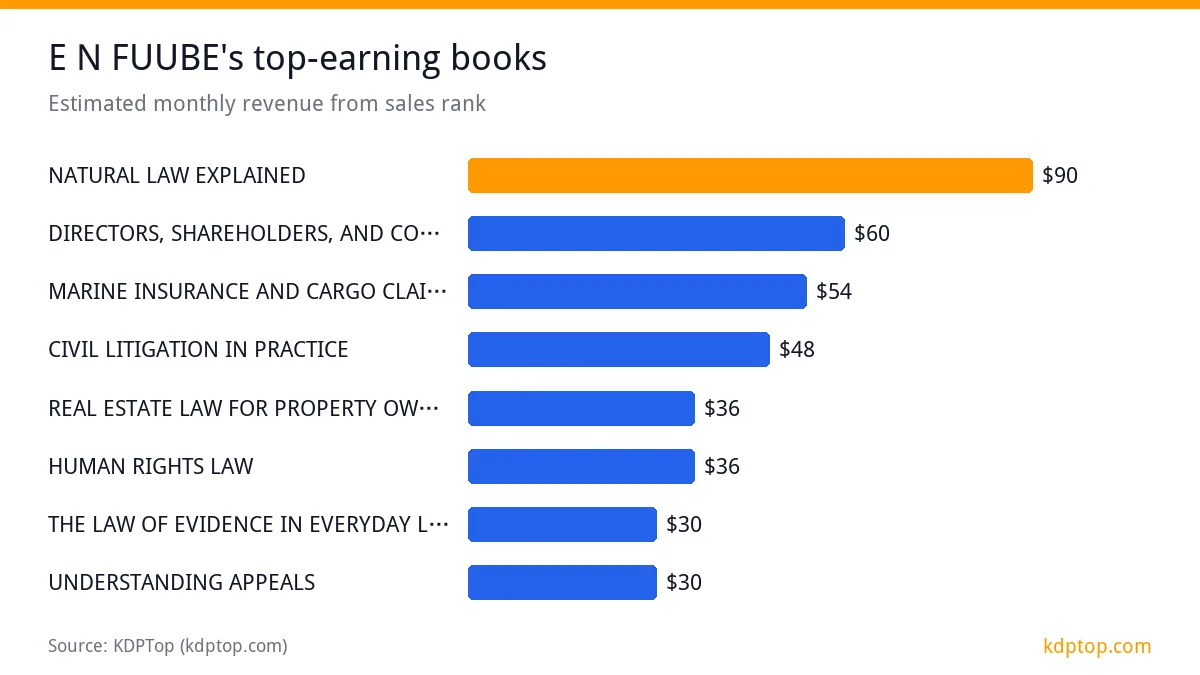
The eight books with the highest estimated revenue range from $90 down to $30 a month. NATURAL LAW EXPLAINED leads at $90, followed by DIRECTORS, SHAREHOLDERS, AND COMPANY DECISIONS at $60 and MARINE INSURANCE AND CARGO CLAIMS EXPLAINED at $54. No single book carries the catalog. The long tail does.
That shape matters for anyone deciding what to publish next. A law list built on many narrow titles can generate nearly $1,000 a month without a breakout. But it also means each book needs to earn its keep through a specific search phrase, not through browse visibility. The top book's BSR is 326,407. That is not a household name. It is a book that ranks for a precise query.
The data cannot tell us royalties, only estimated revenue from sales rank. At $5.99, a 70% royalty on a paperback or ebook is roughly $4, so $90 a month is about 15 units. Small numbers, repeated across 138 titles.

NATURAL LAW EXPLAINED: MORAL PRINCIPLES AND THE FOUNDATIONS OF JUSTICE
by E.N FUUBE
- Price$5.99
- Reviews-
- BSR#326,407
- Est. revenue/mo$90

DIRECTORS, SHAREHOLDERS, AND COMPANY DECISIONS: A PRACTICAL GUIDE
by E.N FUUBE
- Price$9.99
- Reviews-
- BSR#739,661
- Est. revenue/mo$60

MARINE INSURANCE AND CARGO CLAIMS EXPLAINED: A PRACTICAL GUIDE TO HULL INSURANCE, CARGO LOSS, P&I COVER, CLAIMS PROCEDURES AND INSURANCE DISPUTES
by E.N FUUBE
- Price$5.99
- Reviews-
- BSR#414,186
- Est. revenue/mo$54
Pricing: almost everything is $5.99
Show the data
| Price range | Books |
|---|---|
| <$5 | 0 |
| $5–9.99 | 103 |
| $10–14.99 | 0 |
| $15–19.99 | 6 |
| $20+ | 3 |
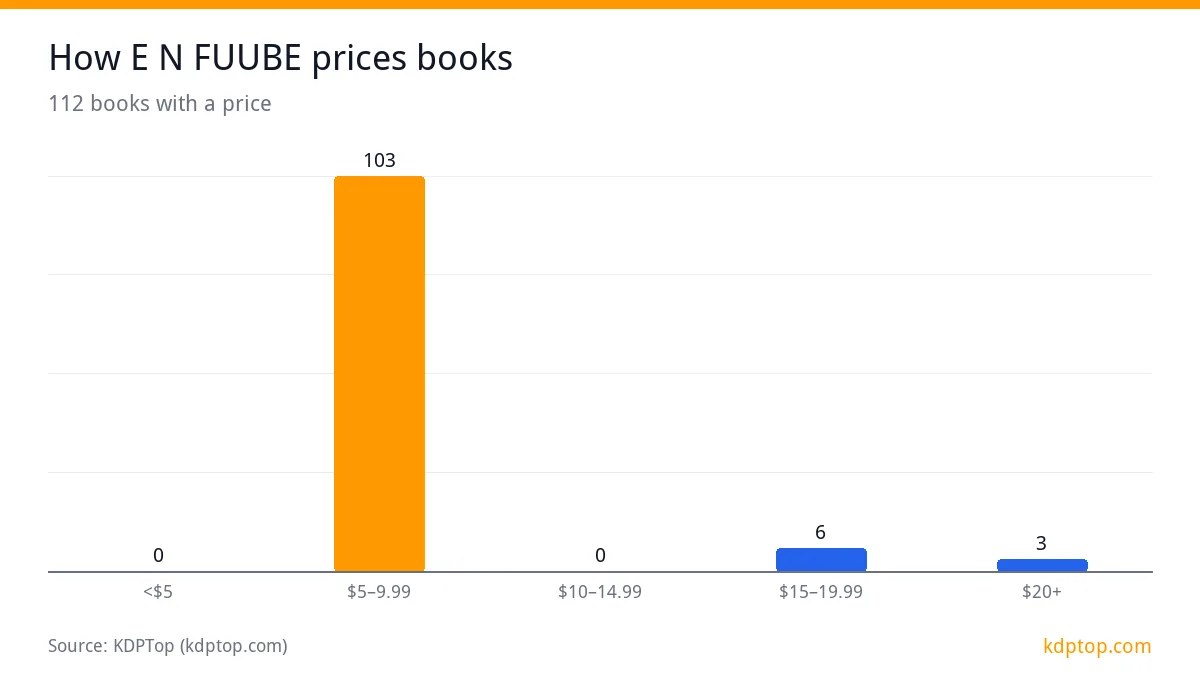
Of the 112 books with a recorded price, 103 sit in the $5 to $9.99 band. The median is $5.99, and so are the 25th and 75th percentiles. That is a single-price strategy with very few exceptions: six books at $15 to $19.99 and three above $20.
For legal nonfiction, $5.99 is low. It signals accessibility — the titles read like plain-language guides, and the price matches. The risk is that low prices invite low expectations, and the review data bears that out: 132 of 138 books have zero reviews, and the average rating across the catalog is 3.4.
A publisher entering this niche should ask whether $5.99 is leaving money on the table. The two $9.99 titles in the top eight earn $60 and $30 a month, so higher prices are not killing sales outright. But the data cannot prove a higher price would earn more. It only shows where this publisher chose to sit.

UNDERSTANDING APPEALS: HOW COURT DECISIONS CAN BE CHALLENGED
by E.N FUUBE
- Price$9.99
- Reviews-
- BSR#1,301,006
- Est. revenue/mo$30
Release pace: 43 new books in 30 days
Show the data
| Month | Books |
|---|---|
| 2026-01 | 18 |
| 2026-02 | 23 |
| 2026-04 | 1 |
| 2026-07 | 24 |
| 2026-08 | 2 |
| 2026-09 | 9 |
| 2026-10 | 15 |
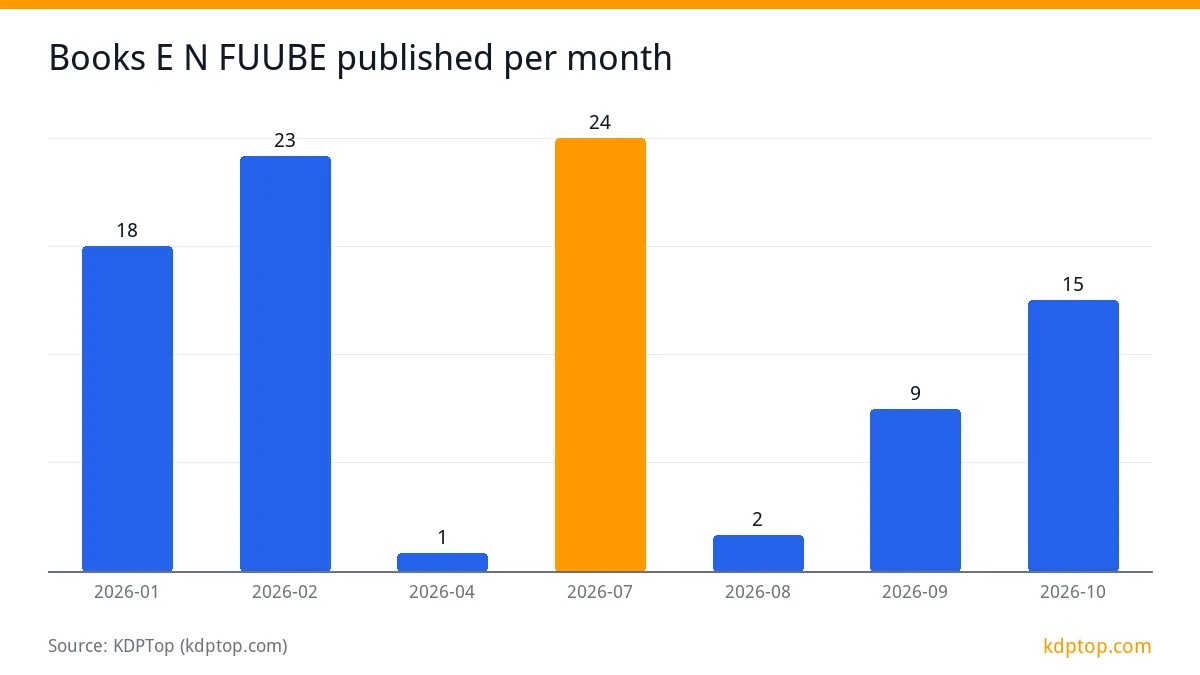
The monthly output is erratic but high. January 2026 saw 18 releases, February 23, July 24, September 9, and October 15. There is a gap in April with one book, and August with two. In the last 30 days alone, 43 new books appeared. That is more than one a day.
This is catalog flooding as a strategy. Each new title gets a brief new-release window, and 23 of those recent books broke out onto a Best Sellers list. That is a strong hit rate for new releases, though the lists are likely narrow category lists rather than overall Amazon lists.
The lesson is not to copy the volume. It is to notice that new releases are this publisher's main discovery mechanism. If you release one book a quarter, you get one window. If you release steadily, you get repeated chances to be seen. The trade-off is quality control: 132 books with no reviews suggests most titles are not accumulating social proof.
Where the books chart: Law Practice and Perspectives on Law
Show the data
| Category | Books on its lists |
|---|---|
| Law Practice | 24 |
| Perspectives on Law | 10 |
| Procedures & Litigation | 10 |
| Business | 7 |
| Business Law | 7 |
| Specialties | 4 |
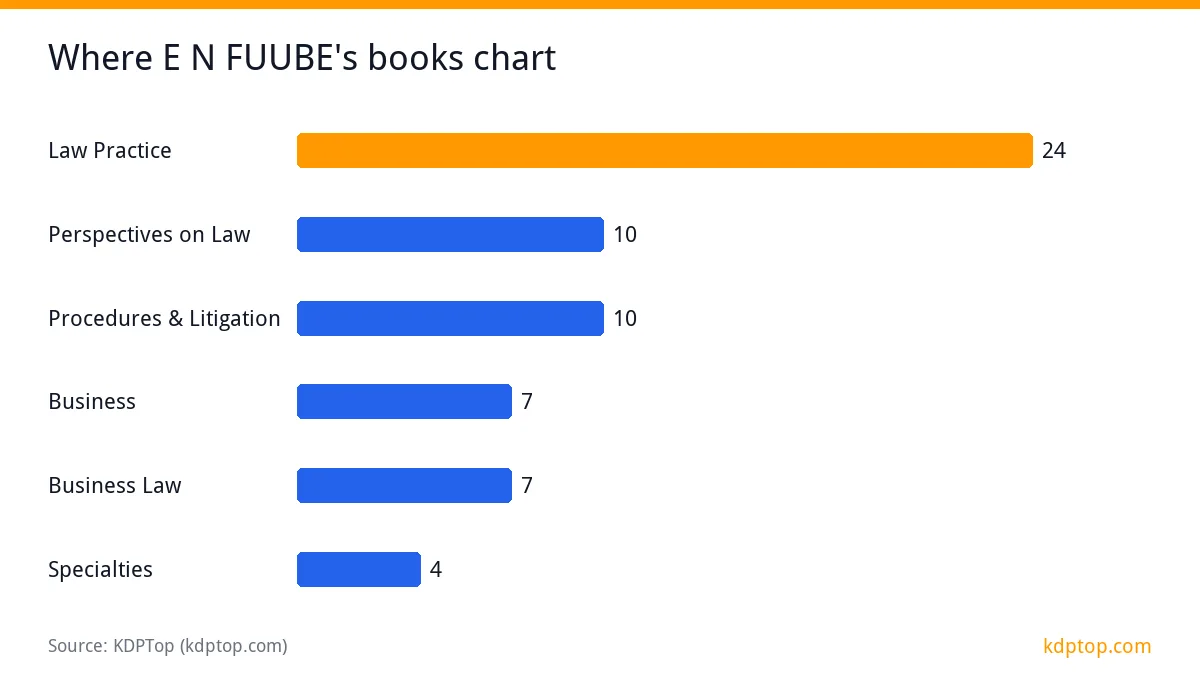
The category placement is concentrated. Law Practice accounts for 24 charting books, Perspectives on Law for 10, Procedures & Litigation for 10, Business for 7, Business Law for 7, and Specialties for 4. These are narrow legal categories, not general nonfiction.
That concentration is deliberate. Law Practice and Perspectives on Law are small enough that a new book with modest sales can reach a list. The same book in a broad category like Business & Money would disappear. For a publisher with no reviews and a $5.99 price, category choice is doing more work than marketing.
If you publish in law, business, or any professional niche, look for categories where the top 100 books have BSRs in the hundreds of thousands. That is where a new title can chart. The data here shows this publisher found those pockets and kept releasing into them.
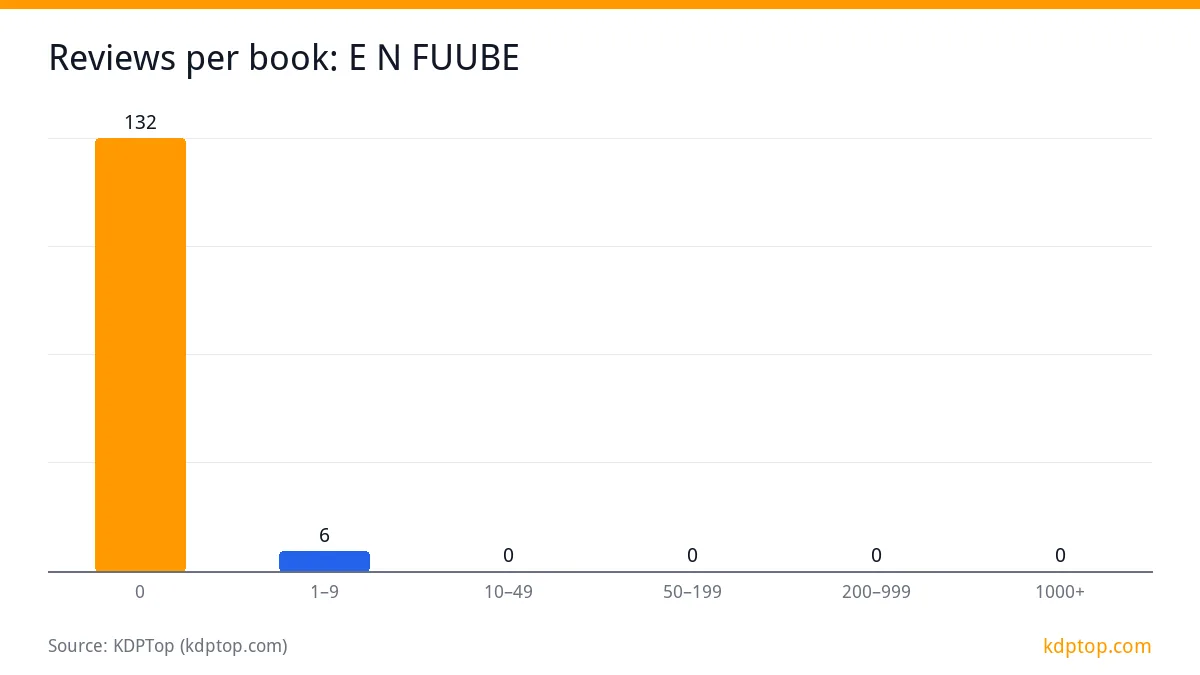
Reviews are almost absent, and that is the weak point
Show the data
| Reviews | Books |
|---|---|
| 0 | 132 |
| 1–9 | 6 |
| 10–49 | 0 |
| 50–199 | 0 |
| 200–999 | 0 |
| 1000+ | 0 |
Of 138 books, 132 have zero reviews. Six have between one and nine. The total review count across the catalog is seven, and the average rating is 3.4. That is not a review moat. It is a review desert.
For a catalog this size, seven reviews is close to nothing. It means buyers are not leaving feedback, or the books are not reaching enough readers to generate it. Either way, social proof is missing from almost every product page.
This is the clearest opening for a competitor. You do not need 138 books to beat this publisher on conversion. You need a handful of titles with ten or twenty honest reviews each. The data cannot tell us why reviews are so sparse — possibly the books are short, possibly they are bought by a narrow professional audience that does not review. But the gap is visible.
What another publisher can take from this catalog
First, the category logic works. Find small legal or professional categories where the competition has weak reviews and high BSRs. Law Practice and Perspectives on Law are proven examples from this catalog.
Second, the price is a choice, not a rule. $5.99 gets you accessibility, but it caps revenue per unit. If your book is comprehensive — like MARINE INSURANCE AND CARGO CLAIMS EXPLAINED, which covers hull insurance, cargo loss, P&I cover, claims procedures, and disputes — a $9.99 or higher price may be justified. The data shows two $9.99 books earning $60 and $30 a month, so the higher price is not automatically punished.
Third, release cadence matters more than any single title. This publisher's 23 breakouts in 30 days came from 43 new books. That is a numbers game. You can play a smaller version of it by releasing consistently into the same narrow categories, rather than one big book a year.
Key takeaways
- E N FUUBE's 138 law books earn an estimated $938 a month, with the top title at $90 — a volume strategy, not a hit strategy.
- Almost every book is priced at $5.99, which suits plain-language legal guides but leaves little room per unit.
- 43 new books in 30 days produced 23 breakouts, showing that frequent releases into narrow categories are this publisher's main discovery engine.
- 132 of 138 books have zero reviews, so a competitor with a few well-reviewed titles can win on conversion.
- Law Practice and Perspectives on Law are the categories where this catalog charts most often — small enough for new books to reach a list.
Books in this analysis

CIVIL LITIGATION IN PRACTICE: FROM CLAIM TO JUDGMENT
by E. N FUUBE
- Price$5.99
- Reviews-
- BSR#570,361
- Est. revenue/mo$48

REAL ESTATE LAW FOR PROPERTY OWNERS: RIGHTS, TRANSACTIONS, AND PROTECTION
by E. N FUUBE
- Price$5.99
- Reviews-
- BSR#877,540
- Est. revenue/mo$36

HUMAN RIGHTS LAW: WHAT EVERY CITIZEN MUST KNOW
by E. N FUUBE
- Price$5.99
- Reviews-
- BSR#916,891
- Est. revenue/mo$36
- Published2026-02

THE LAW OF EVIDENCE IN EVERYDAY LANGUAGE: UNDERSTANDING PROOF AND FACTS IN COURT
by E.N FUUBE
- Price$5.99
- Reviews-
- BSR#1,137,275
- Est. revenue/mo$30
FAQ
How much does E N FUUBE make from KDP?
The estimate is about $938 a month across 138 books, or roughly 145 units. That is modelled from sales rank, not reported by Amazon, so treat it as a ballpark.
What price does E N FUUBE charge for law books?
The median price is $5.99, and 103 of 112 priced books fall between $5 and $9.99. Only nine books are priced above $15.
How often does E N FUUBE publish new books?
The pace is uneven but high: 43 new books in the last 30 days, with monthly totals ranging from 1 to 24 earlier in the year.
Which categories does E N FUUBE's catalog chart in?
Law Practice leads with 24 charting books, followed by Perspectives on Law and Procedures & Litigation with 10 each. Business and Business Law each have 7.
How we got these numbers
Data comes from KDPTop's continuous crawl of Amazon Best Sellers, New Releases, Movers & Shakers and book pages, plus Keepa sales-rank history. Monthly units and revenue are estimated from sales rank (BSR); a single book can be off by ±30%, so use them to compare books, not as exact income. About our data →
Explore KDPTop
Related analysis
-
 Author analysis
Maria Isabel Sanchez Vegara: 150 Books, $19.9K/Month
Maria Isabel Sanchez Vegara has 150 books tracked, median price $11.38, and est. $19,910 monthly revenue. See her top earners and pricing strategy.
-
 Author analysis
Slavka Bodic: 111 Cookbooks, 110 on Best Seller Lists
Slavka Bodic has 111 KDP cookbooks tracked, 110 seen on Best Seller lists, a median price of $2.99 and about $743 in estimated monthly revenue.
-
 Breakout books
765 Crafts Breakouts: 614 Were KDP
In 7 days, 765 Crafts & Hobbies books broke into Best Sellers. 614 were indie, the median price was $7.98, and 453 had zero reviews.