
255 New Science Books Broke Into Best Sellers in 7 Days
255 new Science, Nature & How It Works books hit Best Sellers in 7 days. 62% were indie. Median price $4.99. See which subcategories and formats won.
In the last seven days, 255 books in Science, Nature & How It Works broke into a Best Sellers list. More than half of them, 158, were independently published. That is 62% indie share, and it tells you this category is not locked up by traditional publishers.
The median breakout had zero reviews and cost $4.99. Some of these books reached the top of a list on day zero, meaning they showed up with no review history at all. The data cannot tell us how many copies they sold, because units are modelled from BSR, not reported by Amazon. But the pattern is clear: new science books for kids can break in fast, cheap and with almost no social proof.
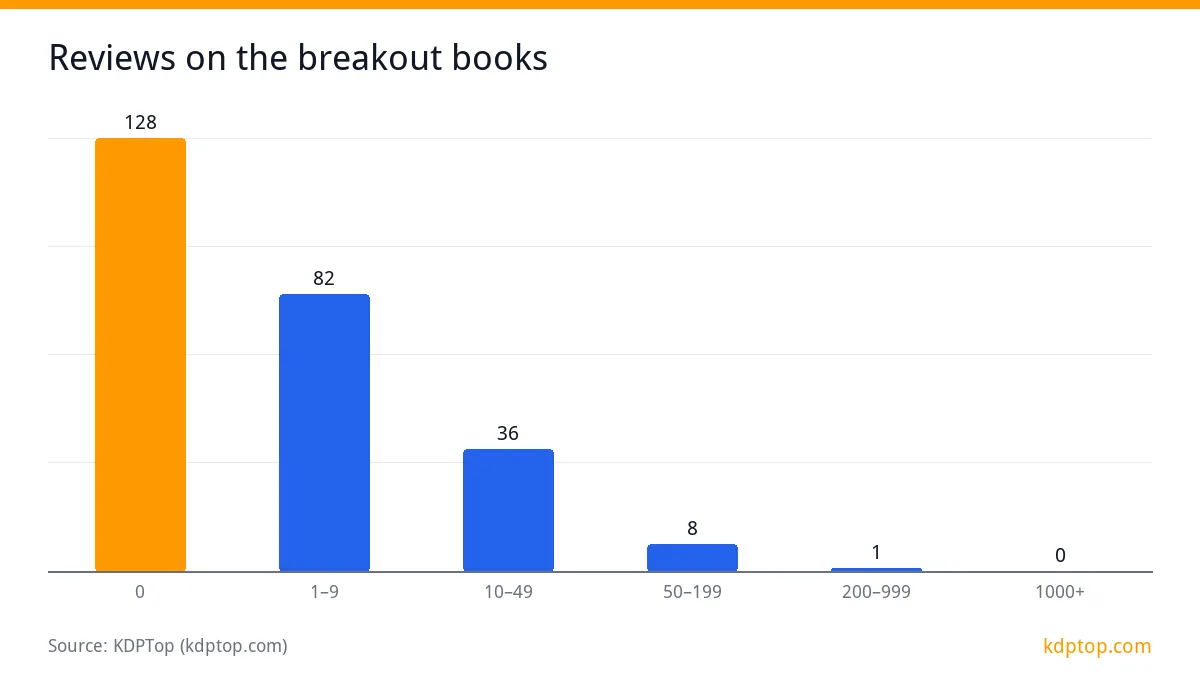
Most breakouts had zero reviews
Show the data
| Reviews | Books |
|---|---|
| 0 | 128 |
| 1–9 | 82 |
| 10–49 | 36 |
| 50–199 | 8 |
| 200–999 | 1 |
| 1000+ | 0 |
Of the 255 breakouts, 128 had no reviews at all. Another 82 had between 1 and 9. That means 210 of 255, or 82%, broke in with fewer than 10 reviews. Only 9 books had 50 or more reviews, and just one had 200 to 999.
This is the opposite of what many authors assume. You do not need a review pipeline to reach a Best Sellers list in this category. You need the right subcategory and a launch that pushes rank for a few days. The median review count at breakout was zero, which means half of these books hit a list before anyone left a review.
That is good news for new KDP publishers. It also means the lists are volatile. A book with zero reviews can reach number one in a narrow list and still have a BSR around 200,000, as The Little Tree Who Was Afraid to Change did in Flowers & Plants. Breakout is not the same as steady sales.

The Little Tree Who Was Afraid to Change: The mindful autumn story about tree for children, favourite picture book perfect for reading aloud to kids age 3-6
by Anna Smithers
- Price$9.99
- Reviews12
- BSR#199,971
- Est. revenue/mo$240
- List rank#1
- Days to chart0

The Ultimate Book of 100,000 Whys: Curiosity Comes Alive! A Full-Color Illustrated Encyclopedia of Big Questions, Clear Answers & Amazing Facts for Curious Kids Ages 6–12
by EVANS NORTH
- Price$2.99
- Reviews3
- BSR#347,782
- Est. revenue/mo$27
- List rank#1
- Days to chart0

The Curious Girl’s Book of Unusual Facts: Wild Knowledge from Outer Space to Ancient Rome, Plus Life Skills, Brain Teasers, Experiments, and Stories of ... Women (Essential toolkit for young girls)
by Melanie Hobart
- Price$2.99
- Reviews5
- BSR#99,865
- Est. revenue/mo$63
- List rank#2
- Days to chart0
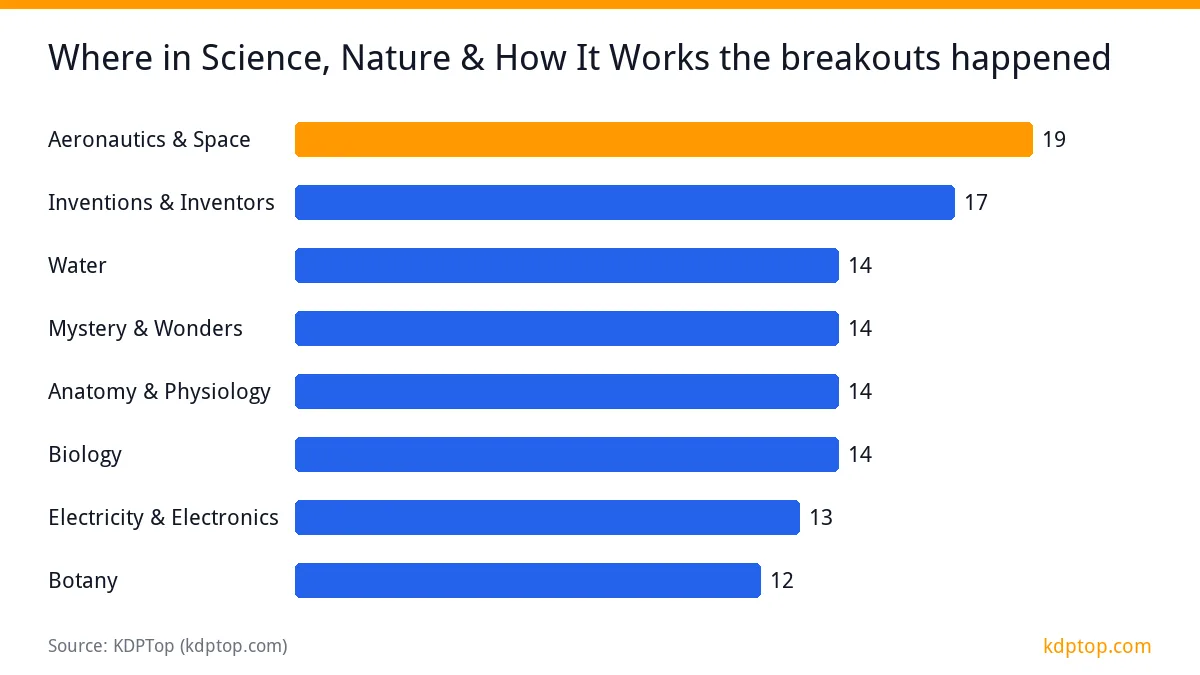
Where the breakouts happened: space, inventions and water
Show the data
| List | Breakouts |
|---|---|
| Aeronautics & Space | 19 |
| Inventions & Inventors | 17 |
| Water | 14 |
| Mystery & Wonders | 14 |
| Anatomy & Physiology | 14 |
| Biology | 14 |
| Electricity & Electronics | 13 |
| Botany | 12 |
The top lists for breakouts were Aeronautics & Space with 19, Inventions & Inventors with 17, Water with 14, Mystery & Wonders with 14 and Anatomy & Physiology with 14. Biology and Electricity & Electronics were close behind at 14 and 13, and Botany had 12.
These are narrow lists, and that is the point. Inventions & Inventors produced breakouts from very different books: a $2.99 fact book for girls, a $4.99 visual encyclopedia of inventions, and a $6.99 Mark Rober title from a traditional publisher. The common thread is a specific promise, not a specific format.
Water and Botany are less obvious. If you publish low-content or kids' nonfiction, those lists may have less competition than space. The data cannot show how many books were launched into each list, only how many broke out, so treat the counts as a signal to check the current top 100 yourself.

100,000 Whys for Kids: Inventions & Technology: A Full-Color Visual Encyclopedia of Amazing Questions & Answers About Inventions, Machines, Computers, ... Illustrated Why Encyclopedia Series Book 3)
by HikayaNest Books
- Price$4.99
- Reviews-
- BSR#351,767
- Est. revenue/mo$15
- List rank#3
- Days to chart0

Lava vs. Laser (CrunchLabs by Mark Rober: Versus #1)
by Mark Rober
- Price$6.99
- Reviews6
- BSR#305,423
- Est. revenue/mo$42
- List rank#4
- Days to chart0
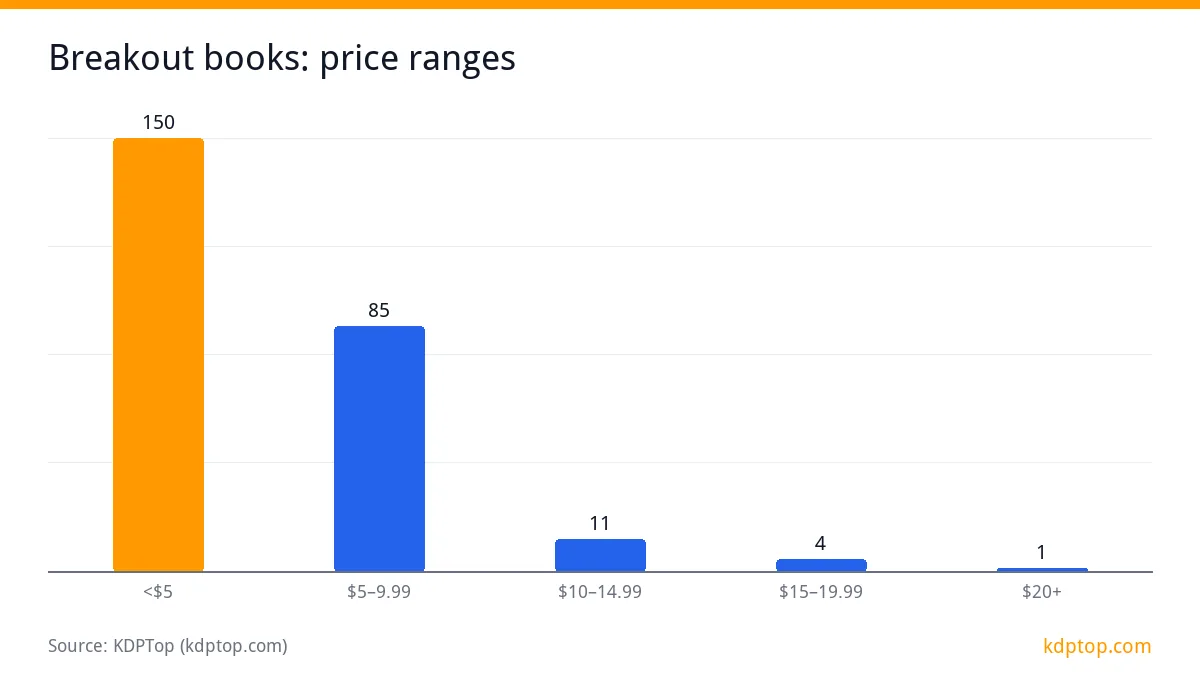
$4.99 is the middle of the market
Show the data
| Price range | Books |
|---|---|
| <$5 | 150 |
| $5–9.99 | 85 |
| $10–14.99 | 11 |
| $15–19.99 | 4 |
| $20+ | 1 |
Price ranges show 150 breakouts under $5 and 85 between $5 and $9.99. Only 11 were $10 to $14.99, four were $15 to $19.99 and one was $20 or more. The median price was $4.99.
Cheap does not mean low quality. The Ultimate Book of 100,000 Whys is $2.99 and reached number one in Chemistry with three reviews. Earth Science Made Easy For Kids is also $2.99 and reached number four in Earthquakes & Volcanoes. At the other end, The Little Tree Who Was Afraid to Change is $9.99 and reached number one in Flowers & Plants, and Barbie's Adventure and the Robot Rescue Team is $9.95 and reached number five in Robotics.
For a new publisher, the under-$5 band is crowded but proven. If you price at $9.99, you need a picture book or a strong series hook to justify it. The data does not include page counts or file sizes, so we cannot say whether the $2.99 books are shorter.

Earth Science Made Easy For Kids: Visual Learning Guide to the Geology, Weather, Oceans and Natural Disasters of Our Planet (Smart STEM Made Easy For Kids Book 7)
by Jonathan Adams
- Price$2.99
- Reviews3
- BSR#298,368
- Est. revenue/mo$54
- List rank#4
- Days to chart0
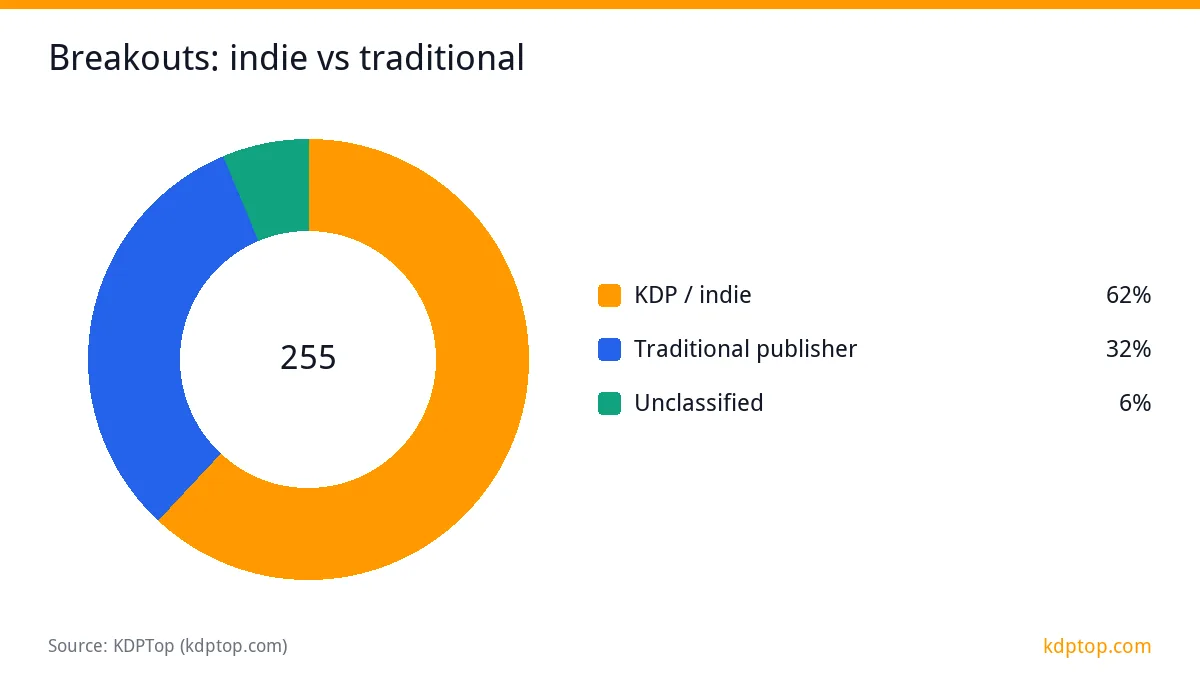
Indie publishers took 158 of 255 spots
Show the data
| Publisher type | Books |
|---|---|
| KDP / indie | 158 |
| Traditional publisher | 81 |
| Unclassified | 16 |
KDP and indie books made up 158 of the 255 breakouts. Traditional publishers took 81, and 16 were unclassified. That is a 62% indie share, which is high for a science category that includes school and library markets.
The breakouts include a mix of product types: kids nonfiction, picture books and at least one puzzle and logic book. The Curious Girl's Book of Unusual Facts by Melanie Hobart is $2.99, has five reviews and reached number two in Inventions & Inventors. It is a KDP title competing directly with a Mark Rober book in the same list.
This does not mean traditional publishers are absent. Lava vs. Laser by Mark Rober reached number four in Inventions & Inventors with six reviews and a 4.8 rating. But the volume is on the indie side, and the median review count of zero suggests many of those indie breakouts are launch-driven rather than review-driven.

The Vagus Nerve for Kids: A Funny Nervous System Book for Kids About Anxiety, Breathing Exercises, Big Feelings, and the Vagus Nerve (Kids Breathe and Believe)
by Rakmi Lemala
- Price$2.99
- Reviews11
- BSR#318,012
- Est. revenue/mo$27
- List rank#6
- Days to chart0
The fastest book and what it had in common
The fastest breakout was The Little Tree Who Was Afraid to Change by Anna Smithers. It reached a Best Sellers list on day zero, meaning it was on a New Releases list within the last 60 days and hit a list immediately. It is a $9.99 picture book with 12 reviews and a 4.7 rating, and it reached number one in Flowers & Plants.
Its BSR at the time of the data was 199,971, with an estimated 24 monthly units and $240 monthly revenue. That is a modest seller by absolute numbers, but it won a narrow list. The title is long and keyword-rich: mindful autumn story, picture book, read aloud, ages 3-6. That is a deliberate metadata strategy.
The other fast breakouts followed a similar pattern: a clear age range, a specific subcategory and a price that matches the format. The data cannot tell us how many days each book spent on a list or what promotion drove the launch. It only shows the snapshot.
What this means for your next science book
If you are deciding what to publish next, the data points to narrow science lists with active breakout counts: Aeronautics & Space, Inventions & Inventors, Water, Mystery & Wonders and Anatomy & Physiology. These lists produced the most breakouts in seven days, and many of the winners had fewer than 10 reviews.
Price under $5 if you are launching a new series or a fact book. The $2.99 to $4.99 range accounted for 150 of 255 breakouts. If you are publishing a picture book, $9.99 can work, but you need a strong title and a clear read-aloud angle.
One caution: a breakout is a list appearance, not a business. The Little Tree had an estimated 24 monthly units at a BSR near 200,000. Use the breakout as a signal to study the list, then check the current top 100 for review counts and prices before you commit.
Key takeaways
- 158 of 255 breakouts in Science, Nature & How It Works were indie published, a 62% share.
- The median breakout had zero reviews and cost $4.99, so review count is not a barrier to a list appearance.
- Aeronautics & Space, Inventions & Inventors and Water produced the most breakouts, with 19, 17 and 14 respectively.
- 150 of 255 breakouts were priced under $5, making the sub-$5 band the most common entry point.
- A breakout can be a narrow-list win: the fastest book reached number one in Flowers & Plants with an estimated 24 monthly units.
Books in this analysis

Barbie’s Adventure and the Robot Rescue Team
by Aqeel AHMED
- Price$9.95
- Reviews-
- BSR#319,754
- Est. revenue/mo$90
- List rank#5
- Days to chart0
FAQ
How many reviews do I need to break into a Best Sellers list in this category?
The median breakout had zero reviews, and 82% had fewer than 10. You do not need a large review count to reach a narrow list, but the data cannot show how long the book stayed there.
What price should I set for a new kids' science book on KDP?
The median breakout price was $4.99, and 150 of 255 breakouts were under $5. Picture books at $9.99 also broke out, but they were fewer and often had a specific read-aloud angle.
Which subcategories had the most breakouts in the last 7 days?
Aeronautics & Space had 19, Inventions & Inventors had 17, and Water, Mystery & Wonders and Anatomy & Physiology each had 14. These are narrow lists where a launch can move rank quickly.
Are traditional publishers dominating science books for kids?
No. Indie publishers took 158 of 255 breakouts, or 62%, while traditional publishers took 81. The indie titles include fact books, picture books and encyclopedias, often priced under $5.
How we got these numbers
Data comes from KDPTop's continuous crawl of Amazon Best Sellers, New Releases, Movers & Shakers and book pages, plus Keepa sales-rank history. Monthly units and revenue are estimated from sales rank (BSR); a single book can be off by ±30%, so use them to compare books, not as exact income. About our data →
Explore KDPTop
Related analysis
-
 Breakout books
765 Crafts Breakouts: 614 Were KDP
In 7 days, 765 Crafts & Hobbies books broke into Best Sellers. 614 were indie, the median price was $7.98, and 453 had zero reviews.
-
 Author analysis
Maria Isabel Sanchez Vegara: 150 Books, $19.9K/Month
Maria Isabel Sanchez Vegara has 150 books tracked, median price $11.38, and est. $19,910 monthly revenue. See her top earners and pricing strategy.
-
 Author analysis
Slavka Bodic: 111 Cookbooks, 110 on Best Seller Lists
Slavka Bodic has 111 KDP cookbooks tracked, 110 seen on Best Seller lists, a median price of $2.99 and about $743 in estimated monthly revenue.