
American Horror Story: Search Demand and KDP Competition
American Horror Story gets 842,851 monthly searches and 74,002 purchases. See its KDP competition, book prices, reviews and publishing opportunities.
American horror story attracts 842,851 monthly searches and 74,002 estimated purchases, but that demand does not automatically translate into a good KDP opportunity. The keyword has 5,799 competing products and a supply-demand ratio of 145.3. There is an audience here. Getting a new book in front of it is another matter.
The more useful finding is the mismatch between search interest and the books appearing in the sample. Only 11 charting books have the exact phrase in their titles, and the analyzed results include television discs, franchise criticism and a small number of independently published books. For KDP publishers, this is a narrow research opportunity, not proof that another generic American Horror Story book will sell.
842,851 monthly searches do not mean 842,851 book buyers
The keyword american horror story records 842,851 monthly searches and 74,002 monthly purchases. The purchase rate is 8.8%. That is a substantial amount of estimated buying activity, but the distinction between searches and purchases matters. Most searches do not turn into purchases, and not every purchase is a book.
The search term refers to an established television franchise. Someone entering american horror story into Amazon might be looking for a season on Blu-ray, commentary, franchise analysis or something else connected to the show. The related suggestion american horror story 13 dvd makes the entertainment-product intent especially clear.
For a KDP publisher, the 74,002 estimated purchases are not a book-sales forecast. They represent modeled demand associated with the keyword, not verified purchases of books. The practical question is how much of that demand comes from people who actually want a book and can be reached with an independent publication.
That distinction should shape the publishing decision. A large keyword can be useful for discovering an audience without being a suitable primary target for a new book.
5,799 competing products create a difficult entry point
There are 5,799 competing products for american horror story. The supply-demand ratio is 145.3. This is a crowded search term, and the volume of searches alone does not make it attractive for a new publisher.
The ratio points to a substantial amount of competing supply relative to demand. It does not tell us how many products are actively selling, how well their listings convert, or how many are genuinely relevant to readers looking for books. A Blu-ray listing and a franchise essay do not compete in exactly the same way, even if both appear in the results.
The category information provides another useful clue. The matching books sit in Horror & Supernatural. That gives publishers a relevant category context, but it does not establish that every matching product is a horror book or that a new title will rank there automatically.
The opportunity is therefore more specific than the headline search volume suggests. Publishers should investigate a clearly defined reader need within Horror & Supernatural rather than treating the entire franchise keyword as an open market.
Eleven charting titles leave room for a closer look
There are 11 charting books with the phrase american horror story in their titles. The analyzed sample contains 6 books. That is a useful starting point for examining the search results, but it is not a complete census of competing publications.
Two traditionally published titles show the nonfiction side of the market. American Horror Story and Philosophy: Life Is but a Nightmare (Popular Culture and Philosophy) by Richard Greene is priced at $11.83 and has 20 reviews. Reading American Horror Story: Essays on the Television Franchise by Rebecca Janicker costs $18.99 and has 7 reviews. Both approach the franchise through analysis rather than original fiction.
The sample also contains The American Horror Story by Mark Rogers, an independently published title priced at $0.00 with 11 reviews and a 2.8 rating. American Horror story book by Mr Khani is priced at $3.00 and has 2 reviews. These listings show that independent books are present, but their small review counts do not establish strong sales or a proven commercial format.
The other prominent result, AMERICAN HORROR STORY SEASON 1 [Blu-ray] by Brad Falchuk, has 2,934 reviews and costs $40.34. Its review count illustrates why raw search-result competition can be misleading. It is a television product, not a direct publishing benchmark for a new KDP book.

American Horror Story and Philosophy: Life Is but a Nightmare (Popular Culture and Philosophy)
by Richard Greene
- Price$11.83
- Reviews20
- Published2017-12

Reading American Horror Story: Essays on the Television Franchise
by Rebecca Janicker
- Price$18.99
- Reviews7
- Published2017-06

AMERICAN HORROR STORY SEASON 1 [Blu-ray]
by Brad Falchuk
- Price$40.34
- Reviews2,934
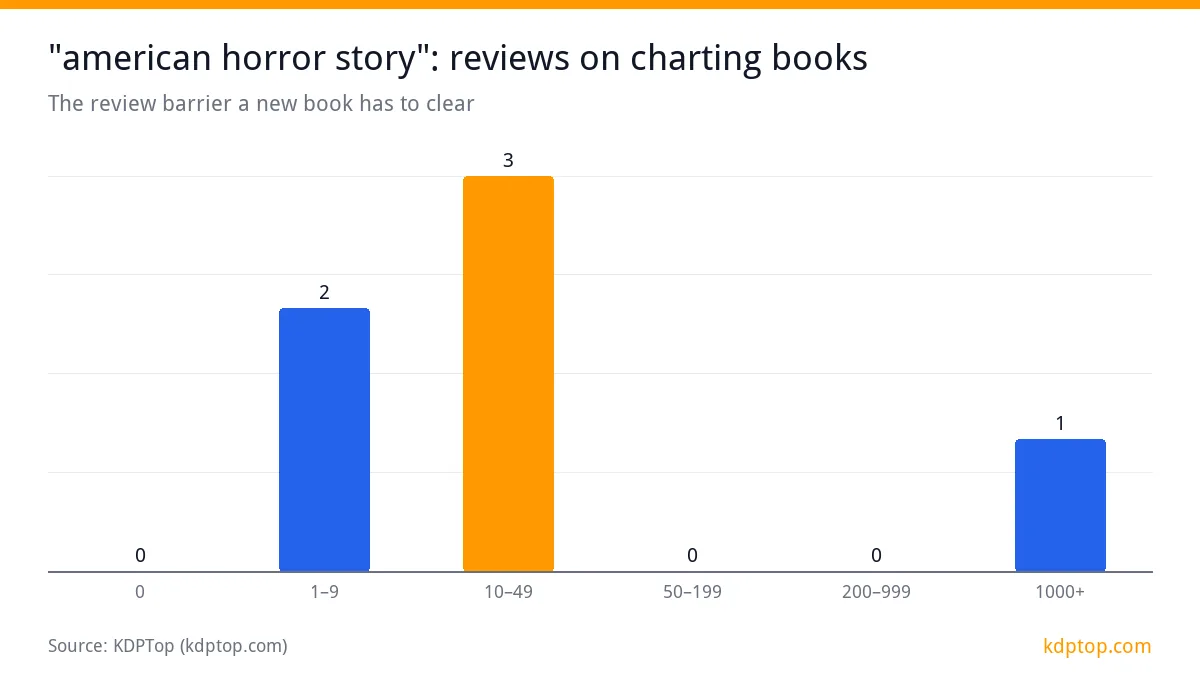
Most charting books have a manageable review count
Show the data
| Reviews | Books |
|---|---|
| 0 | 0 |
| 1–9 | 2 |
| 10–49 | 3 |
| 50–199 | 0 |
| 200–999 | 0 |
| 1000+ | 1 |
The review distribution is more encouraging than the total competing-product count might suggest. Of the 6 analyzed books, 3 have between 10 and 49 reviews. Another 2 have between 1 and 9 reviews. One has more than 1,000 reviews. None falls into the 50–199 or 200–999 ranges.
The median review count is 15.5. That is a relatively modest review benchmark within this sample. A new publisher does not appear to be facing six established book titles with hundreds of reviews apiece. However, the Blu-ray listing with 2,934 reviews is a reminder that product types can distort the apparent competitive picture.
A low review count is not the same as low competition. Reviews accumulate over time, and a book with few reviews may still have strong sales. Conversely, a product with many reviews may have accumulated them over several years. The data does not reveal conversion rates or the sales history behind individual listings.
For publishers, the practical takeaway is to inspect book-specific competitors rather than judging the keyword from its largest review count. The two academic-style titles and the independent listings offer more relevant comparisons than the Blu-ray. Even then, the sample is too small to establish a reliable review threshold for success.
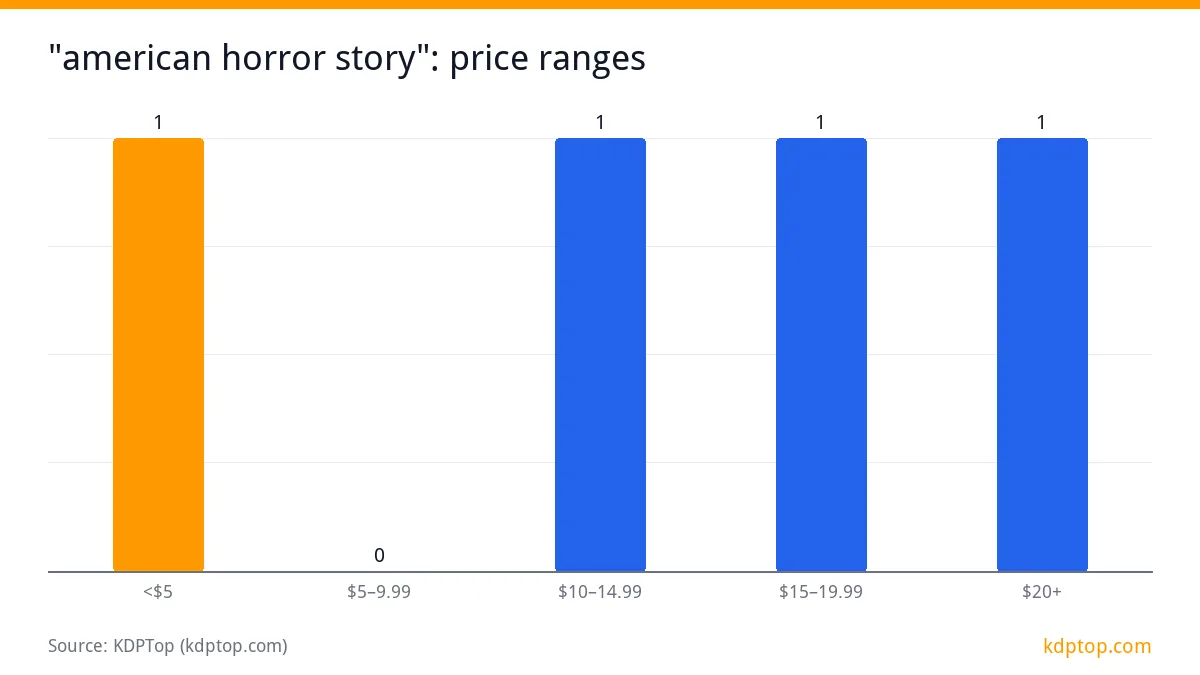
Prices range from free to $40.34
Show the data
| Price range | Books |
|---|---|
| <$5 | 1 |
| $5–9.99 | 0 |
| $10–14.99 | 1 |
| $15–19.99 | 1 |
| $20+ | 1 |
The analyzed products cover a wide price range. One is below $5, one falls between $10 and $14.99, one is between $15 and $19.99, and one costs $20 or more. There are no analyzed products in the $5–9.99 range. The median price is $15.41.
The $40.34 AMERICAN HORROR STORY SEASON 1 [Blu-ray] listing pushes the upper end of the range. It should not be used to justify premium pricing for a paperback. The $18.99 price of Reading American Horror Story: Essays on the Television Franchise is a more relevant comparison for a substantial nonfiction publication, while American Horror Story and Philosophy: Life Is but a Nightmare (Popular Culture and Philosophy) provides another reference at $11.83.
The lower-priced independent examples are The American Horror Story at $0.00 and American Horror story book at $3.00. These prices do not establish that inexpensive books are the best approach. They may reflect different formats, product positioning or pricing decisions.
For a new KDP title, the median price of $15.41 is a reference point, not a recommended list price. Format, page count, production costs and reader expectations should determine the actual price. A short activity book, an illustrated title and a researched nonfiction book should not be priced as though they offer the same product.
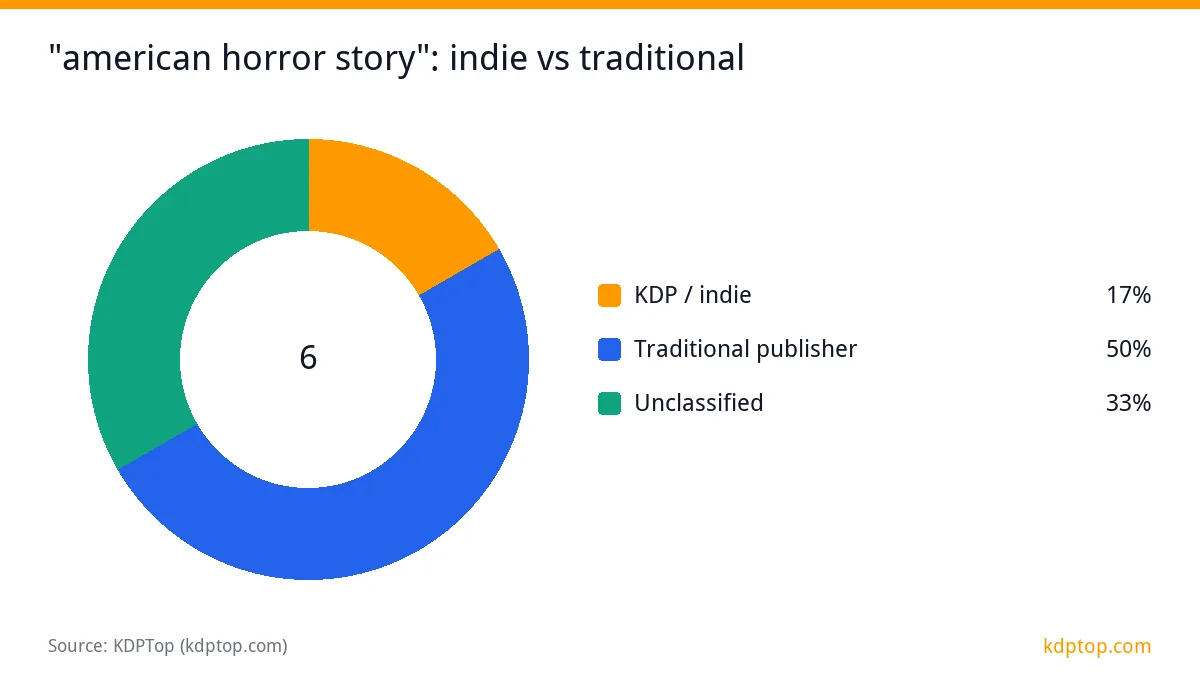
Independent publishing has a small presence in the sample
Show the data
| Publisher type | Books |
|---|---|
| KDP / indie | 1 |
| Traditional publisher | 3 |
| Unclassified | 2 |
The publishing mix is not dominated by independently published books. Of the 6 analyzed results, 3 are identified as traditionally published, 1 as KDP or indie, and 2 are unclassified. That produces an indie share of 17%.
The independent example with a confirmed KDP classification is The American Horror Story by Mark Rogers. Its 11 reviews and $0.00 price show that an independent listing can appear for the keyword, but they do not demonstrate a profitable publishing model. American Horror story book by Mr Khani is another independent-looking result, although its publisher classification is not provided in the data and should not be assumed.
This distinction matters when assessing competition. A low indie share can mean fewer independently published competitors, but it can also indicate that the search term is primarily served by established franchise products and traditional publishing. It does not automatically mean that KDP publishers have an underserved audience waiting for a new title.
There is also a rights issue that keyword research cannot resolve. American Horror Story is an existing entertainment franchise. Publishers should not use its protected branding, characters, artwork or other franchise material without the necessary authorization. A safer commercial direction is an original horror concept that targets comparable reader interests without presenting itself as an official franchise product.

The American Horror Story
by Mark Rogers
- Price$0
- Reviews11
- Published2021-01

American Horror story book
by Mr Khani
- Price$3
- Reviews2
- Published2022-09
An original horror angle is safer than copying the franchise
The most defensible publishing angle is to treat american horror story as evidence of interest in horror entertainment, not as a title to reproduce. The matching books already cover philosophical analysis, television-franchise essays and entertainment products. A publisher looking for a new KDP project should identify a separate reader problem or format preference.
For fiction, that could mean an original anthology of unsettling short stories, a supernatural mystery or a psychological horror novel with its own setting and characters. For nonfiction, a general book about horror television, supernatural storytelling or the history of horror themes may offer a distinct proposition. The subject should stand on its own without relying on the franchise name to attract buyers.
Coloring books and low-content books require a different level of caution. The available sample does not establish demand for horror coloring books, journals or activity books. The keyword data should not be used to claim that these formats sell well simply because the television franchise attracts searches. A publisher considering those formats needs separate research into relevant book-specific search terms and competing titles.
The 11 charting titles with the phrase in their names suggest that exact-title competition is not as extensive as the total product count might imply. But the data does not show how much traffic a new original title could capture. Treat this keyword as a discovery signal, then validate the proposed book against its own category, format and search terms before committing to production.
Key takeaways
- Treat 842,851 monthly searches as broad franchise interest, not as a forecast of KDP book sales.
- Use the 15.5 median review count as a sample benchmark, but compare books with books rather than including Blu-ray products.
- Research Horror & Supernatural for original horror concepts instead of relying on the franchise keyword as a publishing strategy.
- Use $15.41 as a competitor price reference, not an automatic list-price recommendation.
- Do not assume that a 17% indie share proves an underserved market; validate demand for the exact book format before publishing.
Books in this analysis

Creepy House: Tributo a American Horror Story (Mentes Errantes) (Portuguese Edition)
by Mentes Errantes
- Price$0
- Reviews28
FAQ
How many people search for american horror story on Amazon?
The keyword receives 842,851 estimated monthly searches and 74,002 estimated monthly purchases. The purchase rate is 8.8%, but these figures include broader franchise-related shopping intent, not just demand for books.
Is american horror story a good KDP keyword?
It has substantial search interest, but 5,799 competing products and a supply-demand ratio of 145.3 make it a difficult primary target. The 17% indie share suggests limited independent representation in the analyzed sample, not guaranteed room for a profitable new book.
How many reviews do competing American Horror Story books have?
The median review count across the 6 analyzed books is 15.5. Three have 10–49 reviews, two have 1–9, and one has more than 1,000. The highest-review result is AMERICAN HORROR STORY SEASON 1 [Blu-ray], which is not a book.
What category should I target for an American Horror Story-inspired book?
The matching books are associated with Horror & Supernatural. For a new KDP publication, an original horror novel, supernatural mystery or horror anthology is a more defensible direction than using protected franchise names, characters or artwork. The available data does not establish demand for horror coloring books or other low-content formats.
How we got these numbers
Data comes from KDPTop's continuous crawl of Amazon Best Sellers, New Releases, Movers & Shakers and book pages, plus Keepa sales-rank history. Monthly units and revenue are estimated from sales rank (BSR); a single book can be off by ±30%, so use them to compare books, not as exact income. About our data →
Explore KDPTop
Related analysis
-
 Keyword research
A Christmas Carol Devotional: Demand, Competition and Sales
A Christmas Carol devotional gets 15,784 monthly searches but just 76 estimated purchases. See prices, competition, indie share and publishing angles.
-
 Weekly KDP report
Amazon KDP Week 46: 28,346 New Best Sellers
Amazon KDP recorded 28,346 new Best Sellers in Week 46, including 16,600 indie titles. See the leading categories, prices, breakout books and publishing opportunities.
-
 Author analysis
Harold Carver: Inside a 117-Book KDP Publishing Catalog
Harold Carver has 117 KDP books, 88 recently charting titles and 36 breakouts. See his pricing, estimated earnings, release pace and catalog strategy.