
Patchwork KDP Market: Prices, Competition and Opportunity
Patchwork's top 100 books generate an estimated $43,575 monthly. See pricing, review barriers, indie competition and where new KDP publishers can compete.
Patchwork is a difficult category for new KDP publishers, but not a closed one. The top 100 books generate an estimated $43,575 in monthly revenue, yet just 20% are independently published. Traditional publishers hold most of the established positions, and the median book has 148 reviews. That makes this a category where a specific subject and useful instructions matter more than simply producing another general quilting book.
There is one encouraging sign for new entrants: 25 books entered the top 100 since the previous list, and 19% of current best sellers are new releases. The opportunity score is 35 out of 100, so the competition is substantial. Still, the market has room for books that solve a recognizable patchwork problem rather than repeat familiar patterns.
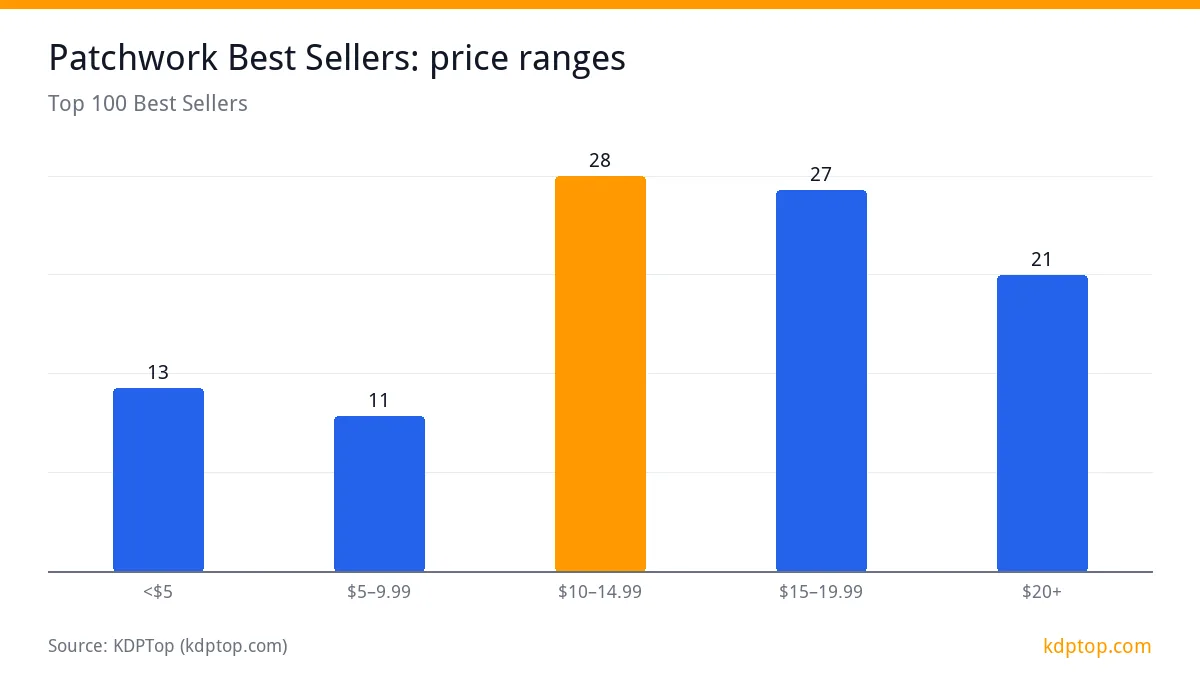
Patchwork buyers are spending mostly $10 to $21
Show the data
| Price range | Books |
|---|---|
| <$5 | 13 |
| $5–9.99 | 11 |
| $10–14.99 | 28 |
| $15–19.99 | 27 |
| $20+ | 21 |
The median price in Patchwork is $17.89. The middle half of the top 100 falls between $13.04 and $20.99. That gives a prospective publisher a fairly clear starting point: readers are accustomed to paying for a substantial craft book, not just a cheap collection of printable patterns.
The largest price group is $10–14.99, containing 28 books. Another 27 sit between $15 and $19.99. Together, those two ranges account for more than half of the category's best sellers. There are also 21 books priced at $20 or above, showing that higher prices are possible when the product offers enough perceived value.
At the lower end, 13 books cost less than $5, while 11 fall between $5 and $9.99. The low-price segment is worth watching, but competing on price alone is not an obvious strategy. A $3.99 book can sell well, as the leading independent example demonstrates, but that does not establish that inexpensive books are the category's strongest long-term opportunity.
For a new publisher, a useful test price is around the category median. A higher price needs a clear reason: more patterns, detailed instructions, distinctive designs or a practical project format. A thin book with a premium price will have a harder time making its case.

10-Inch Square Quilt Block Book: 40+ Quilt Patterns Using Your Favorite Pre-Cuts (Landauer) How to Quilt Without Waste and Create Cohesive Quilting Projects with 10" Squares
by Carolina Moore
- Price$21.41
- Reviews200
- BSR#17,704
- Est. revenue/mo$1,606
- List rank#12

The Ultimate Sashiko Sourcebook: Patterns, Projects and Inspirations
by Susan Briscoe
- Price$17.84
- Reviews1,756
- BSR#14,904
- Est. revenue/mo$1,552
- List rank#1
The Guide Of Granny Square Cardigan Crochet Pattern Book: Easy Step-by-Step Crochet Cardigan Patterns for Women with Classic Granny Squares, Stylish Sleeves, Modern Designs, and Wearable
by Lucas Jack
- Price$3.99
- Reviews-
- BSR#2,570
- Est. revenue/mo$2,992
- List rank#60
- Published2026-10
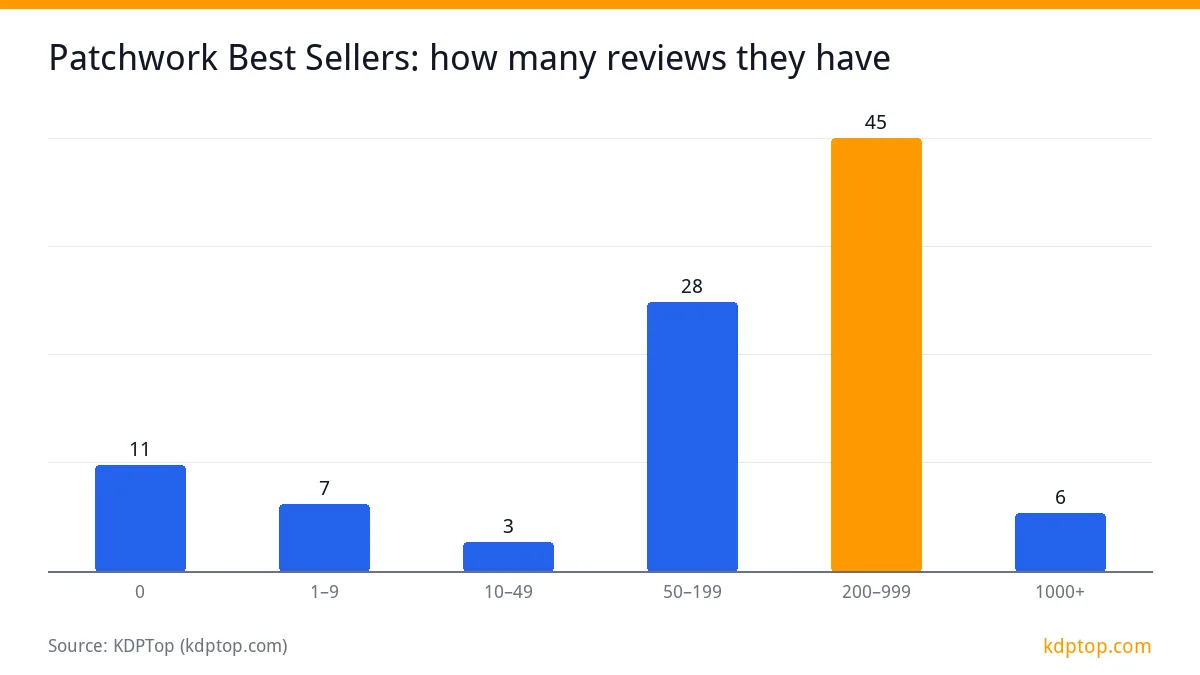
The review barrier is real, but not every winner has hundreds
Show the data
| Reviews | Books |
|---|---|
| 0 | 11 |
| 1–9 | 7 |
| 10–49 | 3 |
| 50–199 | 28 |
| 200–999 | 45 |
| 1000+ | 6 |
The median Patchwork best seller has 148 reviews, and the average rating is 4.7 stars. That is a meaningful hurdle for a new KDP listing. Readers shopping for craft instructions have plenty of established alternatives, and review history provides reassurance that a pattern book is usable and its instructions work.
The biggest review group is 200–999, with 45 books. Another 28 have between 50 and 199 reviews. Only 6 have more than 1,000. This suggests that a large review count is common among established sellers, but it is not a requirement for every position in the category.
There are 26 books with fewer than 50 reviews. That is the more interesting figure for a new publisher. It shows that some books can reach the best-seller list without building a large review history first. However, the low-review group is not necessarily made up of new releases. A low review count alone does not establish publication age or sales momentum.
The 2027 Patchwork Place Quilt Calendar is a useful example. It has 15 reviews and a 5.0-star rating, yet reaches rank 2 on the list. That is evidence that a focused product with a clear buying purpose can compete without the review history of a long-established reference book. A new publisher should aim for a similarly clear proposition, not assume that a low review count guarantees easy entry.
2027 Patchwork Place Quilt Calendar: Includes Instructions for 12 Projects
- Price$19.95
- Reviews15
- BSR#14,714
- Est. revenue/mo$958
- List rank#2

Tula Pink's City Sampler: 100 Modern Quilt Blocks
by Tula Pink
- Price$16.07
- Reviews1,464
- BSR#24,641
- Est. revenue/mo$964
- List rank#14
Traditional publishers control most established positions
Show the data
| Publisher type | Books |
|---|---|
| KDP / indie | 20 |
| Traditional publisher | 79 |
| Unclassified | 1 |
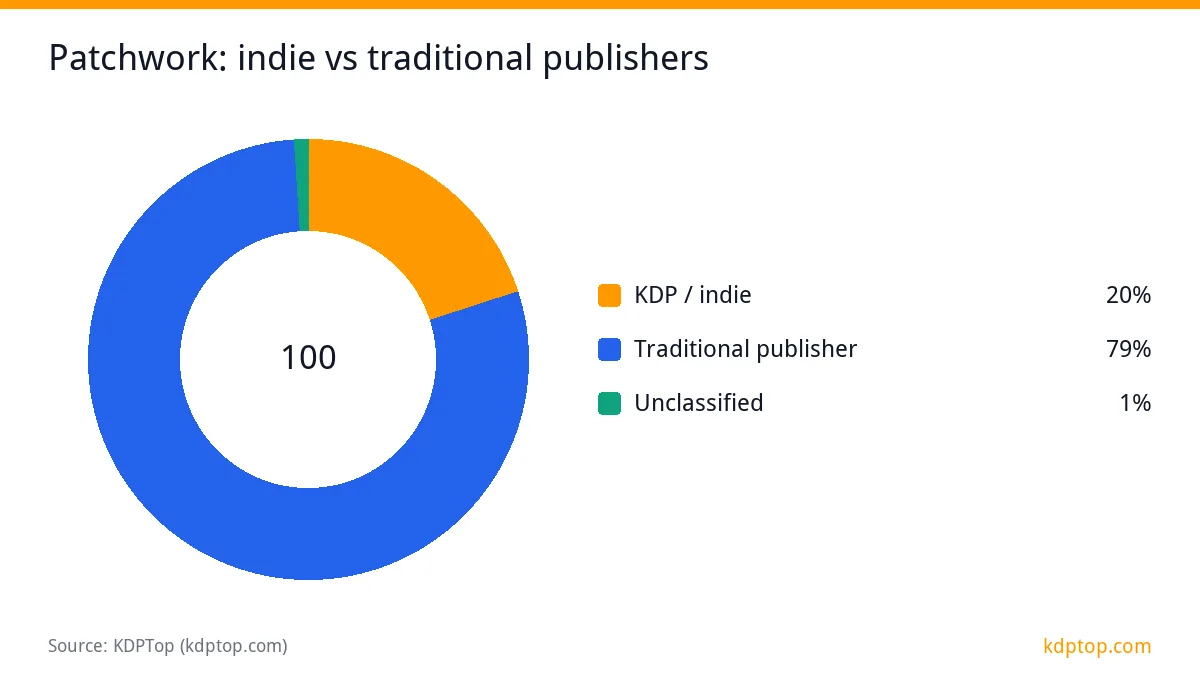
Independent books account for 20% of Patchwork's top 100. Traditional publishers account for 79%, with 1% unclassified. This is a heavily publisher-led category. New KDP publishers are competing against established craft imprints with recognizable authors, backlists and products that have had time to accumulate reviews.
The leading title, The Ultimate Sashiko Sourcebook: Patterns, Projects and Inspirations by Susan Briscoe, is traditionally published. It has 1,756 reviews, a 4.8-star rating and a list position of number one. Its estimated monthly sales are 87 units. This is the sort of established product that makes a broad, generic patchwork book difficult to position against.
Other established titles show the range of subjects that already have buyers. 10-Inch Square Quilt Block Book: 40+ Quilt Patterns Using Your Favorite Pre-Cuts by Carolina Moore has 200 reviews and rank 12. Tula Pink's City Sampler: 100 Modern Quilt Blocks by Tula Pink has 1,464 reviews and rank 14. These are specific propositions with identifiable audiences.
The practical implication is that a new indie publisher should avoid treating Patchwork as one undifferentiated keyword. A narrower subject, such as a particular block size, fabric technique or wearable patchwork project, gives the listing a more precise reason to exist. The data does not prove which keyword converts best, but it does show that specialized subjects already have established products and buyers.
A few books capture a meaningful share of estimated revenue
Show the data
| Book | Est. monthly revenue |
|---|---|
| The Guide Of Granny Square Cardigan C… | $2,992 |
| 10-Inch Square Quilt Block Book | $1,606 |
| The Ultimate Sashiko Sourcebook | $1,552 |
| Wonderful World of Paper-Pieced Quilt… | $1,241 |
| Encyclopedia of Pieced Quilt Patterns | $1,025 |
| Tula Pink's City Sampler | $964 |
| 2027 Patchwork Place Quilt Calendar | $958 |
| Sewing Quilted Patchwork Jackets | $899 |
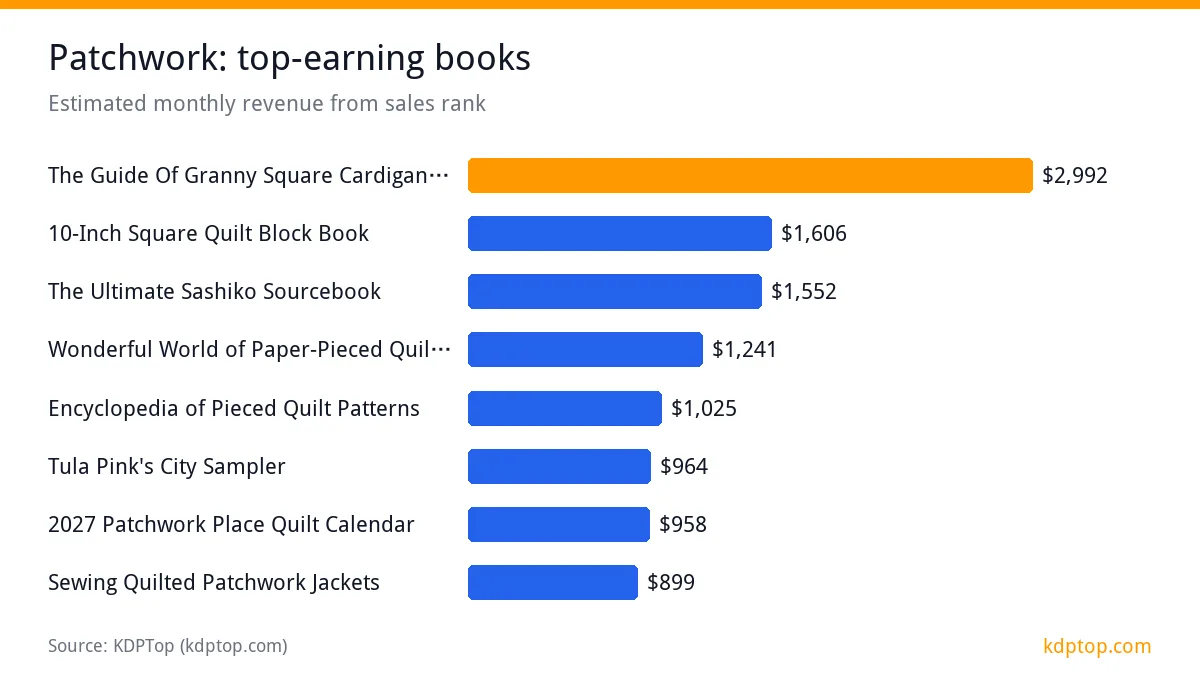
KDPTop estimates that the top 100 Patchwork books generate $43,575 in monthly revenue. The top 10 account for 30% of that amount. Revenue is therefore concentrated toward the leading books, rather than being distributed evenly across the category.
The most notable result is The Guide Of Granny Square Cardigan Crochet Pattern Book: Easy Step-by-Step Crochet Cardigan Patterns for Women with Classic Granny Squares, Stylish Sleeves, Modern Designs, and Wearable by Lucas Jack. It is priced at $3.99, has a BSR of 2,570 and an estimated 750 monthly units. Its estimated monthly revenue is $2,992. It is an independently published title and ranks 60 in Patchwork.
That result deserves attention, but also some caution. The book focuses on crochet cardigan patterns rather than conventional quilting. Its performance suggests that adjacent textile crafts can appear in the Patchwork category and attract buyers. It does not prove that a new patchwork book can reproduce the same sales.
The established titles also produce meaningful estimated revenue. 10-Inch Square Quilt Block Book is estimated at $1,606 monthly, while The Ultimate Sashiko Sourcebook is estimated at $1,552. Wonderful World of Paper-Pieced Quilt Blocks: 30 Nature-Inspired Designs and Beautiful Sampler Projects by Liza Taylor is estimated at $1,241. These results point toward practical, well-defined projects as commercially relevant subjects.
For publishers choosing their next book, the lesson is to examine the actual product behind a strong rank. A broad category label can hide differences between crochet, quilting, sashiko and paper piecing. Build around a subject you can deliver convincingly, rather than copying a successful price or sales estimate.
New releases are creating openings, but most new publishers are not KDP
Show the data
| Publisher type | Books |
|---|---|
| KDP / indie | 83 |
| Traditional publisher | 15 |
| Unclassified | 1 |
New releases account for 19% of the Patchwork best sellers. Meanwhile, 25 books have entered the top 100 since the previous list, producing a turnover rate of 25%. That is enough movement to make the category worth monitoring. Existing leaders are not holding every position indefinitely.
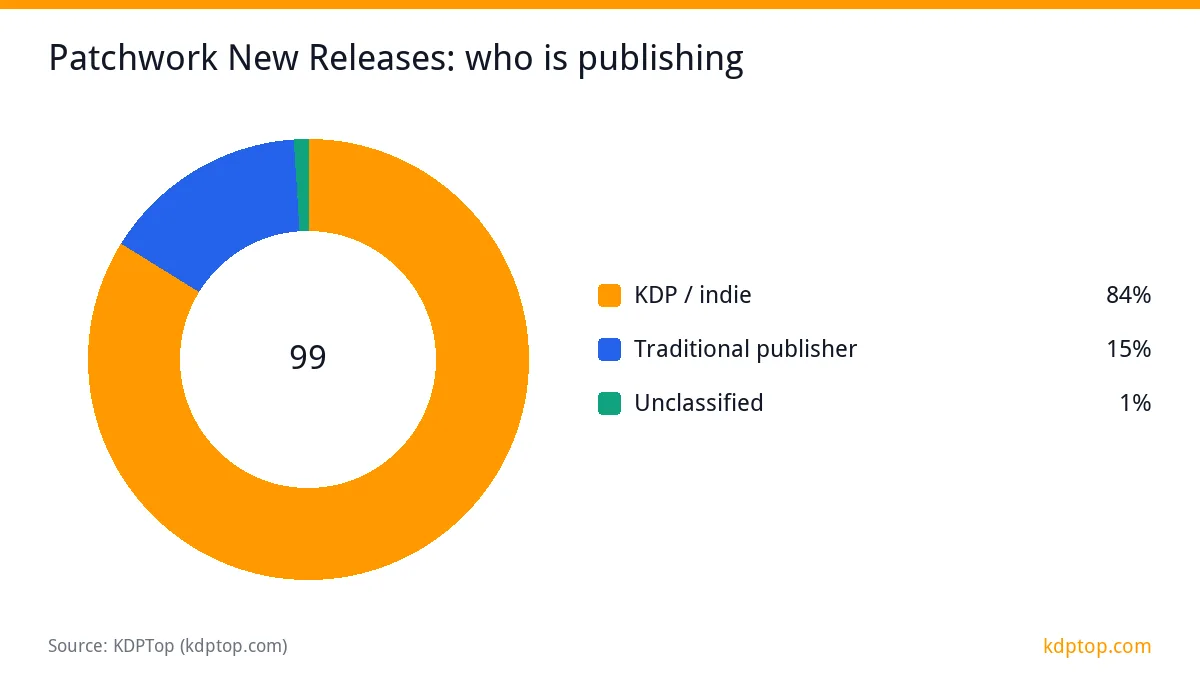
The new-release publisher split is particularly interesting. KDP and indie publishers account for 83% of the new-release group, compared with 15% for traditional publishers and 1% unclassified. This is a different picture from the overall top 100, where independent publishers account for only 20%.
In other words, independent publishers are much more visible among new releases than they are among established best sellers. That does not mean most new KDP titles will become lasting sellers. It does suggest that indie publishers are actively entering the category and that some are getting onto the list.
The Guide Of Granny Square Cardigan Crochet Pattern Book by Lucas Jack is a concrete example. Published on October 24, 2026, it is a recent independent release with a BSR of 2,570 and an estimated 750 monthly units. Its performance is notable, although its crochet focus makes it an adjacent example rather than a direct template for traditional patchwork publishing.
A sensible approach is to target a defined audience and make the product useful immediately. New releases need more than a keyword-rich title. They need recognizable projects, clear instructions and a reason for a patchwork reader to choose them over an established alternative.

Wonderful World of Paper-Pieced Quilt Blocks: 30 Nature-Inspired Designs and Beautiful Sampler Projects (Landauer) 5" and 7" FPP Patterns for Butterflies, Hummingbirds, Flowers, and More
by Liza Taylor
- Price$22.99
- Reviews231
- BSR#26,419
- Est. revenue/mo$1,241
- List rank#5
Is Patchwork worth entering as a new KDP publisher?
The opportunity score is 35 out of 100. That is a modest result, not a green light for a general-purpose patchwork book. The established competition is strong, the median review count is substantial, and traditional publishers dominate the current best-seller list.
But the new-release figures offer a more encouraging view. Independent publishers account for 83% of the new-release group, and 25 books have entered the top 100 since the previous list. There is movement, and indie publishers are participating in it. The challenge is converting a new listing into a position that lasts.
The most defensible publishing ideas are likely to be specific. Consider a focused book of paper-pieced nature designs, a practical guide to 10-inch quilt blocks, or instructions for wearable patchwork projects. Existing titles such as Wonderful World of Paper-Pieced Quilt Blocks and Sewing Quilted Patchwork Jackets show that buyers can be found for clearly defined approaches.
Do not interpret the estimated revenue as money available to a new publisher. The $43,575 is an estimate for the entire top 100, not a forecast for an individual book. Sales and revenue are modelled from Amazon Best Sellers Rank, not reported by Amazon. They can help compare products and identify subjects worth researching, but they cannot establish actual royalties, advertising costs, profit or the sales a new book will achieve.
My publishing decision would be to enter only with a strong, narrow concept and a finished product that can compete on usefulness. Patchwork has buyers, but the easy opportunity is not in publishing another general pattern collection.

Sewing Quilted Patchwork Jackets: Four Approaches, Ten Distinctive Designs, Two Downloadable Patterns (Landauer) Upcycle Your Fabrics and Stash to Create Handmade Quilted Wearables
by Rae Cumbie
- Price$21.41
- Reviews253
- BSR#47,167
- Est. revenue/mo$899
- List rank#41
Key takeaways
- Use the $17.89 median price as a starting benchmark, and justify higher prices with substantial patterns and practical instructions.
- Treat the 148-review median as a real competitive barrier, but study lower-review products such as the 2027 Patchwork Place Quilt Calendar.
- Avoid generic patchwork concepts and target a specific technique, block format or project audience.
- Watch new releases closely: 83% of the new-release group is independently published, despite indie books representing only 20% of the overall top 100.
- Treat estimated monthly revenue as a comparison tool, not a sales forecast or a guarantee of KDP profit.
Books in this analysis
Encyclopedia of Pieced Quilt Patterns (3rd Edition)
by Barbara Brackman
- Price$56.92
- Reviews227
- BSR#67,926
- Est. revenue/mo$1,025
- List rank#85
FAQ
Is Patchwork a good category for KDP self-publishing?
Patchwork has an opportunity score of 35 out of 100, so competition is substantial. However, independent publishers account for 83% of the new-release group, suggesting that focused new books can still enter the market.
How much do Patchwork books sell for on Amazon?
The median price among the top 100 Patchwork books is $17.89. The largest price groups are $10–14.99, with 28 books, and $15–19.99, with 27 books.
How many reviews do Patchwork best sellers need?
The median Patchwork best seller has 148 reviews, and 45 books have between 200 and 999 reviews. However, 26 books have fewer than 50 reviews, showing that a large review history is not universal.
How much revenue does the Patchwork category generate?
KDPTop estimates that the top 100 Patchwork books generate $43,575 in monthly revenue. These figures are modelled from Best Sellers Rank rather than reported by Amazon, so they should be treated as estimates rather than confirmed earnings.
How we got these numbers
Data comes from KDPTop's continuous crawl of Amazon Best Sellers, New Releases, Movers & Shakers and book pages, plus Keepa sales-rank history. Monthly units and revenue are estimated from sales rank (BSR); a single book can be off by ±30%, so use them to compare books, not as exact income. About our data →
Explore KDPTop
Related analysis
-
 Niche analysis
Trivia Books: What the Amazon Best Sellers List Reveals
Trivia books generate an estimated $413,002 monthly across the Top 100. See pricing, review barriers, indie competition and the books leading the category.
-
 Breakout books
Arts Breakouts: 197 New Best Sellers in 7 Days
197 books broke into Best Sellers in Arts, Music & Photography in 7 days. 95 were indie. Median price $11.99, median reviews 0. See what won.
-
 Breakout books
Growing Up & Facts of Life: 341 New Best Sellers in 7 Days
In 7 days, 341 new books hit Best Sellers in Growing Up & Facts of Life. Median price $4.61, median reviews 1, and 60% were indie. See what won.