
Saumya Srivastava: Inside an 87-Book KDP Catalog
Saumya Srivastava has 87 tracked KDP books, 35 recent breakouts and $2,312 in estimated monthly revenue. See pricing, rankings and publishing patterns.
The most useful finding in Saumya Srivastava's catalog is the connection between technical specialization and publishing volume. Across 87 tracked books, the independently published author has 54 books appearing on Best Sellers lists in the last 30 days, with 35 breakouts during that period. The catalog covers semiconductor engineering, digital design, mechatronics, industrial automation and aerospace engineering. These are specialist nonfiction subjects, not broad consumer categories.
Estimated monthly revenue reaches $2,312, based on sales-rank modelling, with estimated monthly units of 229. The strongest individual title, Design for Testability in VLSI, generates an estimated $144 monthly at a $16 list price. The catalog also has a strikingly small review footprint. That makes Srivastava's publishing activity worth studying, but it does not establish that every new technical book will find buyers.
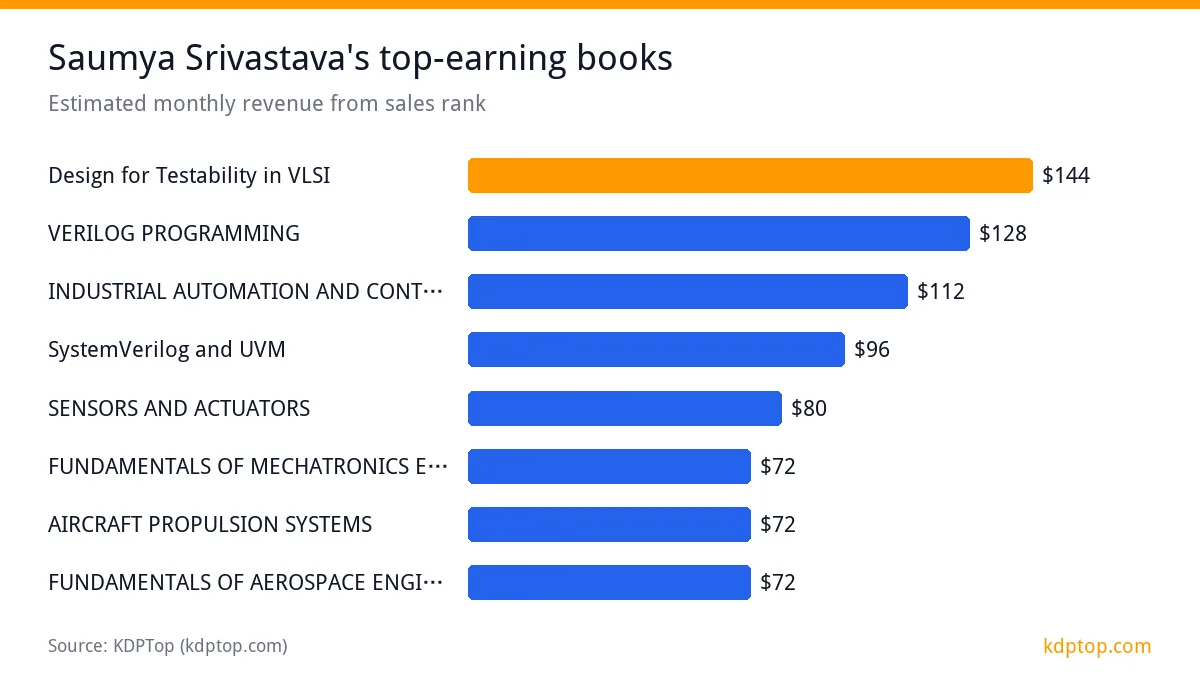
Design for Testability in VLSI leads estimated earnings
Show the data
| Book | Est. monthly revenue |
|---|---|
| Design for Testability in VLSI | $144 |
| VERILOG PROGRAMMING | $128 |
| INDUSTRIAL AUTOMATION AND CONTROL SYS… | $112 |
| SystemVerilog and UVM | $96 |
| SENSORS AND ACTUATORS | $80 |
| FUNDAMENTALS OF MECHATRONICS ENGINEER… | $72 |
| AIRCRAFT PROPULSION SYSTEMS | $72 |
| FUNDAMENTALS OF AEROSPACE ENGINEERING | $72 |
The top-earning title is Design for Testability in VLSI: Scan Design, ATPG, Built-In Self-Test, Fault Modeling, Test Compression, and Test Optimization (VLSI Design & Semiconductor Engineering). Its estimated monthly revenue is $144, based on an estimated 9 monthly units and a $16 price. Its BSR is 458183. That is the strongest revenue result among the supplied individual book records.
VERILOG PROGRAMMING: A Comprehensive Guide to Hardware Description, Digital Logic Design, and Verification with Verilog HDL follows at an estimated $128 monthly. It also costs $16 and has an estimated 8 monthly units. INDUSTRIAL AUTOMATION AND CONTROL SYSTEMS: PLC, SCADA, Sensors, Industrial Networks, Motion Control, and Intelligent Automation comes next at $112, with an estimated 7 monthly units.
SystemVerilog and UVM: A Comprehensive Guide to Constrained-Random Verification and the Universal Verification Methodology contributes an estimated $96. SENSORS AND ACTUATORS contributes $80. Three further supplied titles, FUNDAMENTALS OF MECHATRONICS ENGINEERING, AIRCRAFT PROPULSION SYSTEMS and FUNDAMENTALS OF AEROSPACE ENGINEERING, each contribute an estimated $72 monthly.
The eight displayed books collectively account for $776 in estimated monthly revenue. The figures suggest that specialist reference books can support a higher price than inexpensive general-interest titles. They also show that the leading book is not necessarily selling large quantities. Nine estimated monthly units at $16 produce its reported revenue estimate. Publishers should distinguish between a strong revenue contribution and a high-volume bestseller.

Design for Testability in VLSI: Scan Design, ATPG, Built-In Self-Test, Fault Modeling, Test Compression, and Test Optimization (VLSI Design & Semiconductor Engineering)
- Price$16
- Reviews-
- BSR#458,183
- Est. revenue/mo$144

VERILOG PROGRAMMING: A Comprehensive Guide to Hardware Description, Digital Logic Design, and Verification with Verilog HDL (VLSI Design & Semiconductor Engineering)
- Price$16
- Reviews-
- BSR#399,665
- Est. revenue/mo$128

INDUSTRIAL AUTOMATION AND CONTROL SYSTEMS: PLC, SCADA, Sensors, Industrial Networks, Motion Control, and Intelligent Automation (Mechatronics, Robotics & Industrial Automation)
- Price$16
- Reviews-
- BSR#294,895
- Est. revenue/mo$112
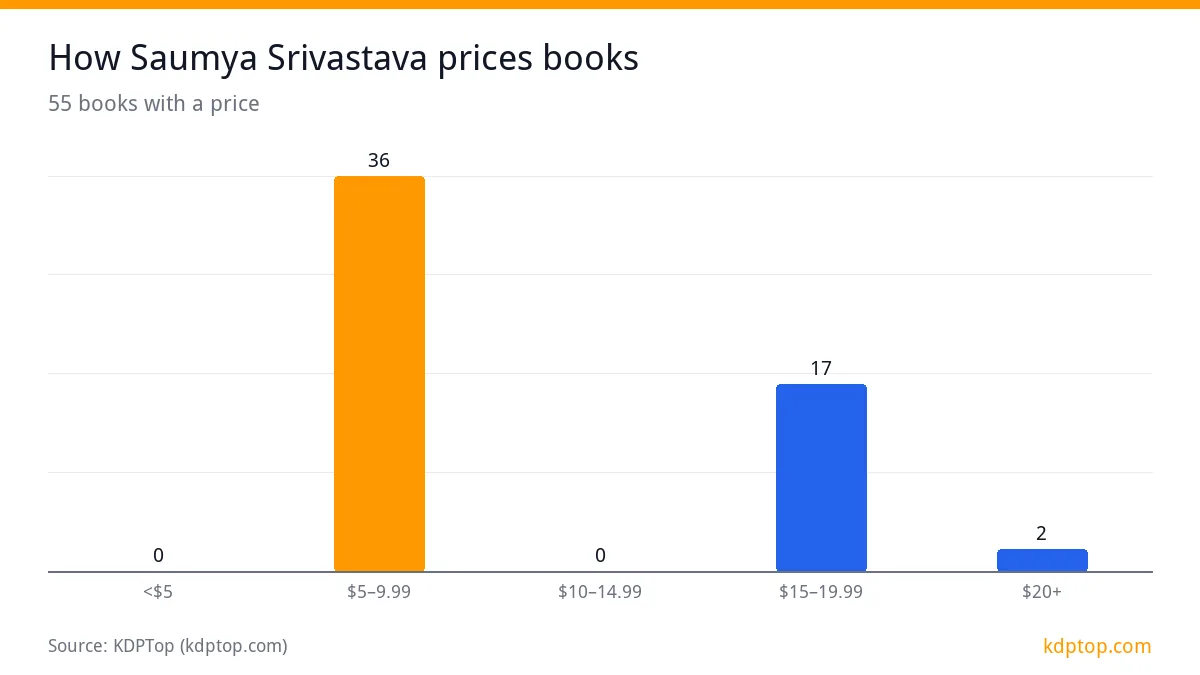
The $8 and $16 price points do most of the work
Show the data
| Price range | Books |
|---|---|
| <$5 | 0 |
| $5–9.99 | 36 |
| $10–14.99 | 0 |
| $15–19.99 | 17 |
| $20+ | 2 |
The pricing data covers 55 books with a recorded price. Of those, 36 are priced between $5 and $9.99, while 17 sit between $15 and $19.99. Another 2 cost $20 or more. None of the recorded titles falls below $5 or in the $10–14.99 range.
The median price is $8. The 25th percentile is also $8, while the 75th percentile is $16. This indicates a catalog with two meaningful pricing groups rather than a smooth progression through every price bracket. The lower-priced group provides an accessible entry point, while the higher-priced group accommodates more substantial reference material.
The individual book records illustrate the difference. SENSORS AND ACTUATORS is priced at $8 and has estimated monthly revenue of $80. Design for Testability in VLSI costs $16 and generates an estimated $144. The higher-priced book produces more estimated revenue despite having an estimated monthly unit count of 9, compared with 10 for SENSORS AND ACTUATORS.
That comparison is useful for publishers deciding how to price a technical manuscript. A higher price can increase revenue per sale, but it needs to be supported by the book's scope, usefulness and presentation. A short introduction and a comprehensive engineering reference should not automatically share a price. Srivastava's figures suggest that different levels of technical coverage can coexist within one catalog.

SENSORS AND ACTUATORS: Principles, Design and Applications in Instrumentation, Mechatronics and Automation (Mechatronics, Robotics & Industrial Automation)
- Price$8
- Reviews-
- BSR#1,621,670
- Est. revenue/mo$80
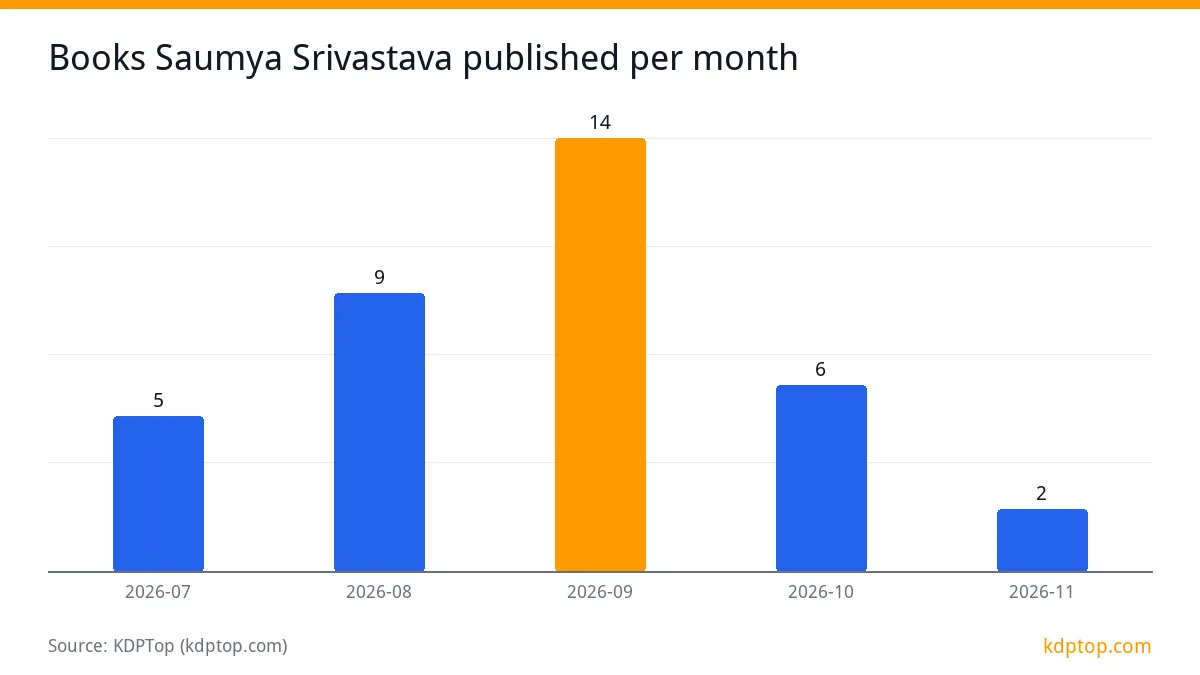
Publishing volume accelerated before November
Show the data
| Month | Books |
|---|---|
| 2026-07 | 5 |
| 2026-08 | 9 |
| 2026-09 | 14 |
| 2026-10 | 6 |
| 2026-11 | 2 |
The monthly release chart shows 5 books in July 2026, 9 in August, 14 in September, 6 in October and 2 in November. September is the busiest month in the displayed period. October then falls to 6, followed by 2 in November. The November figure should be treated as a partial-month observation because the latest recorded release is November 2.
The catalog's first recorded release is July 6, 2026, and its latest is November 2, 2026. Across the last 30 days, the author has 50 new books recorded and 35 breakouts. A breakout means a new book on a New Releases list within the last 60 days that reached a Best Sellers list. This is a substantial number of recent list appearances relative to the reported release activity.
The data does not establish that every title followed the same production process or that the monthly release counts represent identical publishing workloads. It does show a rapid expansion of the tracked catalog over a relatively short period.
For other publishers, the practical question is not simply how to publish more frequently. It is how to maintain useful content, accurate technical explanations, consistent formatting and appropriate metadata while increasing output. A release schedule is only productive if the resulting books satisfy a real reader need. In technical nonfiction, errors can damage credibility across an entire series.
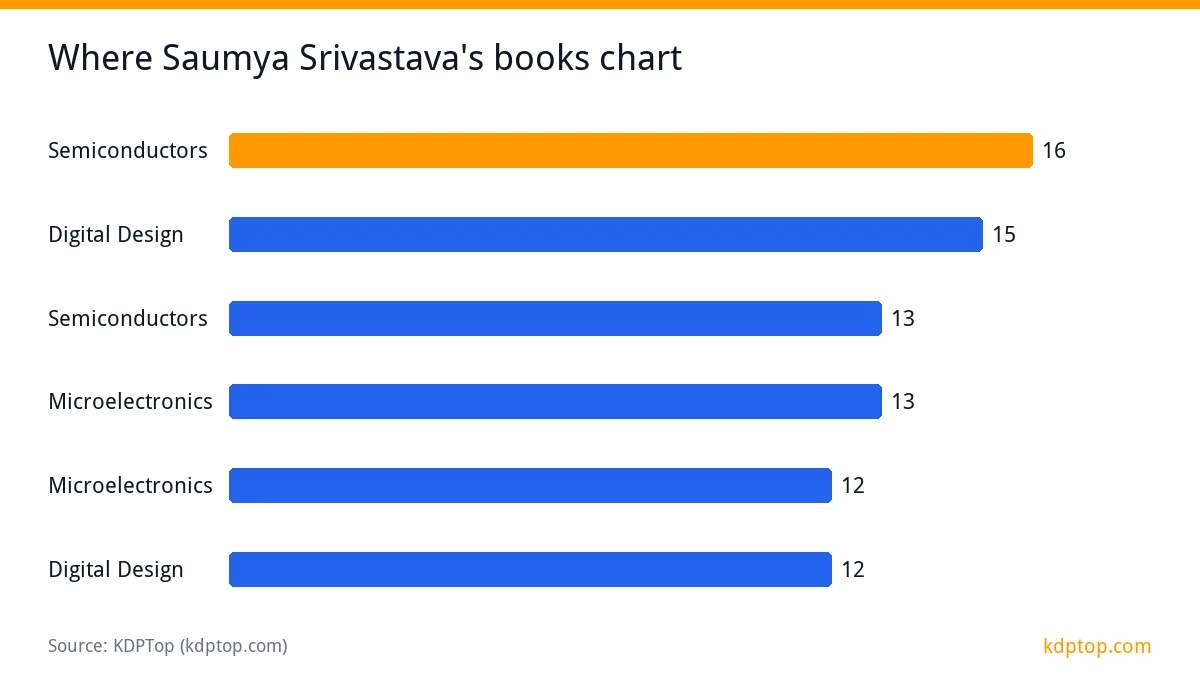
Semiconductors and digital design dominate chart appearances
Show the data
| Category | Books on its lists |
|---|---|
| Semiconductors | 16 |
| Digital Design | 15 |
| Semiconductors | 13 |
| Microelectronics | 13 |
| Microelectronics | 12 |
| Digital Design | 12 |
The leading categories in the supplied chart data are Semiconductors with 13 books, Digital Design with 12 and Microelectronics with 12. These figures reinforce the catalog's concentration in semiconductor engineering and related hardware subjects.
This concentration is relevant because it shows where the author has established the strongest visible category presence. Design for Testability in VLSI and VERILOG PROGRAMMING both fit naturally into the semiconductor and digital-design subject cluster. SystemVerilog and UVM adds another closely related topic through hardware verification.
A publisher researching these categories should look beyond the category names. Semiconductors is broad. Readers may be looking for practical explanations of scan design, automatic test pattern generation, fault modelling or built-in self-test. Those are more specific subject and keyword opportunities than simply publishing another general semiconductor textbook.
The opportunity for a new publisher is to identify a subject that has a clear audience but is not already adequately served by existing books. KDPTop's opportunity score is designed to estimate how much room a category leaves new indie books, with higher scores indicating more room. The supplied data does not include opportunity scores, so it cannot establish which of these three categories is easiest to enter. Category presence is evidence of activity, not proof of an attractive market for every new entrant.

SystemVerilog and UVM: A Comprehensive Guide to Constrained-Random Verification and the Universal Verification Methodology (VLSI Design & Semiconductor Engineering)
- Price$16
- Reviews-
- BSR#540,240
- Est. revenue/mo$96
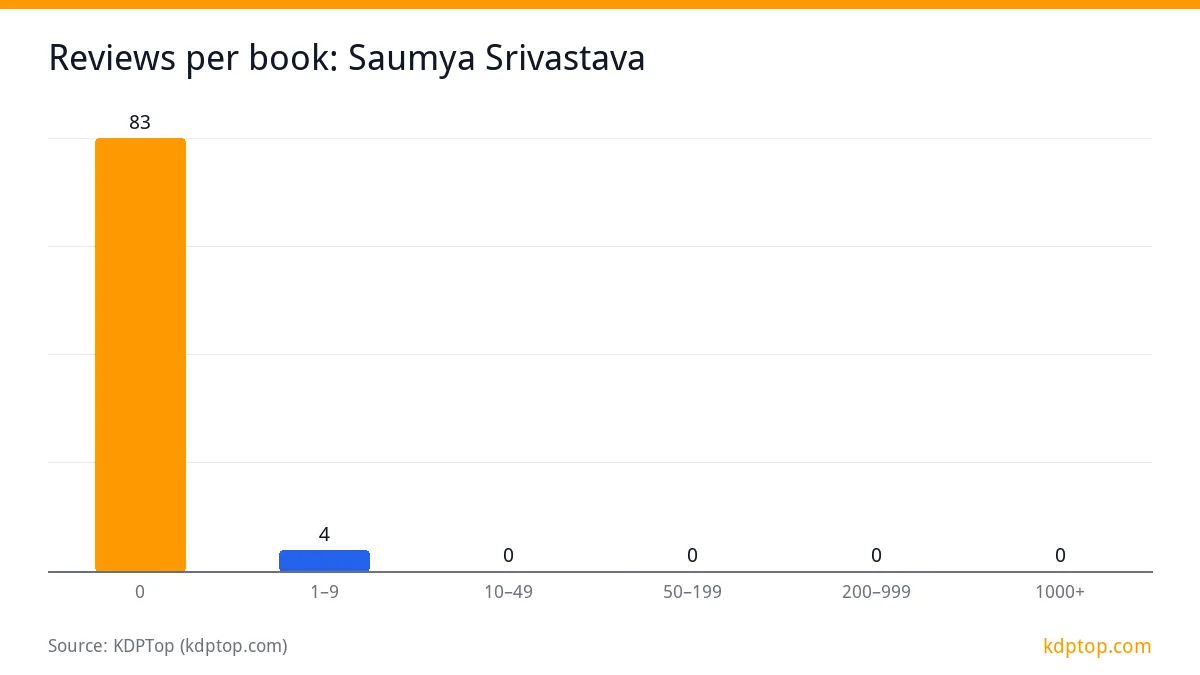
Best Seller appearances come with very few reviews
Show the data
| Reviews | Books |
|---|---|
| 0 | 83 |
| 1–9 | 4 |
| 10–49 | 0 |
| 50–199 | 0 |
| 200–999 | 0 |
| 1000+ | 0 |
The review distribution is perhaps the most unusual part of this catalog. Of the 87 tracked books, 83 have no recorded reviews. Only 4 fall into the 1–9 review range. No books appear in any of the higher review brackets shown in the chart.
The catalog has 4 total reviews, a median of 1.0 reviews and an average rating of 4.0. Those figures describe a very small amount of visible customer feedback. They should not be treated as a representative measure of satisfaction across all readers. With so few reviews, the rating provides limited evidence about the quality or reception of the wider catalog.
At the same time, 54 books have appeared on Best Sellers lists during the last 30 days, and the best recorded rank is 3. This is a useful reminder that review volume and sales-rank activity measure different things. A book can achieve a visible category ranking without accumulating a large review history.
For a new publisher, there is no reason to treat reviews as an automatic prerequisite for publishing. But there is also no reason to ignore them. Clear descriptions, accurate subject targeting, professional covers and useful sample content help readers make informed decisions. Genuine reader feedback can then help improve future editions. The data does not explain why these books have so few reviews, so copying the review profile would be a poor strategy.
What another KDP publisher can learn from this catalog
Srivastava's catalog offers a practical example of a specialist publishing strategy. It combines related technical subjects, a recognizable series structure, two main price groups and a high release rate. The estimated monthly revenue of $2,312 across 87 tracked books suggests that the combined catalog matters more than any single title.
The reported 100% indie share also makes this a relevant case for independent publishers studying specialist nonfiction. The supplied records identify the books as KDP-published rather than traditionally published. That does not reveal the author's production costs, advertising expenditure, editing arrangements or actual profit. Revenue estimates are not royalty statements.
A sensible approach for another publisher would be to select a narrow subject, research the specific questions readers ask, and develop a small group of genuinely useful related books. For example, someone with suitable engineering expertise could investigate whether hardware verification, semiconductor testing or industrial automation has an underserved reader need. The goal would be to offer a better resource, not reproduce Srivastava's titles or their wording.
The main limitation is the nature of the data itself. Estimated units and revenue are modelled from BSR, not reported by Amazon. Rankings can change, and the estimates do not show actual payments, advertising costs or profit margins. Still, the combination of category appearances, pricing, release activity and individual book estimates provides a useful view of how one technical KDP catalog is performing.
Key takeaways
- Study adjacent technical subjects rather than entering unrelated categories; Srivastava's strongest visible areas are Semiconductors, Digital Design and Microelectronics.
- Consider both $8 and $16 price points when the manuscript's scope and reader value justify different levels of pricing.
- Research specific reader problems such as scan design, Verilog programming and industrial automation instead of relying on broad engineering keywords.
- Treat publishing frequency as a production challenge: increasing releases only helps when technical accuracy, editing and reader usefulness remain consistent.
- Do not use Best Sellers appearances or estimated revenue as substitutes for actual profit data; BSR-based estimates cannot reveal production costs, advertising expenditure or royalties.
Books in this analysis

FUNDAMENTALS OF MECHATRONICS ENGINEERING: An Integrated Approach to Mechanical, Electrical, Control and Computer Systems (Mechatronics, Robotics & Industrial Automation)
- Price$8
- Reviews-
- BSR#319,245
- Est. revenue/mo$72

AIRCRAFT PROPULSION SYSTEMS: Jet Engines, Turbofans, Turbojets, Turboprops, Ramjets, Scramjets, and Propulsion Performance (Modern Aerospace Engineering Series)
- Price$8
- Reviews-
- BSR#336,490
- Est. revenue/mo$72
- Published2026-09

FUNDAMENTALS OF AEROSPACE ENGINEERING: Principles of Aerodynamics, Flight Mechanics, Propulsion, Aircraft Structures, and Space Systems (Modern Aerospace Engineering Series)
- Price$8
- Reviews-
- BSR#456,254
- Est. revenue/mo$72
- Published2026-09
FAQ
How many books has Saumya Srivastava published on KDP?
KDPTop tracks 87 books by Saumya Srivastava, with recorded releases between July 6, 2026, and November 2, 2026. All tracked books are classified as independently published through KDP.
How much does Saumya Srivastava earn from Amazon KDP?
KDPTop estimates monthly revenue at $2,312 across the tracked catalog, based on sales-rank modelling. This is estimated revenue, not confirmed Amazon royalty income or profit.
What is Saumya Srivastava's best-selling KDP book?
Design for Testability in VLSI: Scan Design, ATPG, Built-In Self-Test, Fault Modeling, Test Compression, and Test Optimization is the leading supplied title by estimated monthly revenue. It generates an estimated $144 monthly at a $16 price, with a BSR of 458183.
What categories does Saumya Srivastava publish in?
The leading categories are Semiconductors, Digital Design and Microelectronics. The wider catalog also covers mechatronics, robotics, industrial automation, aerospace engineering and technical study guides.
How we got these numbers
Data comes from KDPTop's continuous crawl of Amazon Best Sellers, New Releases, Movers & Shakers and book pages, plus Keepa sales-rank history. Monthly units and revenue are estimated from sales rank (BSR); a single book can be off by ±30%, so use them to compare books, not as exact income. About our data →
Explore KDPTop
Related analysis
-
 Author analysis
Wei Long KDP Profile: 115 Books, Pricing and Earnings
Wei Long has 115 tracked KDP books, with 66 reaching bestseller lists in 30 days. Examine estimated earnings, pricing, release pace and reviews for publishers.
-
 Author analysis
Jimmy C. Matteson: 69 Books and a $5,858 Monthly Estimate
Jimmy C. Matteson has 69 tracked KDP books and an estimated $5,858 monthly revenue. See his repair manual catalog, pricing, rankings and release activity.
-
 Author analysis
E N FUUBE: 138 Law Books, $938 a Month
E N FUUBE has 138 KDP law books, priced mostly at $5.99, earning an estimated $938 monthly. 46 hit bestseller lists in 30 days.