

Best Medicine: Amazon Keyword Demand and Competition
Best medicine gets 107,930 monthly searches but only 1,003 purchases. See competing books, prices, reviews, categories and the KDP publishing opportunity.
Best medicine gets 107,930 monthly Amazon searches and 1,003 monthly purchases, a purchase rate of just 0.9%. The gap matters. People search this phrase frequently, but relatively few searches turn into purchases. KDP publishers looking at this keyword need to pay attention to what shoppers actually mean when they use it.
The six analyzed books are all traditionally published. None is independently published through KDP. That leaves an interesting gap in the current sample, although 529 competing products and 114 books with the phrase in their titles make this a difficult keyword to target broadly. The existing books cover medicine, nutrition, children's health and humor, so a focused publishing angle will matter more than simply putting Best Medicine on a cover.
1. Best Medicine has high search volume and weak buying intent
The keyword records 107,930 monthly searches against 1,003 monthly purchases. That produces a purchase rate of 0.9%. For a publisher, this is the first number worth understanding. Search volume measures interest in a phrase. Purchases indicate how much of that interest turns into buying activity. Here, the conversion between the two is low.
The supply-demand ratio is 204.0, with 529 competing products. KDPTop's opportunity score measures how much room a category leaves new independently published books, but the underlying keyword figures already suggest that a broad approach carries risks. A large audience is searching, yet the available purchase activity is relatively small compared with that search volume.
There are 114 charting books with best medicine in their titles. That is a substantial group of existing titles competing for relevance. A new publisher should be cautious about treating all 107,930 searches as potential customers for one book. Someone searching for medicine recommendations has a different intention from someone looking for a joke book or a book about nutrition.
Estimated purchases and revenue are modelled from Amazon Best Sellers Rank (BSR), where a lower rank is better. Amazon does not report these sales figures directly. The purchase estimate is useful for comparing the keyword with its search volume, but it should not be treated as a verified count of customer orders.
2. Doctors & Medicine dominates the existing book selection
Show the data
| Category | Books |
|---|---|
| Doctors & Medicine | 6 |
| Occupational Therapy | 2 |
| Jokes & Riddles | 2 |
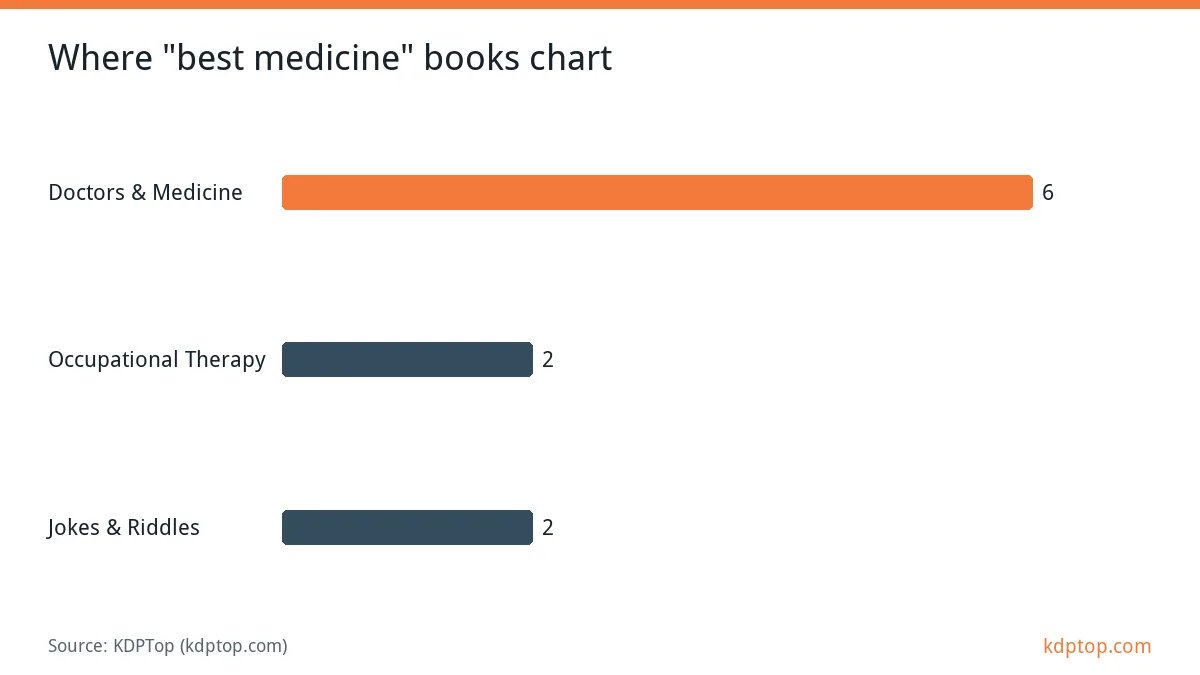
Doctors & Medicine accounts for 6 category appearances in the analyzed data. Occupational Therapy accounts for 2, and Jokes & Riddles accounts for another 2. The category distribution shows that best medicine attracts several kinds of books, even though its wording sounds like a straightforward health-related search.
Food Is Your Best Medicine: The Pioneering Nutrition Classic by Henry G. Bieler M.D. is one of the clearest examples. The book has 433 reviews, a 4.4 rating and a listed price of $7.99. Its BSR is 84,216, with estimated monthly sales of 18 units and estimated monthly revenue of $144. It was published in 1987 and remains relevant to the keyword's nutrition angle.
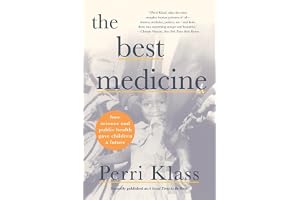
The Best Medicine: How Science and Public Health Gave Children a Future by Perri Klass takes a different approach. It has 61 reviews, a 4.4 rating and a listed price of $18.95. Its BSR is 370,501, with estimated monthly sales of 3 units and estimated monthly revenue of $57.
For a KDP publisher, the category spread suggests that a book needs a clear subject before it needs this broad keyword. A nutrition book, an occupational therapy resource and a humor collection have different audiences. Trying to compete with all three using the same generic title would make positioning difficult.
3. Review counts show an established competition group
Show the data
| Reviews | Books |
|---|---|
| 0 | 0 |
| 1-9 | 1 |
| 10-49 | 2 |
| 50-199 | 1 |
| 200-999 | 2 |
| 1000+ | 0 |
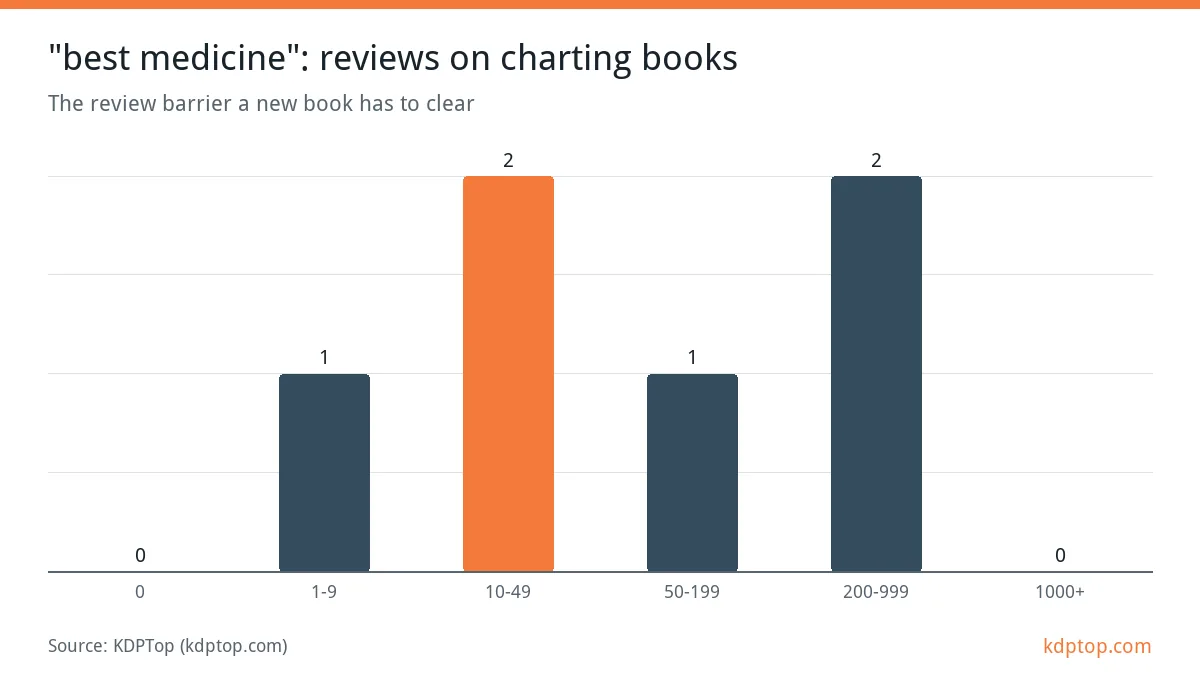
The review distribution covers six analyzed books. Two have between 200 and 999 reviews, one has between 50 and 199, two have between 10 and 49, and one has between 1 and 9. None falls into the 1,000-plus review range.
The median review count is 52.5. That gives a more useful picture of the middle of this sample than looking only at Food Is Your Best Medicine by Henry G. Bieler, which has 433 reviews. A new title would still face books with established customer feedback, but the sample does not show that every competing title has hundreds of reviews.
You Are the Best Medicine by Julie Aigner Clark has 44 reviews and a 4.3 rating. Its listed price is $34.00. Laughter, The Best Medicine by the Editors of Reader's Digest appears in two editions. One has 2 reviews and a 5.0 rating, while the other has 29 reviews and a 4.2 rating. These examples show how different the competition can look even when books share almost identical keyword wording.
The review figures are worth checking when choosing a format and angle. A new humor book would be entering a different competitive group from a nutrition title. Review counts alone cannot establish how difficult a book is to sell, but they help identify how much customer feedback existing titles have accumulated.
4. The $34 median price points to expensive titles
Show the data
| Price range | Books |
|---|---|
| <$5 | 0 |
| $5-9.99 | 1 |
| $10-14.99 | 0 |
| $15-19.99 | 1 |
| $20+ | 3 |
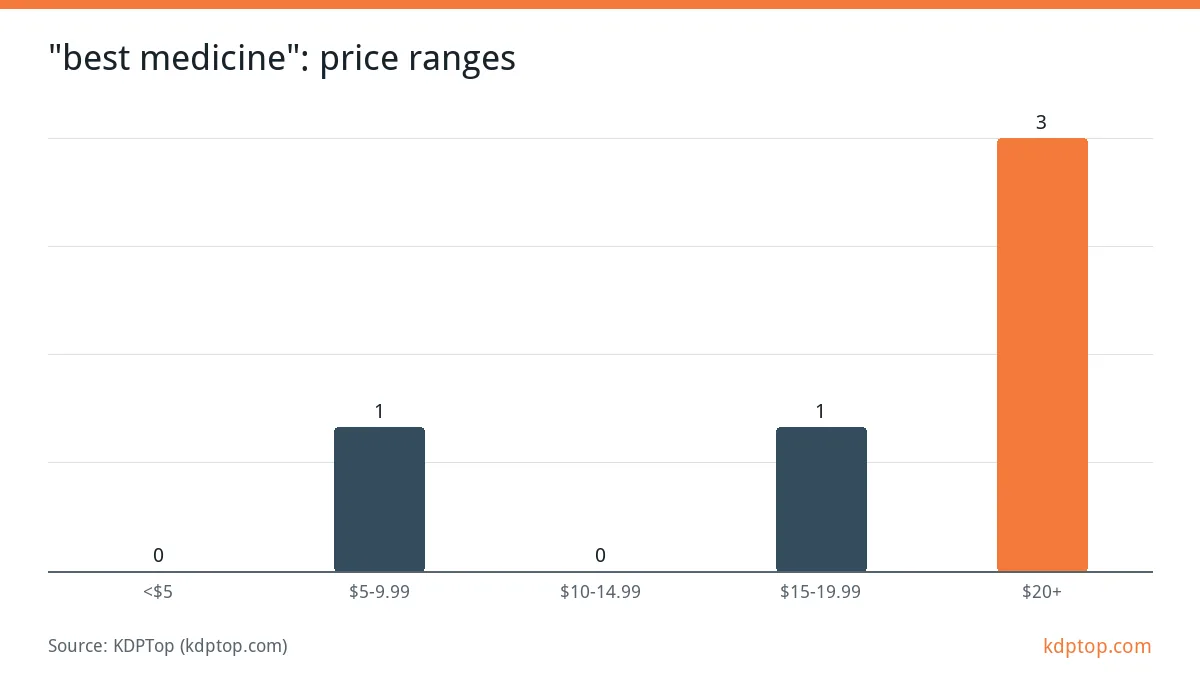
The median listed price is $34.00. The price distribution shows one book in the $5-9.99 range, one in the $15-19.99 range and three in the $20-plus range. No analyzed books fall below $5 or between $10 and $14.99. The distribution accounts for five priced records, while the analysis covers six books.
The individual listings help explain the spread. Food Is Your Best Medicine: The Pioneering Nutrition Classic costs $7.99, while The Best Medicine: How Science and Public Health Gave Children a Future costs $18.95. You Are the Best Medicine is listed at $34.00. Another edition of Food Is Your Best Medicine by Henry G. Bieler is listed at $350.89, and a Laughter, The Best Medicine edition is listed at $49.28.
That $350.89 listing deserves caution. A high asking price does not establish strong demand or a realistic selling price. The same applies to the $49.28 humor edition. Publishers should distinguish listed prices from actual transaction prices when assessing what customers are willing to pay.
For a new KDP book, the $34 median is a reference point rather than a pricing instruction. A short joke book or simple low-content notebook has a different production cost and customer expectation from a substantial nonfiction book. The format and perceived usefulness should determine the price.
5. Zero indie titles creates a possible positioning gap
The indie share is 0%. All six analyzed books come from traditional publishers. There are no independently published KDP books in this particular sample, which gives publishers a reason to investigate the keyword further.
The distinction matters because established titles such as Food Is Your Best Medicine and The Best Medicine already have recognizable subject matter and customer reviews. A new independent publisher could approach a narrower audience with a more specific book. Occupational Therapy is one category worth examining, particularly if the publisher has a clearly defined educational or practical subject.
There are limits to what the zero indie share tells us. The analysis covers six books, not all 529 competing products. It does not establish that KDP publishers have never tried the keyword or that an independently published book would automatically rank. The absence of indie titles in this sample is a research lead, not proof of an easy market.
I would investigate the individual category results before committing to a manuscript. Look at the books appearing in Doctors & Medicine and Occupational Therapy, then compare their actual subjects, formats and reader expectations. A narrow book with a clear audience has a more defensible position than a generic title built around best medicine.
Key takeaways
- Best medicine receives 107,930 monthly searches but only 1,003 estimated monthly purchases, so broad search interest should not be mistaken for buying demand.
- All six analyzed books are traditionally published, producing a 0% indie share in the sample, but this does not establish that the wider competition is free of KDP titles.
- Doctors & Medicine has the most category appearances, with Occupational Therapy and Jokes & Riddles providing narrower publishing directions.
- The median review count is 52.5, so publishers should study individual competing titles rather than assume every established book has a large review advantage.
- Research a specific angle such as a medicine organizer or humor collection before committing to the broad best medicine keyword.
Books in this analysis

Food Is Your Best Medicine: The Pioneering Nutrition Classic
by Henry G. Bieler M.D.
- Price$7.99
- Reviews433
- BSR#84,216
- Est. revenue/mo$144
- Published1987-07
The Best Medicine: How Science and Public Health Gave Children a Future
by Perri Klass
- Price$18.95
- Reviews61
- BSR#370,501
- Est. revenue/mo$57

You Are the Best Medicine
by Julie Aigner Clark
- Price$34
- Reviews44
- Published2010-09

Food Is Your Best Medicine
by Henry G. Bieler
- Price$351
- Reviews433
- Published1973-01

Laughter, The Best Medicine
by Editors of Reader's Digest
- Price-
- Reviews2

Laughter, The Best Medicine
by Editors of Reader's Digest
- Price$49.28
- Reviews29
Common questions
How many people search for best medicine on Amazon each month?
The keyword receives 107,930 monthly searches and has 1,003 estimated monthly purchases. Its purchase rate is 0.9%, which indicates that substantial search activity does not translate into equally strong buying activity.
How competitive is the best medicine Amazon keyword?
There are 529 competing products and 114 charting books with best medicine in their titles. The six analyzed books have a median of 52.5 reviews, and all six are traditionally published.
Can KDP publishers compete for the best medicine keyword?
The analyzed sample has a 0% indie share, suggesting room to investigate independent publishing angles. However, six analyzed books are not enough to establish that the wider market lacks KDP competition. A focused subject such as a medicine organizer or a humor book offers a clearer starting point than a generic title.
What type of book should I publish for best medicine?
The matching books appear in Doctors & Medicine, Occupational Therapy, and Jokes & Riddles. Related searches also suggest medicine organizers, health information and humor books. Choose a specific audience and format first, then assess its competition separately. Estimated sales are modelled from BSR rather than reported directly by Amazon.
How we got these numbers
Data comes from KDPTop's continuous crawl of Amazon Best Sellers, New Releases, Movers & Shakers and book pages, plus each book's sales-rank history. Monthly units and revenue are estimated from sales rank (BSR); a single book can be off by ±30%, so use them to compare books, not as exact income. About our data
Explore KDPTop
- Studio: make the bookTurn the niche into a coloring or puzzle book ready for KDP, cover included
- Free category finderDescribe your book and get the KDP categories to pick
- Chrome extensionSee estimated sales and BSR right on Amazon
- User guideHow to read decision cards, scores and sales estimates
- PricingWhat the free plan covers and what paid plans add
Related analysis
-
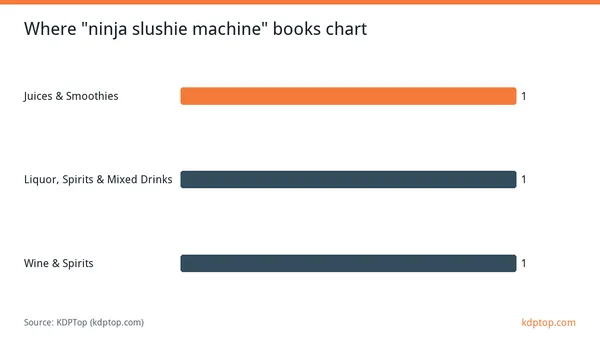
Ninja Slushie Machine: Keyword Demand and KDP Competition
Ninja slushie machine gets 275,288 monthly searches and 2,037 purchases. See its competition, book prices, review barriers and practical KDP publishing angles.
-
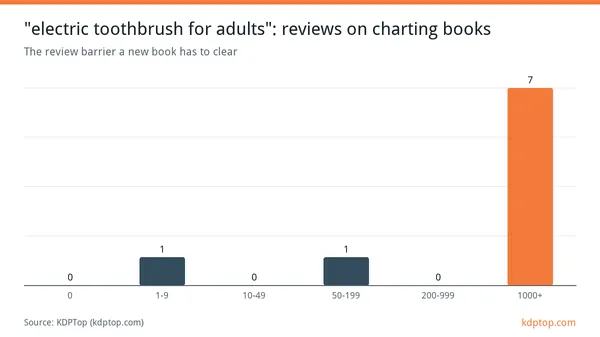
Electric Toothbrush for Adults: Demand and KDP Competition
Electric toothbrush for adults recorded 213,155 searches and 13,344 purchases in October 2026. Review counts, prices and competition reveal a difficult KDP keyword.
-
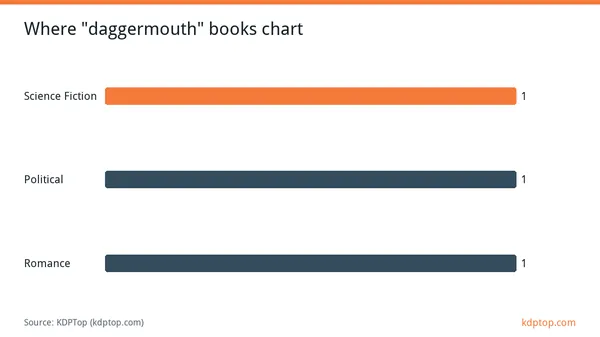
Daggermouth Keyword Research: Demand, Competition and KDP
Daggermouth gets 80,379 monthly searches but only 659 estimated purchases. See its review barrier, $23.34 median price and indie competition.