

Hayden Van Der Post: 889 Books, Pricing and KDP Earnings
Hayden Van Der Post has 889 tracked KDP books, 187 recent bestseller appearances and an estimated $4,240 in monthly catalog revenue. Here is what his publishing data shows.
Hayden Van Der Post has 889 tracked books, with 187 appearing on Amazon Best Sellers lists during the last 30 days. KDPTop estimates his catalog generates $4,240 in monthly revenue from 417 units. Seven of his 16 recent releases qualify as breakouts. Those figures make his catalog worth studying, particularly for publishers working in technical nonfiction and specialist reference books.
His approach relies on a large catalog, prices well above the usual low-content range, and a steady flow of new titles. Financial Engineering, Python, Options, and Econometrics & Statistics account for much of his category visibility. There are useful lessons here for publishers considering specialist nonfiction, although the sales estimates and limited review history require some caution.
A catalog built around specialist nonfiction
Hayden Van Der Post's catalog covers technical subjects that require readers to have a particular interest or professional need. Financial Engineering is the most prominent category, followed by Python, Options, Econometrics & Statistics, and Financial Risk Management. His main book types include how-to guides, study guides and reference books, nonfiction, workbooks, and other formats.
This is a different publishing model from producing large numbers of journals, planners, or simple activity books. A title such as Python in Excel for Finance: Modeling, Forecasting, and Optimization: Master Advanced FP&A and Quant Techniques in a Familiar Interface (Excel with Python) targets readers who want to apply a specific technical skill. Its subject gives the book a clear reason to exist, and its $56.99 list price reflects that specialist positioning.
The catalog's category mix also suggests a repeatable subject strategy. A publisher familiar with financial analysis could develop related books around budgeting, statistical modelling, investment analysis, and programming applications. Each title would address a separate reader problem while remaining within a recognizable area of expertise.
For a publisher coming from low-content books, the main lesson is that specialist nonfiction offers room to charge more when the material has practical value. It also demands credible content. A technical title needs accurate explanations, useful examples, and enough depth to justify its price.
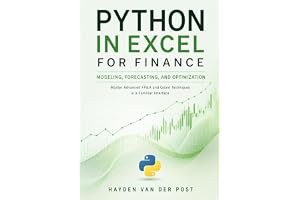
Python in Excel for Finance: Modeling, Forecasting, and Optimization: Master Advanced FP&A and Quant Techniques in a Familiar Interface (Excel with Python)
- Price$56.99
- Reviews1
- BSR#3,291,601
- Est. revenue/mo$342
- Published2026-02

Strategic Alpha: Engineering Market Dominance through Applied Game Theory and Neuroeconomics: Harnessing Game Theory, Neuroeconomics, and Market Psychology for Predictive Edge
- Price$59.99
- Reviews-
- BSR#1,170,812
- Est. revenue/mo$180
- Published2025-07

Advanced Budgeting & Financial Management for Nonprofits (Budgeting in Fp&a)
- Price$34.99
- Reviews-
- BSR#879,712
- Est. revenue/mo$105
- Published2025-04
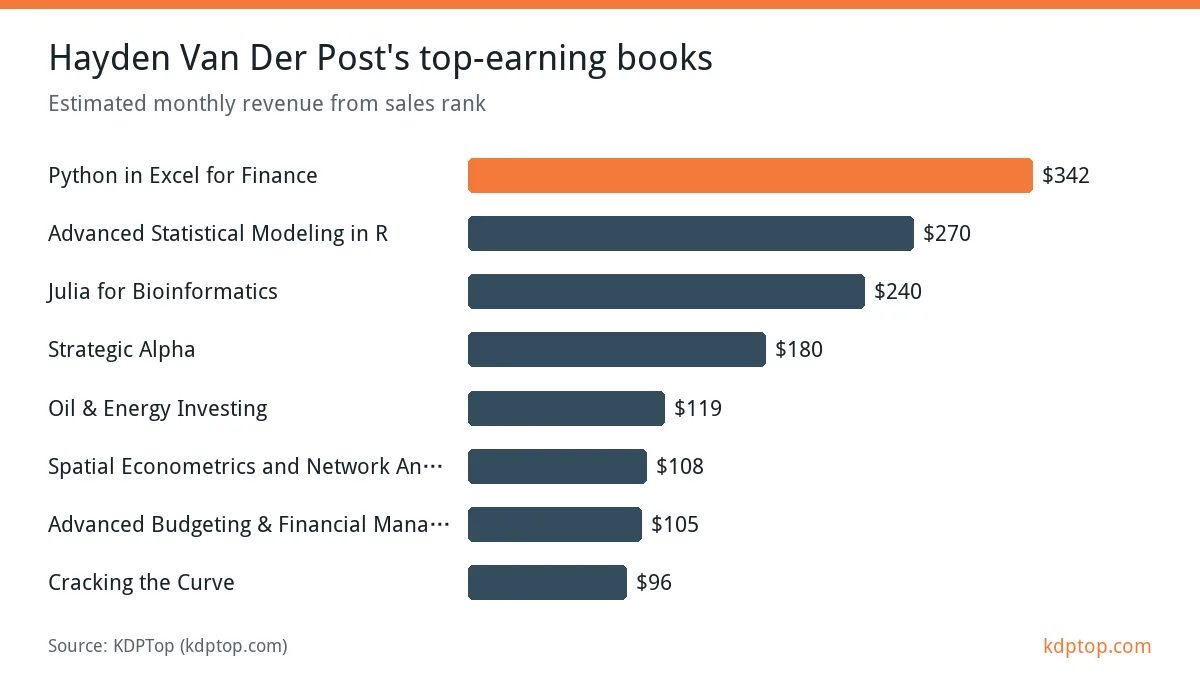
Python in Excel for Finance leads the revenue list
Show the data
| Book | Est. monthly revenue |
|---|---|
| Python in Excel for Finance | $342 |
| Advanced Statistical Modeling in R | $270 |
| Julia for Bioinformatics | $240 |
| Strategic Alpha | $180 |
| Oil & Energy Investing | $119 |
| Spatial Econometrics and Network Anal… | $108 |
| Advanced Budgeting & Financial Manage… | $105 |
| Cracking the Curve | $96 |
Python in Excel for Finance: Modeling, Forecasting, and Optimization is the leading Hayden Van Der Post title in the supplied earnings data. KDPTop estimates monthly revenue at $342, based on six estimated monthly units and a listed price of $56.99. Its recorded Best Sellers Rank is 3,291,601. That combination deserves a closer look. Six estimated monthly units is modest volume, but the high selling price produces a meaningful revenue figure for one title. Publishers often focus on unit volume when evaluating a niche. This example shows why price and revenue need to be considered together. Several other Hayden Van Der Post titles have estimated monthly revenue worth examining. Julia for Bioinformatics: Genomic Analysis, Sequence Processing, and Biological Modeling is estimated at $240 from six units, with a $39.99 price. Strategic Alpha: Engineering Market Dominance through Applied Game Theory and Neuroeconomics is estimated at $180 from three units, priced at $59.99. Oil & Energy Investing: Exploration Companies, Pipelines, Refining, and the Structure of Global Energy Markets (The Global Energy Markets Series) brings in an estimated $119 monthly from three units. Spatial Econometrics and Network Analysis with Python: Modeling Spatial Dependence, Interconnected Markets, and Graph-Based Economic Systems is estimated at $108 from three units. Mercer, not Hayden Van Der Post. It should not be counted as part of Van Der Post's catalog earnings without further verification. These figures are estimates modelled from sales rank, not sales reports from Amazon. They provide a useful indication of relative commercial activity, but they do not establish actual royalties, advertising costs, production expenses, or net profit.

Julia for Bioinformatics: Genomic Analysis, Sequence Processing, and Biological Modeling
- Price$39.99
- Reviews-
- BSR#531,848
- Est. revenue/mo$240
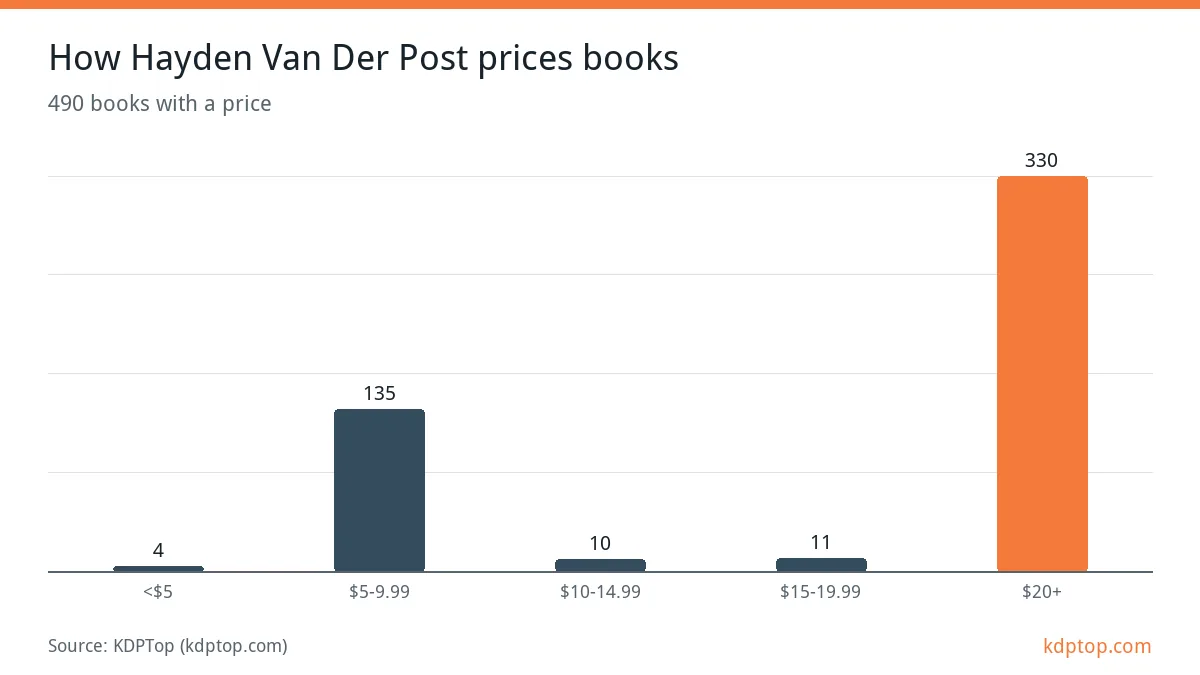
Premium pricing is the dominant approach
Show the data
| Price range | Books |
|---|---|
| <$5 | 4 |
| $5-9.99 | 135 |
| $10-14.99 | 10 |
| $15-19.99 | 11 |
| $20+ | 330 |
The pricing distribution covers 490 books with recorded prices. Of these, 330 are priced at $20 or more. Another 135 fall between $5 and $9.99. Only four cost less than $5, while 10 sit between $10 and $14.99 and 11 between $15 and $19.99.
The median catalog price is $33.38. The lower quartile is $9.99, while the upper quartile reaches $39.99. This is a substantial departure from the inexpensive pricing commonly used for notebooks, trackers, and basic low-content books.
The higher prices make sense when the subject requires specialist knowledge or provides a practical reference. Advanced Budgeting & Financial Management for Nonprofits (Budgeting in Fp&a), for example, is priced at $34.99. Cracking the Curve: Advanced Bond Strategies for Active Traders: Move beyond buy-and-hold. Master the hidden plays in fixed income markets is priced at $23.99.
A publisher considering this approach should start with the reader's reason for paying. A workbook that helps someone complete a specific task can justify a higher price than a generic collection of blank pages. A technical reference needs enough useful material to support the same decision.
There is also a practical warning in the data. The median price describes the middle of the books with recorded prices, not the price of every title in the 889-book catalog. The chart should be treated as a pricing sample rather than a complete breakdown of all listings.

Cracking the Curve: Advanced Bond Strategies for Active Traders: Move beyond buy-and-hold. Master the hidden plays in fixed income markets.
- Price$23.99
- Reviews-
- BSR#2,565,047
- Est. revenue/mo$96
- Published2025-03
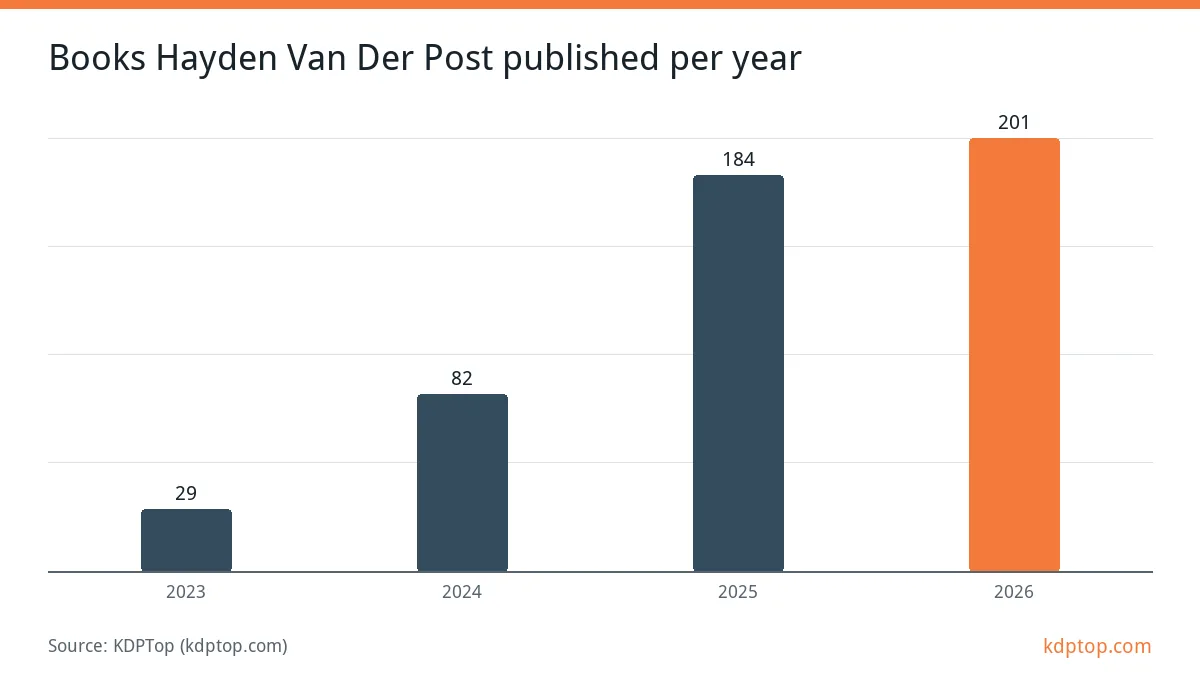
Publishing volume accelerated through 2026
Show the data
| Year | Books |
|---|---|
| 2023 | 29 |
| 2024 | 82 |
| 2025 | 184 |
| 2026 | 201 |
The annual publishing figures show a clear increase in recorded releases. The chart lists 29 books for 2023, 82 for 2024, 184 for 2025, and 201 for 2026. The first recorded release date is October 10, 2023, and the latest is November 2, 2026.
The increase from 82 books in 2024 to 184 in 2025 is particularly notable. The 2026 figure has already reached 201 in the supplied data. That suggests a publishing operation that has increased its output rather than relying on a small collection of titles to generate all its activity.
Recent releases provide another useful measure. Van Der Post published 16 new books during the last 30 days, and seven qualify as breakouts. A breakout is a new book on a New Releases list within the last 60 days that reached a Best Sellers list. Seven breakouts from 16 recent releases is a substantial result within this dataset.
Publishers should be careful about copying the release pace without understanding the production process. Technical nonfiction needs research, editing, and subject knowledge. A schedule that works for a publisher with established workflows may create quality problems for someone producing their first specialist guide.
The annual figures also need a qualification. Their displayed counts add up to 496, not the full catalog total of 889. They therefore describe the releases represented in this chart, rather than providing a complete accounting of every tracked book.

Oil & Energy Investing: Exploration Companies, Pipelines, Refining, and the Structure of Global Energy Markets (The Global Energy Markets Series)
- Price$39.51
- Reviews-
- BSR#674,414
- Est. revenue/mo$119
- Published2026-03

Spatial Econometrics and Network Analysis with Python: Modeling Spatial Dependence, Interconnected Markets, and Graph-Based Economic Systems
- Price$35.99
- Reviews-
- BSR#563,712
- Est. revenue/mo$108
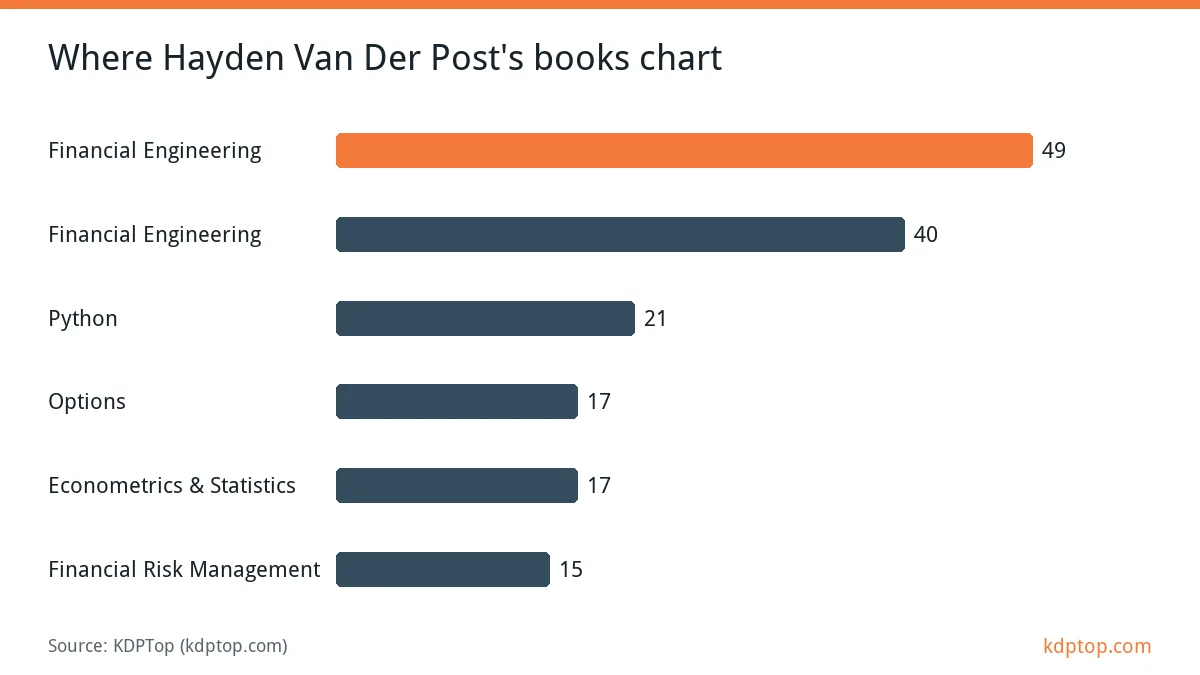
Financial Engineering accounts for the most category appearances
Show the data
| Category | Books on its lists |
|---|---|
| Financial Engineering | 49 |
| Financial Engineering | 40 |
| Python | 21 |
| Options | 17 |
| Econometrics & Statistics | 17 |
| Financial Risk Management | 15 |
Financial Engineering leads the category chart with 40 appearances. Python follows with 21, while Options and Econometrics & Statistics each record 17. Financial Risk Management has 15.
This concentration gives a clearer picture of the catalog's commercial direction. The subjects connect through quantitative finance, programming, and analytical methods. Readers interested in one area may also have a reason to buy books in another. That creates opportunities for related titles and a recognizable subject identity across a catalog.
For an independent publisher, the useful move is to identify a narrow subject with several distinct reader problems. Someone researching Python for financial analysis might also need help with forecasting, statistical modelling, or portfolio risk. Those are potential publishing topics because they address related needs.
The category numbers measure appearances in the supplied chart. They do not establish the size of each category's total market or prove that every book in a category sells well. A category with many appearances can also have substantial competition.
KDPTop's opportunity score is a separate measure of how much room a category leaves new indie books. Higher scores indicate more room. No opportunity scores are included here, so category appearance counts alone cannot tell publishers which subject is easiest to enter.
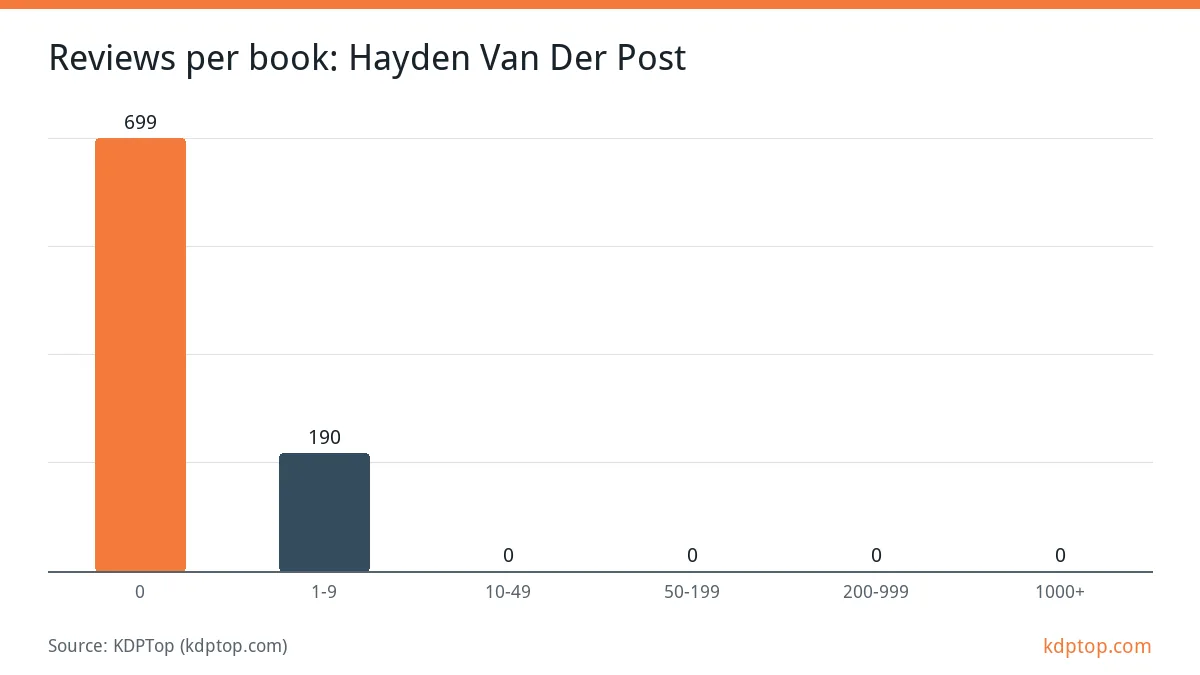
The review record is much thinner than the catalog
Show the data
| Reviews | Books |
|---|---|
| 0 | 699 |
| 1-9 | 190 |
| 10-49 | 0 |
| 50-199 | 0 |
| 200-999 | 0 |
| 1000+ | 0 |
The 889 tracked books have accumulated 193 reviews in total. The median is one review per book, and the average rating is 3.5 stars. The distribution shows 699 books with no reviews and 190 with between one and nine. No books appear in the higher review brackets shown in the chart.
That is a striking gap between catalog activity and reader feedback. A large publishing operation can accumulate bestseller-list appearances while individual books still have very little review history. The 187 books seen on Best Sellers lists during the last 30 days indicate broad recent visibility, but the review figures show that this visibility does not translate into a large body of public feedback.
For publishers studying the catalog, reviews are a useful quality signal, but they are an incomplete one. A book with few reviews may still sell. A book with a high rating and a small number of reviews also has limited evidence behind that rating.
The recorded best rank across the lists is second place. That gives the catalog a strong recent ranking result, although the data does not identify which title achieved that position. Publishers should avoid attributing that rank to the leading revenue title without book-level confirmation.
The broader lesson is to evaluate a catalog through several measures. Bestseller appearances show ranking activity. Estimated units and revenue indicate modelled sales performance. Reviews provide some evidence of reader response. None of these measures independently establishes profitability or long-term demand.
What another KDP publisher can learn
Hayden Van Der Post's catalog suggests that specialist nonfiction can support a higher-price publishing strategy when titles address specific professional or technical needs. Python in Excel for Finance provides a useful example: its estimated monthly revenue is $342, despite an estimated six monthly units.
The first practical lesson is to research connected topics before producing a series. Financial Engineering, Python, Options, and Econometrics & Statistics offer several related subject areas. A publisher with relevant knowledge could investigate search demand and competition for each topic before choosing a first book.
The second lesson is to consider the economics of each title. A $39.99 reference book with modest unit volume may generate more revenue than a much cheaper book selling several times as many copies. That does not automatically mean higher profit. Printing costs, Amazon fees, advertising, refunds, and editing expenses all affect the final result.
The third lesson concerns publishing capacity. The increase in annual release counts and the seven recent breakouts suggest that catalog expansion is a central part of this operation. A new publisher can borrow the planning principle by building a consistent schedule around related subjects. Copying the volume without the research and production capacity would be a poor decision.
Finally, the review distribution deserves attention. With 699 books showing no reviews, publishers should not assume that a large catalog automatically creates strong customer feedback. Clear descriptions, accurate metadata, useful interiors, and reader satisfaction still matter.
Van Der Post's catalog offers a case study in specialist subject selection, premium pricing, and sustained publishing activity. Its estimates provide clues about what may be working, but a publisher should validate demand and production economics before committing to a similar strategy.
Key takeaways
- Research specialist nonfiction topics such as Financial Engineering and Python when you have the knowledge to produce genuinely useful reference material.
- Evaluate revenue alongside estimated unit sales: Python in Excel for Finance generates an estimated $342 monthly from six units at $56.99.
- Consider premium pricing when a book solves a specific professional problem and contains enough useful material to justify its price.
- Build a release schedule around related subjects rather than increasing output faster than your research and editing capacity.
- Treat bestseller appearances, sales estimates, and reviews as separate signals, and verify category demand before committing to a new title.
Books in this analysis

Advanced Statistical Modeling in R: A Comprehensive Guide: Designing Robust, Interpretable, and Production-Ready Models Beyond Black-Box Machine Learning
by Julian K. Mercer
- Price$44.99
- Reviews-
- BSR#476,516
- Est. revenue/mo$270
- Published2026-01
Common questions
How many books has Hayden Van Der Post published on KDP?
KDPTop tracks 889 books under Hayden Van Der Post's catalog. The recorded first release is October 10, 2023, and the latest release is November 2, 2026. The annual publishing chart covers 496 releases, so it does not account for the entire tracked catalog.
How much does Hayden Van Der Post earn from Amazon KDP?
KDPTop estimates his catalog generates $4,240 in monthly revenue from 417 estimated monthly units. These figures are modelled from Amazon Best Sellers Rank, not reported by Amazon. They do not represent verified royalties or profit.
What is Hayden Van Der Post's highest-earning book?
Python in Excel for Finance: Modeling, Forecasting, and Optimization is the leading Hayden Van Der Post title in the supplied earnings data, with estimated monthly revenue of $342. It is listed at $56.99, with six estimated monthly units and a BSR of 3,291,601.
What categories does Hayden Van Der Post publish in?
His leading categories include Financial Engineering, Python, Options, Econometrics & Statistics, and Financial Risk Management. His catalog focuses heavily on technical nonfiction, financial subjects, programming, and specialist reference material.
How we got these numbers
Data comes from KDPTop's continuous crawl of Amazon Best Sellers, New Releases, Movers & Shakers and book pages, plus each book's sales-rank history. Monthly units and revenue are estimated from sales rank (BSR); a single book can be off by ±30%, so use them to compare books, not as exact income. About our data
Explore KDPTop
- Studio: make the bookTurn the niche into a coloring or puzzle book ready for KDP, cover included
- Free category finderDescribe your book and get the KDP categories to pick
- Chrome extensionSee estimated sales and BSR right on Amazon
- User guideHow to read decision cards, scores and sales estimates
- PricingWhat the free plan covers and what paid plans add
Related analysis
-
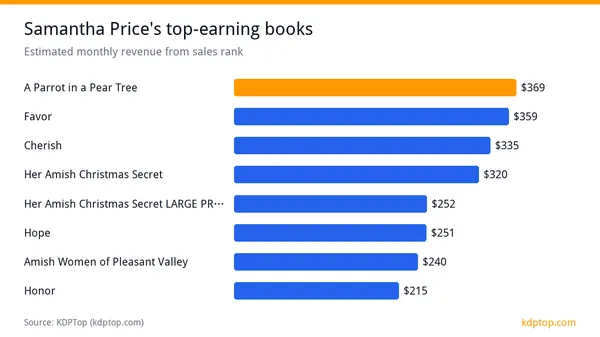
Samantha Price: How 342 KDP Books Build a Profitable Catalog
Samantha Price has 342 tracked KDP books, 201 recent bestseller appearances and 8 breakouts. See her pricing, Amish fiction catalog and estimated earnings.
-
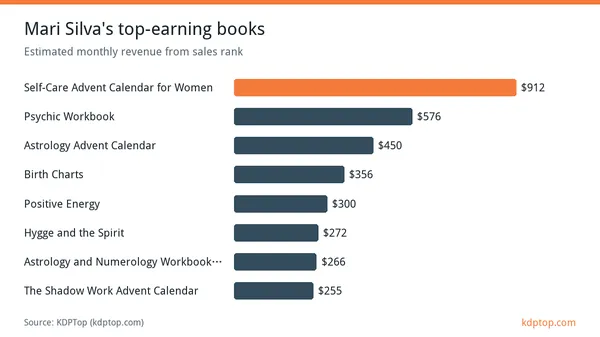
Mari Silva on KDP: 577 Books, 13 Breakouts in 30 Days
Mari Silva has 577 tracked KDP books, 317 recent bestseller appearances and 13 breakouts in 30 days. See her pricing, top earners and publishing strategy.
-
Stella Stepp: 109 Books, 32 Breakouts and $26,417 a Month
Stella Stepp has 109 tracked KDP books, 32 recent breakouts and estimated monthly revenue of $26,417. Her catalog shows how focused short romance publishing works.