

Soap Making Books: Can Indie Publishers Still Break In?
Soap Making has 67% indie representation, a $14.72 median price and 35% bestseller turnover. See the review barrier, revenue leaders and room for new KDP books.
67% of the 100 bestselling Soap Making books are independently published, and 35% of the list changed between the latest two snapshots. That gives KDP publishers a substantial presence in the category. The opportunity score is 32 out of 100, though, which points to limited room for another general-purpose soapmaking book without a clear reason for buyers to choose it.
The median book costs $14.72 and has 27 reviews. More than half the list has fewer than 50 reviews, so an established review count is not a requirement for competing here. The stronger challenge is finding a useful subject within a category where established instructional books already cover the basics.
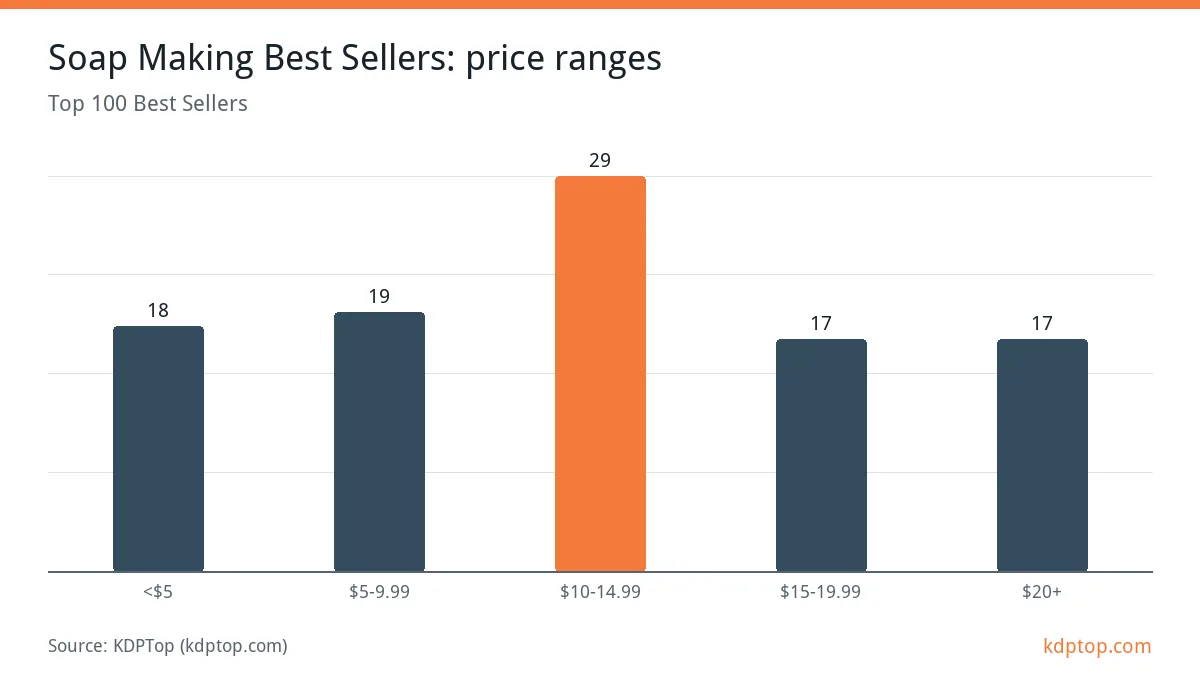
Soap Making book prices: the $10 to $15 range leads
Show the data
| Price range | Books |
|---|---|
| <$5 | 18 |
| $5-9.99 | 19 |
| $10-14.99 | 29 |
| $15-19.99 | 17 |
| $20+ | 17 |
The largest price group is $10 to $14.99, with 29 of the 100 bestselling books in that range. Another 19 books cost $5 to $9.99, while 18 are priced below $5. At the other end, 17 books cost $15 to $19.99 and another 17 cost $20 or more. The market has room for both inexpensive entry-level books and more expensive specialist guides.
The median price of $14.72 sits near the upper end of the largest price bracket. The middle half of the list falls between $11.99 and $19.99. That gives a new publisher a reasonable starting reference for pricing a conventional instructional paperback. A book priced well above $20 needs enough practical content to justify the difference.
The top of the category shows that buyers will pay more for a focused subject. Minimalist Soapmaking: How to Make Incredible Soaps in Less Time with Just a Few Ingredients by Simi Khabra costs $25.99 and has estimated monthly revenue of $1,403. The Natural Soapmaking Handbook: Easy Recipes and Techniques for Beautiful Soaps from Herbs, Essential Oils and Other Botanicals, also by Simi Khabra, costs $20.49 and generates an estimated $1,352 monthly.
For a new KDP publisher, the pricing decision should follow the book's contents. A collection of basic recipes will have a harder time justifying a premium price than a detailed formulation reference with practical explanations, ingredient information and repeat-use value.
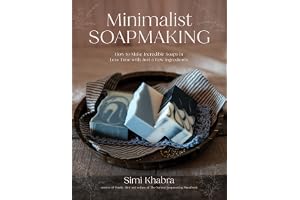
Minimalist Soapmaking: How to Make Incredible Soaps in Less Time with Just a Few Ingredients
by Simi Khabra
- Price$25.99
- Reviews77
- BSR#26,221
- Est. revenue/mo$1,403
- List rank#4
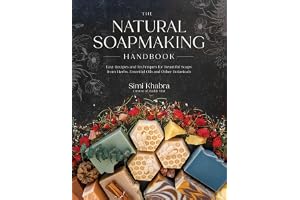
The Natural Soapmaking Handbook: Easy Recipes and Techniques for Beautiful Soaps from Herbs, Essential Oils and Other Botanicals
by Simi Khabra
- Price$20.49
- Reviews562
- BSR#17,849
- Est. revenue/mo$1,352
- List rank#3
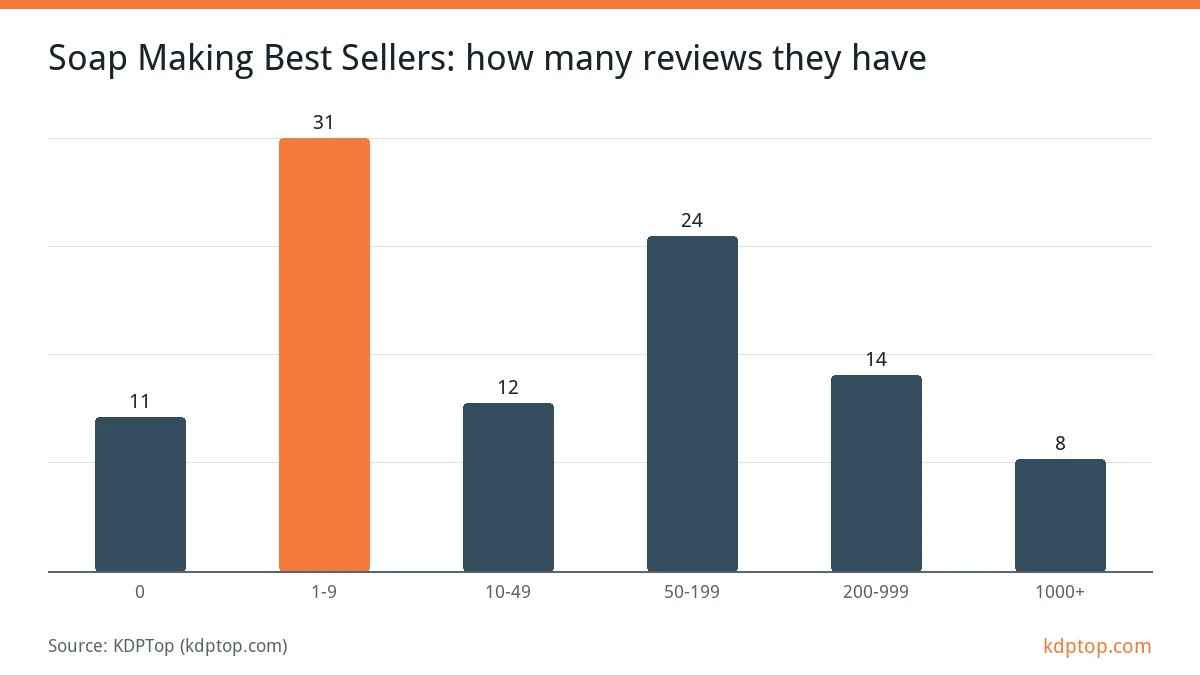
The review barrier is lower than the category's leaders suggest
Show the data
| Reviews | Books |
|---|---|
| 0 | 11 |
| 1-9 | 31 |
| 10-49 | 12 |
| 50-199 | 24 |
| 200-999 | 14 |
| 1000+ | 8 |
The median Soap Making bestseller has 27 reviews. There are 54 books with fewer than 50 reviews, including 11 with no reviews and 31 with only one to nine. That is useful information for publishers assessing how much social proof a new book needs before it can compete.
The largest review group is one to nine, accounting for 31 books. Another 12 have 10 to 49 reviews. Twenty-four have between 50 and 199, while 14 have between 200 and 999. Only eight books have at least 1,000 reviews. The category includes a meaningful number of books that have found a place on the bestseller list without accumulating a large review history.
Pure Soapmaking: How to Create Nourishing, Natural Skin Care Soaps by Anne-Marie Faiola illustrates the other end of the range. It leads the category and has 2,875 reviews, a 4.7-star rating and an estimated 105 monthly units. Its price is $8.86. This is an established title with a considerable review advantage, and a new publisher should not expect to reproduce its position simply by matching its price.
The more useful comparison is with newer and less-reviewed books. Soaper’s Formula Bible: Bench-Side Guide to Oils, Butters & Process Choices by Laura Mercer has 74 reviews and a 4.8-star rating. Its September 2026 publication date and position among the listed bestsellers show that a specialist instructional subject can attract attention without thousands of reviews.
For a new book, the practical target is a clear subject and a useful reader outcome. Review counts suggest that the category does not require years of accumulated feedback before a book can appear on the list. They do not reveal how much advertising, external traffic or existing audience support each title received.
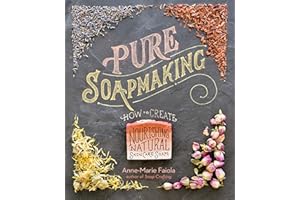
Pure Soapmaking: How to Create Nourishing, Natural Skin Care Soaps
- Price$8.86
- Reviews2,875
- BSR#23,329
- Est. revenue/mo$930
- List rank#1
- Published2016-01
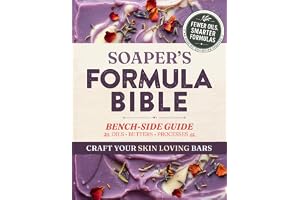
Soaper’s Formula Bible: Bench-Side Guide to Oils, Butters & Process Choices | Formulate Your Own Balanced, Skin-Loving Soaps or Adapt Recipes to What You Have for Ideal Lather, Longevity & Skin Needs
by Laura Mercer
- Price$22.97
- Reviews74
- BSR#80,318
- Est. revenue/mo$620
- List rank#7
- Published2026-09
Indie publishers already control most of Soap Making
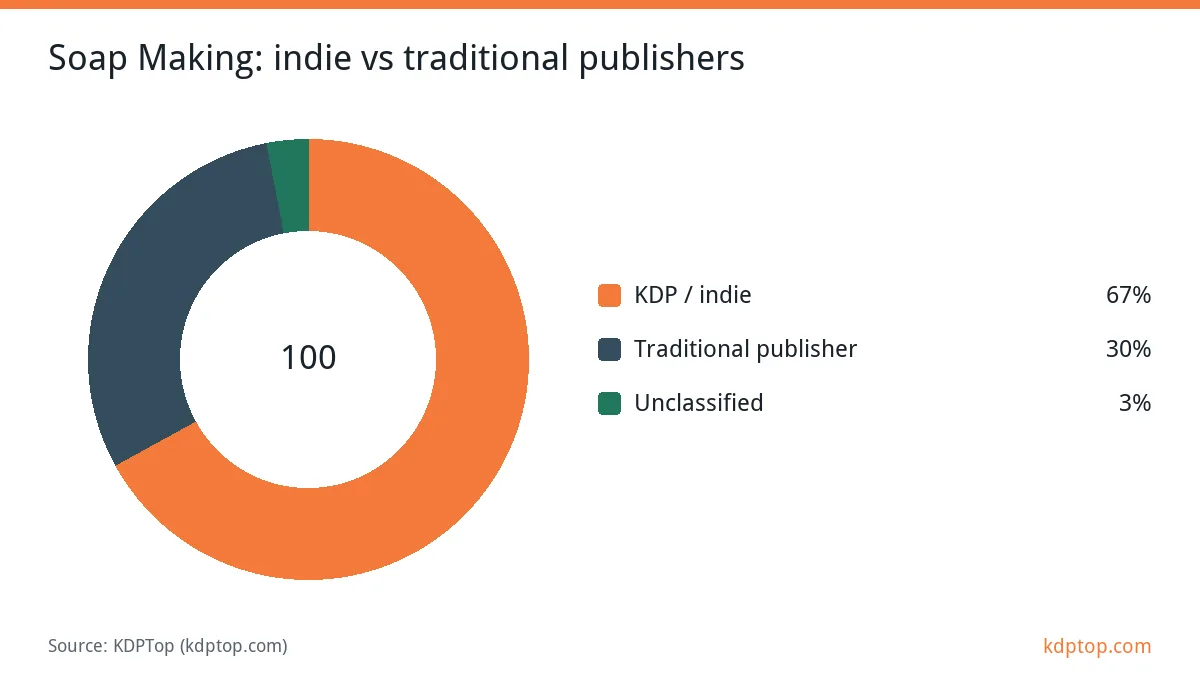
Show the data
| Publisher type | Books |
|---|---|
| KDP / indie | 67 |
| Traditional publisher | 30 |
| Unclassified | 3 |
Independently published books account for 67% of the Top 100. Traditional publishers account for 30%, with 3% unclassified. This is a category where KDP publishers already have a substantial share of bestseller visibility.
That figure matters because a publisher entering Soap Making is competing against other independent authors as well as established publishing houses. The presence of indie books across the list suggests that independent publishing is an established route into the category. It does not mean that every new title has an easy path to sales.
Yoder Homestead Press provides one example. The Complete Amish Survival Guide: Self-Sufficient Living with a Practical Cookbook, No-Electricity Baking, Home Apothecary, Traditional Homestead ... (The Amish Self-Sufficient Living) ranks second. It costs $19.99 and has 179 reviews, with estimated monthly revenue of $1,079. Its broad homesteading subject reaches beyond soapmaking, but its presence shows that adjacent self-sufficiency topics can also compete in this category.
Soap Making Business Startup: How to Start, Run & Grow a Million Dollar Success From Home! by Suzanne Carpenter is another listed KDP title. It has 1,925 reviews, a 4.5-star rating and estimated monthly revenue of $444 at a price of $13.87. Its business angle gives it a different buyer proposition from recipe and formulation books.
The publishing decision here is to identify a specific reader. Someone learning to make soap for personal use has different needs from someone developing products to sell. A book that addresses one of those audiences clearly has a more defensible position than another broad introduction to soapmaking.
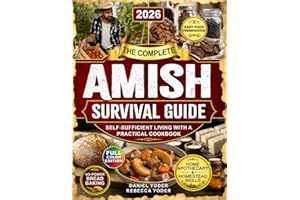
The Complete Amish Survival Guide: Self-Sufficient Living with a Practical Cookbook, No-Electricity Baking, Home Apothecary, Traditional Homestead ... (The Amish Self-Sufficient Living)
by Yoder Homestead Press
- Price$19.99
- Reviews179
- BSR#7,327
- Est. revenue/mo$1,079
- List rank#2
- Published2026-03
Soap Making Business Startup: How to Start, Run & Grow a Million Dollar Success From Home!
by Suzanne Carpenter
- Price$13.87
- Reviews1,925
- BSR#72,321
- Est. revenue/mo$444
- List rank#10
Who earns the most from Soap Making books?
Show the data
| Book | Est. monthly revenue |
|---|---|
| Minimalist Soapmaking | $1,403 |
| The Natural Soapmaking Handbook | $1,352 |
| The Complete Amish Survival Guide | $1,079 |
| Pure Soapmaking | $930 |
| Beeswax Alchemy | $648 |
| Soaper’s Formula Bible | $620 |
| Simple & Natural Soapmaking | $468 |
| Soap Making Business Startup | $444 |
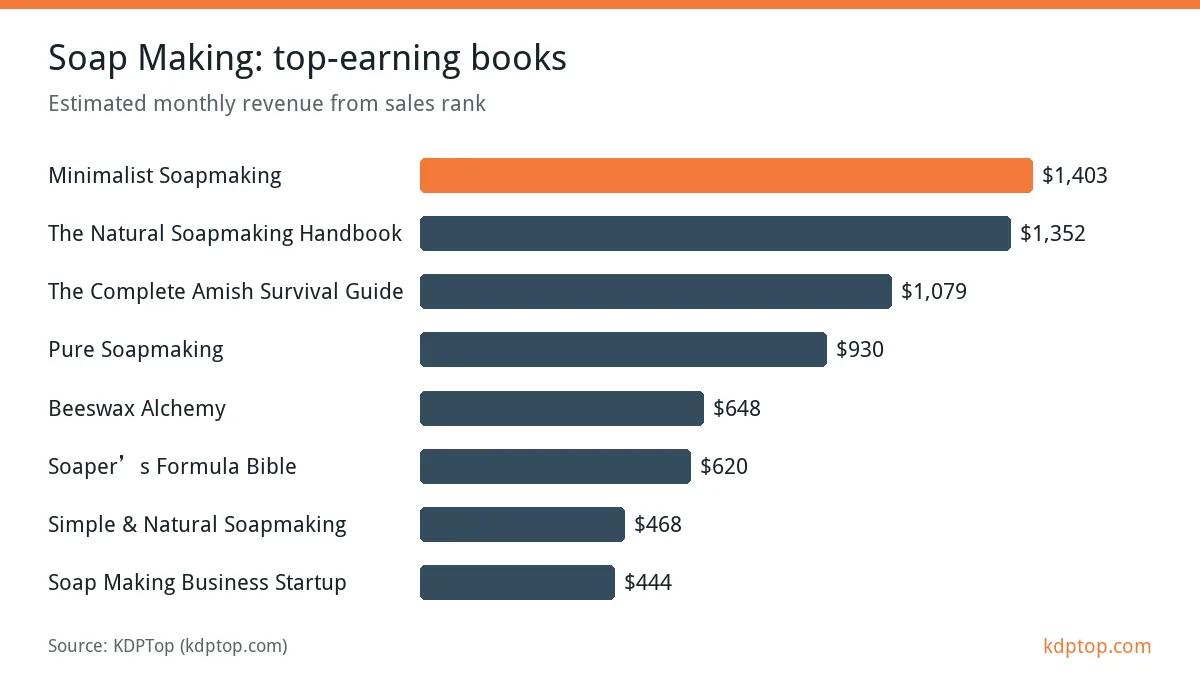
The eight displayed revenue leaders have estimated monthly revenue ranging from $444 to $1,403. Minimalist Soapmaking by Simi Khabra leads this group at $1,403, followed closely by The Natural Soapmaking Handbook at $1,352. Both titles have relatively high prices and strong ratings, at 4.9 stars each.
The revenue estimates put these books ahead of several older titles. Minimalist Soapmaking has 77 reviews and an estimated 54 monthly units. The Natural Soapmaking Handbook has 562 reviews and an estimated 66 monthly units. Their estimated revenues are close despite the difference in review counts and unit estimates. Price makes a substantial difference to the revenue comparison.
Pure Soapmaking generates an estimated $930 monthly from 105 units, despite its lower $8.86 price. Its estimated unit volume is higher than that of the other listed titles, but its revenue is lower. That is a useful distinction for publishers deciding between a lower-priced book aimed at broader demand and a higher-priced specialist reference.
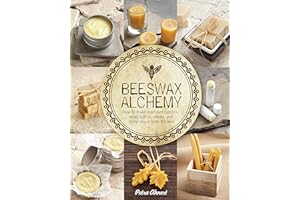
Beeswax Alchemy: How to Make Your Own Soap, Candles, Balms, Creams, and Salves from the Hive by Petra Ahnert costs $26.99 and generates an estimated $648 monthly from 24 units. Simple & Natural Soapmaking by Jan Berry costs $14.17 and generates an estimated $468 from 33 units. The figures show how a specialist book can earn more per estimated sale while moving fewer copies.
The entire Top 100 has estimated monthly revenue of $17,272. The top 10 account for 45% of that amount. Revenue is therefore concentrated among a relatively small group of books. A new publisher should assess the likely economics of a title against the broader list rather than assume that entering the bestseller rankings will produce revenue comparable to the leaders.
All unit and revenue figures are modelled from Amazon Best Sellers Rank. Amazon does not report these individual sales figures publicly. They are estimates, so they are useful for comparing titles and spotting patterns, not for treating a monthly income projection as guaranteed.
Turnover creates openings, but new releases remain a minority
Show the data
| Publisher type | Books |
|---|---|
| KDP / indie | 72 |
| Traditional publisher | 5 |
| Unclassified | 4 |
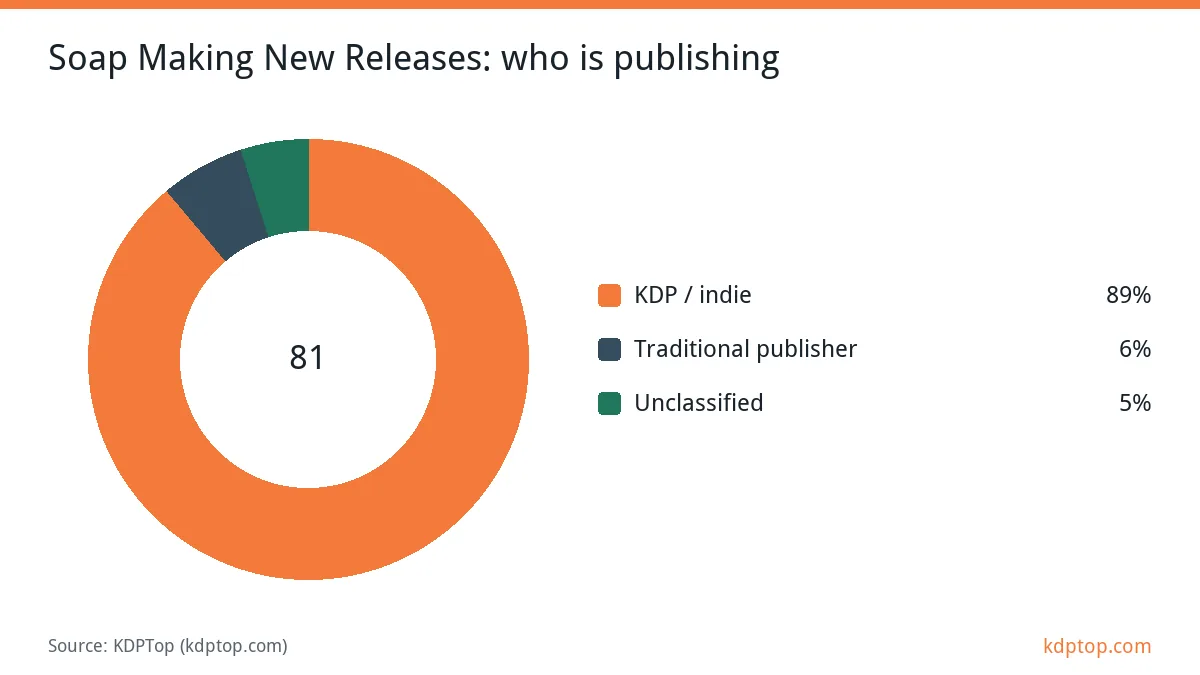
Thirty-five books entered the Top 100 since the previous list, giving Soap Making a turnover rate of 35%. That is enough movement to show that bestseller positions change. Publishers are not looking at a completely fixed list of long-established titles.
New releases account for 14% of the current Top 100. In other words, most of the books currently holding bestseller positions are not recent releases. A new book can enter the list, but the category still has a substantial base of established titles. This makes it sensible to study the books that have maintained their positions rather than build a publishing plan around new-release visibility alone.
The new-release publisher breakdown reports 72 for KDP/indie, 5 for traditional publishers and 4 unclassified. These displayed figures do not add up to 100, and their units are unspecified. They should not be read as percentages or used to calculate the share of new releases independently. The overall 14% new-release share is the clearer measure of how much of the bestseller list consists of recent books.
The opportunity score is 32 out of 100. KDPTop uses this score to estimate how much room a category leaves new independent books, with higher scores indicating more room. A score of 32 suggests that publishers should approach this category selectively. The 67% indie share and 35% turnover are encouraging, but the opportunity score warns against treating those figures as evidence of easy entry.
One promising direction is to narrow the subject. The existing leaders cover minimalist recipes, botanical ingredients, general soapmaking techniques and formulation choices. A new book could address a specific production problem, a particular ingredient group or the business needs of small-scale soapmakers. The book needs enough depth to give buyers a reason to choose it over the established references.
What should a KDP publisher make next?
The strongest evidence points toward practical instructional books. The leading titles explain how to make soap, choose ingredients or formulate a product. The category's revenue leaders are predominantly how-to books, and their subjects give readers a specific result to work toward.
A general beginner's soapmaking guide would enter a crowded part of the market. Pure Soapmaking and Simple & Natural Soapmaking already cover broad instructional territory. The Natural Soapmaking Handbook has an established position around botanicals, herbs and essential oils. Repeating those subjects without a meaningful difference would give buyers little reason to switch.
A more focused formulation book is worth examining. Soaper’s Formula Bible covers oils, butters and process choices, with an emphasis on creating balanced soaps or adapting recipes to available ingredients. Its 74 reviews and estimated $620 monthly revenue show that a specialist reference can attract buyers. A new publisher could investigate related needs that are not adequately addressed by the current leaders, such as ingredient substitutions or a particular production method.
The business angle also has evidence behind it. Soap Making Business Startup has a substantial review history, while the category includes books that connect soapmaking with wider homesteading and self-sufficient living interests. A practical guide for someone selling handmade soap could target pricing, production planning, product development and small-business operations. Those subjects need useful, specific instruction rather than generic motivational material.
Coloring books and low-content journals are less directly supported by this data. The supplied bestseller examples are instructional books, and the category figures do not establish demand for soap-themed activity books, logbooks or planners. A publisher considering those formats should research their individual subcategories before assuming that the main Soap Making bestseller list predicts their performance.
My reading of this category is that a focused instructional paperback is the most defensible next project. The $14.72 median price gives a useful pricing reference, and the 27-review median suggests that a new book does not need an enormous review history to become competitive. The 32-point opportunity score calls for a narrow subject, a clear buyer and enough original practical information to justify another book on the shelf.
Simple & Natural Soapmaking: Create 100% Pure and Beautiful Soaps with The Nerdy Farm Wife’s Easy Recipes and Techniques
by Jan Berry
- Price$14.17
- Reviews1,771
- BSR#58,312
- Est. revenue/mo$468
- List rank#9
Key takeaways
- Use the $11.99 to $19.99 middle price range as the initial pricing reference for a conventional Soap Making instructional paperback.
- Treat 27 reviews as the category's median review count; 54 of the 100 bestsellers have fewer than 50 reviews.
- Develop a specialist instructional subject rather than another general beginner's soapmaking guide.
- Study formulation and business-focused books such as Soaper’s Formula Bible and Soap Making Business Startup for narrower reader needs.
- Treat the 35% turnover as evidence of list movement, while remembering that only 14% of the current Top 100 consists of new releases.
Books in this analysis
Beeswax Alchemy: How to Make Your Own Soap, Candles, Balms, Creams, and Salves from the Hive
by Petra Ahnert
- Price$26.99
- Reviews1,458
- BSR#77,122
- Est. revenue/mo$648
- List rank#6
- Published2015-04
Common questions
Is Soap Making a good KDP niche in 2026?
Soap Making has a 67% indie share and 35% bestseller turnover, showing that independent publishers have a substantial presence. However, its opportunity score is 32 out of 100, so a new book needs a specific subject and a clear competitive difference.
How much should a Soap Making book cost on Amazon?
The median price is $14.72, and half of the Top 100 falls between $11.99 and $19.99. Specialist books can command higher prices: Minimalist Soapmaking costs $25.99 and has estimated monthly revenue of $1,403.
How many reviews do Soap Making books need to rank?
The median bestseller has 27 reviews, and 54 books in the Top 100 have fewer than 50. Soaper’s Formula Bible has 74 reviews and ranks among the listed bestselling titles, showing that a large review history is not universal.
What type of Soap Making book sells best?
The leading revenue examples are practical how-to books covering minimalist soapmaking, natural ingredients and formulation. Minimalist Soapmaking and The Natural Soapmaking Handbook generate estimated monthly revenues of $1,403 and $1,352 respectively, although these estimates are modelled from BSR rather than reported Amazon sales.
How we got these numbers
Data comes from KDPTop's continuous crawl of Amazon Best Sellers, New Releases, Movers & Shakers and book pages, plus each book's sales-rank history. Monthly units and revenue are estimated from sales rank (BSR); a single book can be off by ±30%, so use them to compare books, not as exact income. About our data
Explore KDPTop
- Studio: make the bookTurn the niche into a coloring or puzzle book ready for KDP, cover included
- Free category finderDescribe your book and get the KDP categories to pick
- Chrome extensionSee estimated sales and BSR right on Amazon
- User guideHow to read decision cards, scores and sales estimates
- PricingWhat the free plan covers and what paid plans add
Related analysis
-
Growing Up & Facts of Life: 341 New Best Sellers in 7 Days
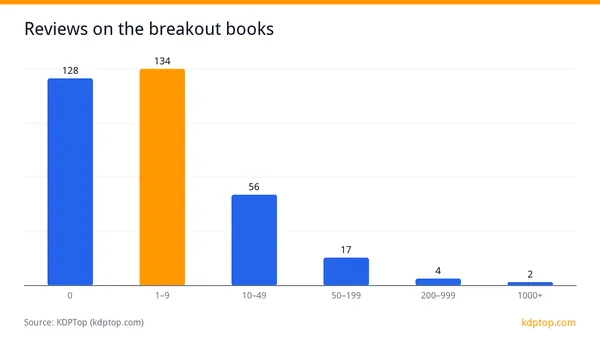
In 7 days, 341 new books hit Best Sellers in Growing Up & Facts of Life. Median price $4.61, median reviews 1, and 60% were indie. See what won.
-
Children's eBooks: 2,157 New Bestsellers in 7 Days
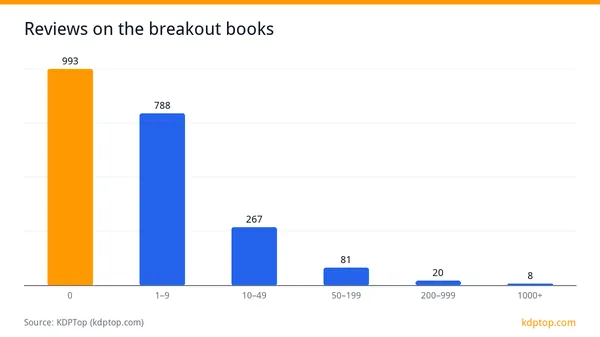
In the last 7 days, 2,157 children's eBooks hit a Best Sellers list. Most had 1 review or fewer and cost under $5. Here's what that means for your next book.
-
765 Crafts Breakouts: 614 Were KDP
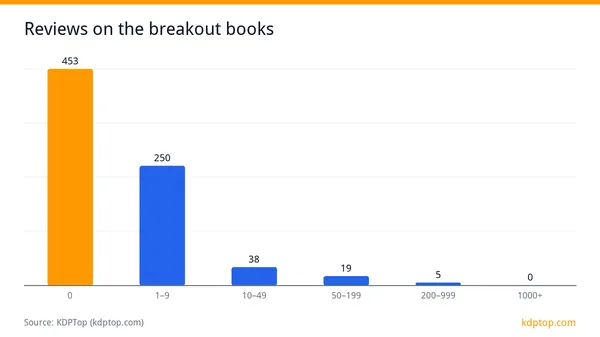
In 7 days, 765 Crafts & Hobbies books broke into Best Sellers. 614 were indie, the median price was $7.98, and 453 had zero reviews.