

Waterloo Keyword Research: Demand, Competition and KDP Angles
Waterloo gets 91,289 monthly Amazon searches and 12,488 purchases. Explore its 458 competing products, review levels, prices and nonfiction publishing opportunities.
Waterloo attracts 91,289 Amazon searches and 12,488 estimated monthly purchases, with a purchase rate of 13.7%. The keyword has 458 competing products, a supply-demand ratio of 199.3 and no independently published books among the six analyzed. That last figure deserves attention: every sampled book comes from a traditional publisher, leaving an identifiable gap for KDP publishers considering historical nonfiction.
The existing results focus on the Battle of Waterloo, the Napoleonic Wars and Belgium. Books such as Letters from the Battle of Waterloo by Gareth Glover and Marshal Ney At Quatre Bras by Paul L. Dawson show the subject matter Amazon associates with this search. A new publisher could compete with a focused historical account, provided the manuscript offers useful research and a clear angle. The keyword has demand, but the small sample cannot establish how much of that demand a new KDP title could capture.
Waterloo has 12,488 estimated monthly purchases
The keyword generates 91,289 monthly searches and 12,488 estimated purchases. Its 13.7% purchase rate suggests that a meaningful portion of shoppers searching for Waterloo proceed to buy a book. For a publisher, that is a reasonable starting point for investigating the subject. The search term has commercial activity rather than being purely informational.
There are 458 competing products, while 258 charting books contain the phrase in their titles. These figures describe two different aspects of competition. The first indicates the size of the competing product pool; the second shows how frequently the keyword appears in titles among charting books. A title containing Waterloo therefore needs a reason to attract attention beyond simply matching the search.
The supply-demand ratio is 199.3. KDPTop reports this as part of its keyword research, and it should be considered alongside purchase activity and the competing titles. The figures support further investigation, but they do not guarantee that a new book will rank or sell. Estimated purchases are modelled from sales rank rather than reported directly by Amazon.
My publishing decision would be to keep Waterloo on the research shortlist. The purchase activity is substantial enough to justify examining the narrower historical subjects behind the keyword before committing to a manuscript.
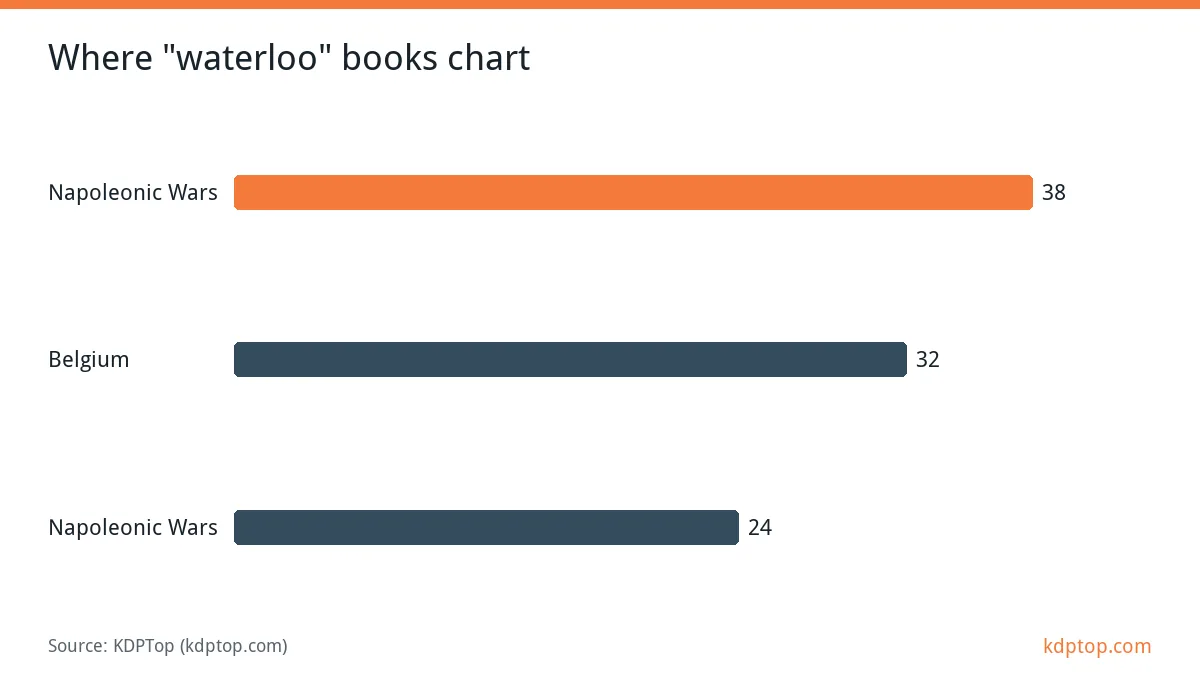
Napoleonic Wars and Belgium are the main category connections
Show the data
| Category | Books |
|---|---|
| Napoleonic Wars | 38 |
| Belgium | 32 |
| Napoleonic Wars | 24 |
The matching books appear in Napoleonic Wars and Belgium. The category chart reports 24 for Napoleonic Wars and 32 for Belgium. These are the category values supplied by the research data, rather than verified category-wide sales figures.
This matters when choosing a book concept. Waterloo is a broad historical search term, but the books Amazon associates with it have a fairly specific subject. A manuscript about the campaign, its military figures or its consequences has a clearer connection to the existing results than a general European history book.
Letters from the Battle of Waterloo: Unpublished Correspondence by Allied Officers from the Siborne Papers, by Gareth Glover, is a useful example. Its focus on correspondence gives readers access to a particular kind of historical material. Marshal Ney At Quatre Bras: New Perspectives on the Opening Battle of the Waterloo Campaign, by Paul L. Dawson, takes a similarly focused approach through an individual commander and an earlier engagement in the campaign.
A new KDP title could explore a narrower subject while retaining Waterloo in its title and metadata where appropriate. The campaign's lesser-known participants, documentary sources and individual battles offer possible editorial directions. Category relevance should guide the concept before the publisher settles on a title.

Letters from the Battle of Waterloo: Unpublished Correspondence by Allied Officers from the Siborne Papers
by Gareth Glover
- Price$11.99
- Reviews28
- BSR#1,124,407
- Est. revenue/mo$132
- Published2018-10

Marshal Ney At Quatre Bras: New Perspectives on the Opening Battle of the Waterloo Campaign
by Paul L. Dawson
- Price$3.99
- Reviews21
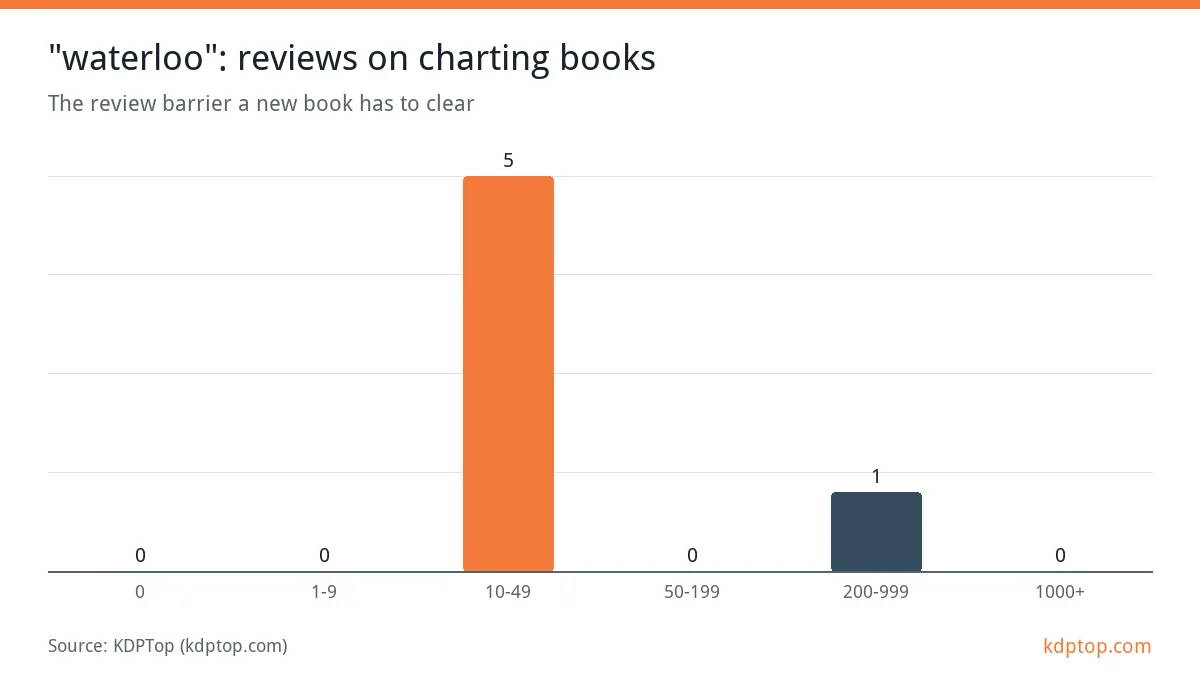
The six-book sample has no indie competition
Show the data
| Reviews | Books |
|---|---|
| 0 | 0 |
| 1-9 | 0 |
| 10-49 | 5 |
| 50-199 | 0 |
| 200-999 | 1 |
| 1000+ | 0 |
All six analyzed books are traditionally published. The measured indie share is 0%, which means the current sample contains no independently published KDP titles. This is the most interesting competitive detail for a self-publisher considering Waterloo.
The review distribution is relatively accessible on the surface. Five books fall into the 10-49 review range, and one falls into the 200-999 range. The median is 24.5 reviews. A publisher looking at these numbers might reasonably conclude that the visible review barrier is manageable compared with categories dominated by established titles carrying thousands of reviews.
For example, Letters from the Battle of Waterloo has 28 reviews and a 4.7 rating. Guthrie's War: A Surgeon of the Peninsula & Waterloo, by Michael Crumplin, has 20 reviews and a 4.3 rating. Marshal Ney At Quatre Bras has 21 reviews and a 3.8 rating. These books illustrate the review levels found among several matching titles.
Waterloo: The Aftermath by Paul O'Keeffe is the exception, with 338 reviews and a 4.4 rating. Its larger review count indicates that at least one title has built a more substantial reader response. The absence of indie books in this sample is encouraging, but it does not establish that traditional publishers are absent from the wider search results or that KDP books would automatically gain visibility.
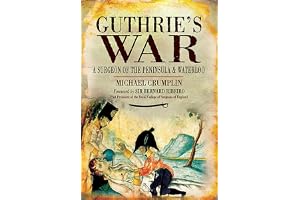
Guthrie's War: A Surgeon of the Peninsula & Waterloo
by Michael Crumplin
- Price$8.99
- Reviews20
- BSR#104,445
- Est. revenue/mo$54
- Published2010-08
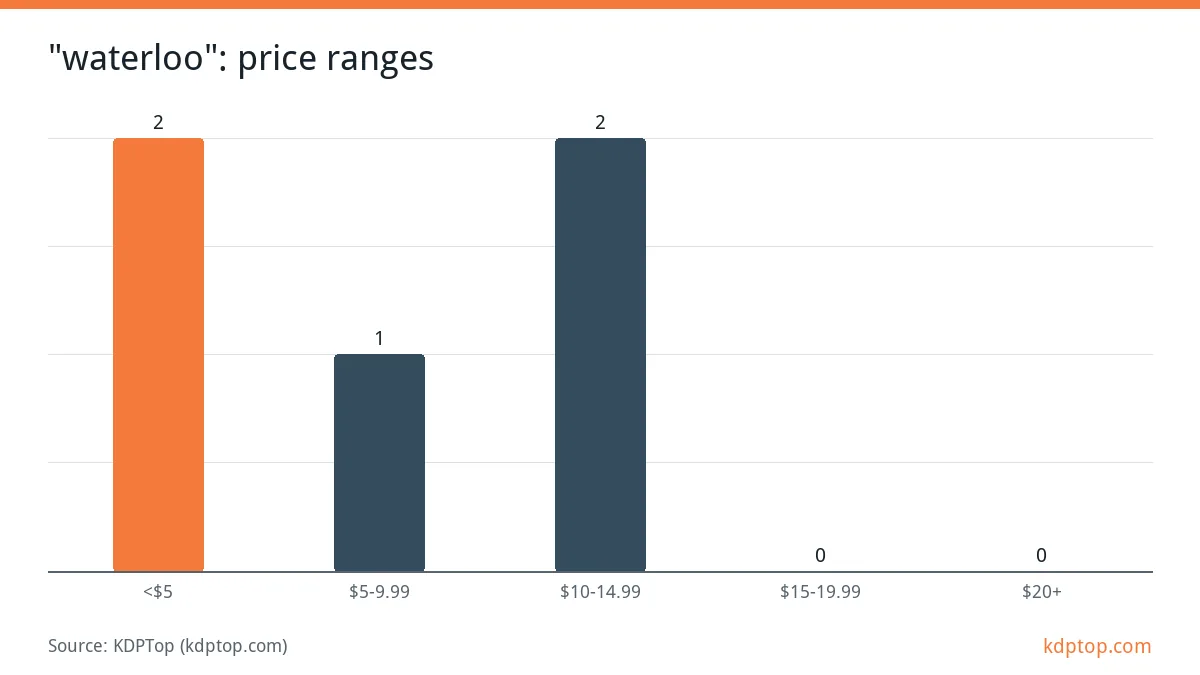
Waterloo book prices cluster below $15
Show the data
| Price range | Books |
|---|---|
| <$5 | 2 |
| $5-9.99 | 1 |
| $10-14.99 | 2 |
| $15-19.99 | 0 |
| $20+ | 0 |
The median price is $8.99. The price chart places two books below $5, one in the $5-9.99 range and two in the $10-14.99 range. No books appear in either of the higher price brackets shown in the chart.
The individual listings give a useful view of the range. Marshal Ney At Quatre Bras costs $3.99, Georgiana Darcy's Diary / Pemberley to Waterloo Bundle (Pride and Prejudice Chronicles) by Anna Elliott costs $4.99, and Guthrie's War costs $8.99. Letters from the Battle of Waterloo costs $11.99, while The Battle of Waterloo: Europe in the Balance by Rupert Matthews costs $12.83. Waterloo: The Aftermath is listed at $0.00.
For a new nonfiction publisher, the $8.99 median provides a sensible reference point for evaluating a potential paperback price. A more specialized historical work might justify a higher price if it includes substantial original research, useful illustrations or carefully sourced documentary material. The sample does not establish that readers will pay more for a new title, however.
I would avoid competing on price alone. Historical nonfiction needs enough substance to persuade readers that the book is worth purchasing. A short, carefully researched account with a clearly defined subject may have a stronger proposition than an inexpensive book that repeats familiar campaign history.

Georgiana Darcy's Diary / Pemberley to Waterloo Bundle (Pride and Prejudice Chronicles)
by Anna Elliott
- Price$4.99
- Reviews33
- Published2013-04
Existing Waterloo titles reveal useful editorial angles
The strongest publishing clue comes from the range of historical approaches already represented. Gareth Glover's Letters from the Battle of Waterloo uses unpublished correspondence by Allied officers from the Siborne Papers. Michael Crumplin's Guthrie's War: A Surgeon of the Peninsula & Waterloo approaches the period through a medical perspective. Paul L. Dawson's Marshal Ney At Quatre Bras examines a specific commander and engagement.
These titles suggest that readers searching Waterloo may be interested in more than a general account of the battle. A KDP publisher could investigate military medicine, Allied correspondence, the campaign's opening engagements or the experiences of individual officers. Each concept gives the book a more precise subject while preserving its connection to the main keyword.
Waterloo: The Aftermath by Paul O'Keeffe provides another direction. Its title focuses on what followed the battle. A book examining the political, military or social consequences of the campaign could appeal to readers whose interest extends beyond the fighting itself. The Battle of Waterloo: Europe in the Balance by Rupert Matthews offers a broader historical framing that a new publisher would need to differentiate carefully.
One possible approach is a focused nonfiction paperback supported by primary sources, maps and a clear chronology. Another is a biography or account of a less familiar participant in the campaign. These ideas require proper historical research. Simply adding Waterloo to a generic military history title is unlikely to provide a compelling reason for readers to choose it.
What a KDP publisher should do before writing
Waterloo looks more promising as a focused nonfiction project than as a generic low-content publishing target. The matching books are historical nonfiction, and the category connections point toward Napoleonic Wars and Belgium. A coloring book, blank journal or generic notebook would have a weaker connection to the products represented in this sample.
Start by researching narrower search phrases related to the campaign, including Waterloo battle history, Battle of Waterloo officers, Napoleonic Wars and Waterloo aftermath. Check the actual Amazon results for each phrase. The purpose is to find a subject with a recognizable reader audience and fewer directly relevant competing titles than the broad keyword.
Next, examine the existing books in detail. Pay attention to their contents, publication formats, illustrations, source notes and reader complaints. The review counts provide a starting point, but they do not reveal which subjects readers want covered or what is missing from current editions. Those questions require examining the books and their reviews directly.
The six-book sample is small, and all six publishers are traditional. It cannot establish the performance of the entire Waterloo search market. Estimated units and revenue are modelled from BSR, which is Amazon Best Sellers Rank, where a lower rank is better. The figures are not sales reports from Amazon. Treat them as directional evidence when deciding what to research next.
My verdict is to investigate Waterloo further, particularly for a well-sourced historical nonfiction book with a narrow editorial focus. The combination of 12,488 estimated monthly purchases, a 24.5 median review count and a 0% indie share makes the keyword worth testing. The next decision should depend on finding a specific subject that existing titles do not cover well.
Key takeaways
- Waterloo has 91,289 monthly searches and 12,488 estimated purchases, making it worth investigating as a nonfiction keyword.
- All six analyzed books are traditionally published, giving the sample an indie share of 0%.
- Napoleonic Wars and Belgium are the main category connections to examine when selecting a book concept.
- The $8.99 median price provides a useful starting reference for pricing a focused historical paperback.
- Research a narrower Waterloo subject, such as military medicine or Allied correspondence, before committing to a manuscript.
Books in this analysis

Waterloo: The Aftermath
by Paul O'Keeffe
- Price$0
- Reviews338
- BSR#976,314
- Published2017-01

The Battle of Waterloo: Europe in the Balance
by Rupert Matthews
- Price$12.83
- Reviews15
Common questions
Is Waterloo a good Amazon KDP keyword?
Waterloo has 91,289 monthly searches and 12,488 estimated purchases, with a 13.7% purchase rate. The six analyzed books have a 0% indie share, which makes the keyword worth researching for a focused historical nonfiction title. The small sample does not guarantee that a new KDP book will sell.
How competitive is the Waterloo book keyword?
The research identifies 458 competing products and 258 charting books with Waterloo in their titles. The median review count is 24.5, with five of the six analyzed books in the 10-49 review range. This suggests a relatively modest review barrier within the sample.
What type of book should I publish for Waterloo?
The existing results are primarily historical nonfiction connected to the Napoleonic Wars and Belgium. Potential subjects include Allied officers' correspondence, military medicine, individual commanders and the aftermath of the battle. A focused, well-sourced historical account has a clearer connection to these results than a generic journal or notebook.
What is the best price for a Waterloo nonfiction book?
The analyzed books have a median price of $8.99, with the chart showing most priced listings below $15. An $8.99 paperback is a reasonable starting reference, although a more substantial historical work may support a different price depending on its length, research and production costs.
How we got these numbers
Data comes from KDPTop's continuous crawl of Amazon Best Sellers, New Releases, Movers & Shakers and book pages, plus each book's sales-rank history. Monthly units and revenue are estimated from sales rank (BSR); a single book can be off by ±30%, so use them to compare books, not as exact income. About our data
Explore KDPTop
- Studio: make the bookTurn the niche into a coloring or puzzle book ready for KDP, cover included
- Free category finderDescribe your book and get the KDP categories to pick
- Chrome extensionSee estimated sales and BSR right on Amazon
- User guideHow to read decision cards, scores and sales estimates
- PricingWhat the free plan covers and what paid plans add
Related analysis
-
Daggermouth Keyword Research: Demand, Competition and KDP
Daggermouth gets 80,379 monthly searches but only 659 estimated purchases. See its review barrier, $23.34 median price and indie competition.
-
Prequel Keyword Research: 142,737 Searches, Little KDP Competition
The keyword prequel gets 142,737 monthly searches but only 685 estimated purchases. Six analyzed books show high review barriers and no indie representation.
-
Warrior Cats Keyword Research: Demand, Competition and KDP
Warrior Cats gets 87,871 monthly searches but has zero indie representation among the analyzed books. See the competition, prices and publishing angles.