

Yannis Keller: Inside an 82-Book KDP Trading Catalog
Yannis Keller has 82 KDP books, with 73 appearing on Best Sellers lists in 30 days. See his trading topics, prices, estimated earnings and release pace.
Yannis Keller has 82 tracked books, and 73 appeared on Amazon Best Sellers lists during the last 30 days. KDPTop estimates his catalog generates $3,197 in monthly revenue from approximately 340 units. Every tracked book is independently published, and his catalog focuses heavily on trading education, particularly futures, candlestick patterns and liquidity strategies.
The publishing pace is just as interesting. Keller released 53 books in the last 30 days, including 44 breakouts. His catalog combines narrowly focused trading guides with reference books and study material. Prices range from inexpensive titles below $5 to specialist books above $20. For publishers studying this catalog, the useful question is how Keller connects a specific subject to a repeatable series of books, rather than how many titles he can release.
73 of 82 books appeared on Best Sellers lists
Keller's catalog has 82 tracked titles. Of those, 73 appeared on Amazon Best Sellers lists during the last 30 days. His best recorded position was number 8. That gives the catalog a substantial presence across its tracked categories, although an appearance on a category list does not establish how many copies a book sells.
KDPTop estimates monthly catalog sales at 340 units and monthly revenue at $3,197. The median listed price is $6.99, while the middle half of priced books falls between $4.92 and $17.99. These figures suggest a catalog with different price points rather than one uniform pricing strategy.
All 82 tracked books are independently published through KDP. There is no traditional publisher represented in the supplied catalog data. For another independent publisher, the relevant observation is that Keller has built a sizable specialist catalog under one author name and maintains visibility across several related categories.
There is a limitation worth keeping in mind. Estimated units and revenue are modelled from Amazon Best Sellers Rank, not reported sales from Amazon. Category placement, rank movement and estimated revenue provide useful signals, but they do not reveal exact orders, advertising costs, refunds or profit.
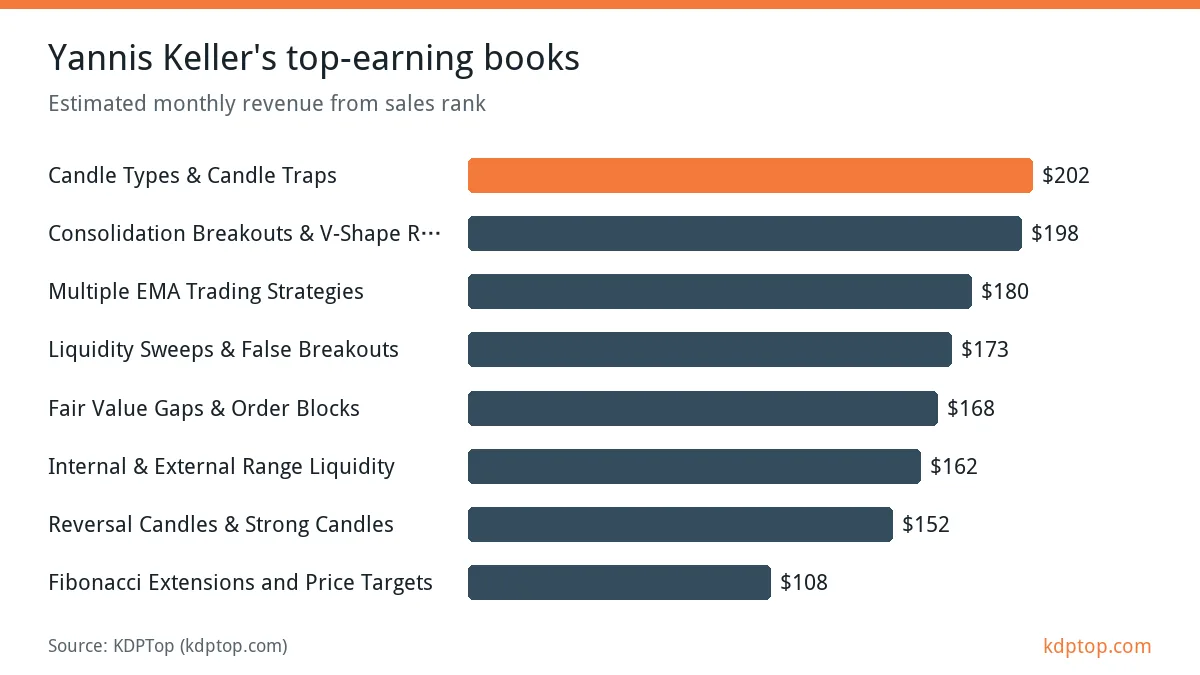
Eight leading titles cover specific trading problems
Show the data
| Book | Est. monthly revenue |
|---|---|
| Candle Types & Candle Traps | $202 |
| Consolidation Breakouts & V-Shape Rec… | $198 |
| Multiple EMA Trading Strategies | $180 |
| Liquidity Sweeps & False Breakouts | $173 |
| Fair Value Gaps & Order Blocks | $168 |
| Internal & External Range Liquidity | $162 |
| Reversal Candles & Strong Candles | $152 |
| Fibonacci Extensions and Price Targets | $108 |
Candle Types & Candle Traps: The Candlestick Atlas of Strength, Position, the Levels Drawn on Each Candle and the Lower Timeframe Path That Built It ... & Liquidity Trading: Price Action Setups is Keller's highest-revenue tracked title. KDPTop estimates $202 in monthly revenue, with nine monthly units and a Best Sellers Rank of 310,579. Its listed price is $22.44.
Consolidation Breakouts & V-Shape Recoveries: Ping-Pong Ranges, Consolidation Poppers, What Happens Before and After Big Moves, and Which V-Shapes ... & Liquidity Trading: Price Action Setups follows at an estimated $198 per month. Multiple EMA Trading Strategies: Exponential Moving Averages 9, 13, 21, 34, 50, 100 and 200 Measured — How Price Holds, Breaks and Retests the Average ... Manual: Settings, Signals and Evidence brings in an estimated $180 at a listed price of $29.99.
Liquidity Sweeps & False Breakouts: Stop Hunts, Sweep-and-Reverse and Sweep-and-Continue Structures, and How to Tell a Fake Breakout from a Real One ... & Liquidity Trading: Price Action Setups generates an estimated $173 monthly. Fair Value Gaps & Order Blocks: Mitigation Blocks, Breaker Blocks, Fill Rate and How to Grade Strong, Moderate, Weak and Fake Zones follows at $168. Internal & External Range Liquidity: Equal Highs, Equal Lows and How to Predict the Next Draw on Liquidity from IRL to ERL and ERL to IRL generates $162.
The remaining two books in the leading group are Reversal Candles & Strong Candles: Candlestick Reversal Patterns, Momentum Candles and the Lower Timeframe Structure Inside Every Higher Timeframe ... & Liquidity Trading: Price Action Setups, at an estimated $152, and Fibonacci Extensions and Price Targets: Where Runs Actually Stop: Measured-Move Depths from One to Five, Tested Against Chance, at $108. The common thread is subject specificity. Each title addresses a recognizable trading concept, giving a potential reader a fairly clear idea of the subject before opening the product page.
For publishers, this is a useful approach to study. A broad book about technical analysis has to compete across a wide range of reader needs. A book about exponential moving averages or liquidity sweeps addresses a narrower question. Keller's revenue estimates show that these specialized subjects can support individual titles, although the data cannot establish whether readers buy multiple books in the series.

Candle Types & Candle Traps: The Candlestick Atlas of Strength, Position, the Levels Drawn on Each Candle and the Lower Timeframe Path That Built It ... & Liquidity Trading: Price Action Setups)
- Price$22.44
- Reviews-
- BSR#310,579
- Est. revenue/mo$202

Consolidation Breakouts & V-Shape Recoveries: Ping-Pong Ranges, Consolidation Poppers, What Happens Before and After Big Moves, and Which V-Shapes ... & Liquidity Trading: Price Action Setups)
- Price$21.99
- Reviews-
- BSR#310,574
- Est. revenue/mo$198
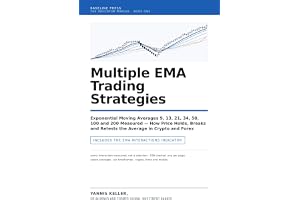
Multiple EMA Trading Strategies: Exponential Moving Averages 9, 13, 21, 34, 50, 100 and 200 Measured — How Price Holds, Breaks and Retests the Average ... Manual: Settings, Signals and Evidence)
- Price$29.99
- Reviews-
- BSR#488,319
- Est. revenue/mo$180
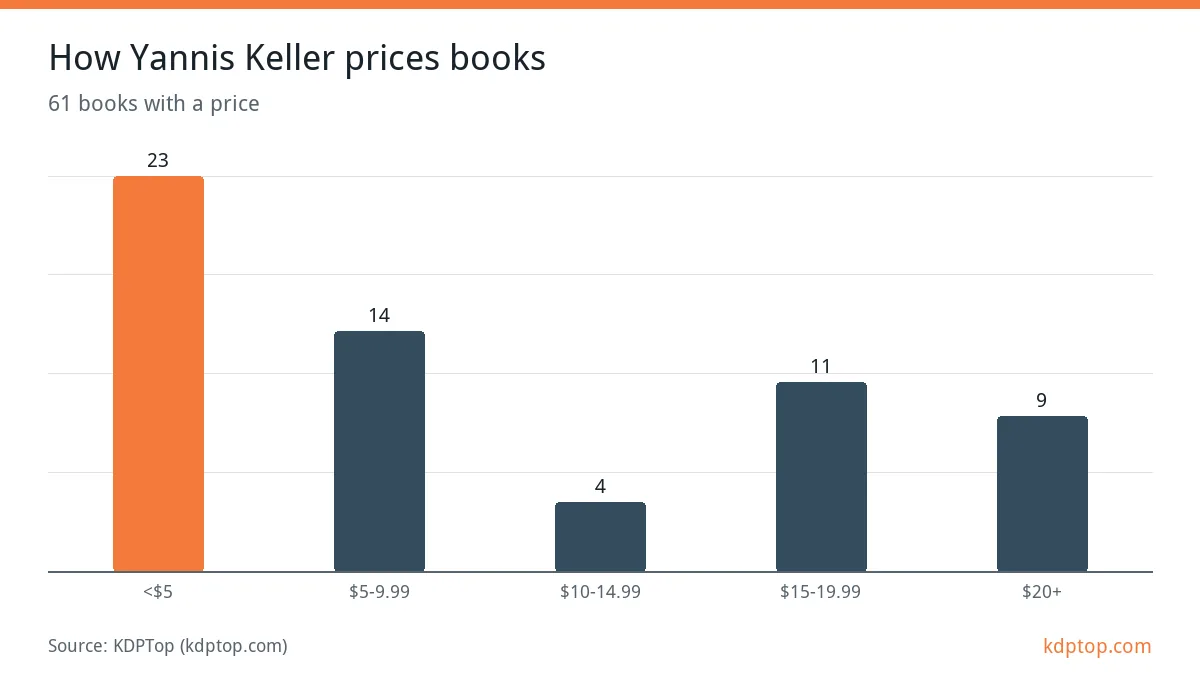
The catalog uses both budget and specialist pricing
Show the data
| Price range | Books |
|---|---|
| <$5 | 23 |
| $5-9.99 | 14 |
| $10-14.99 | 4 |
| $15-19.99 | 11 |
| $20+ | 9 |
Of the 61 books with a recorded price, 23 are listed below $5. Another 14 fall between $5 and $9.99. Four cost between $10 and $14.99, while 11 are priced between $15 and $19.99. The remaining nine cost $20 or more.
The distribution has a clear split. A substantial portion of the priced catalog sits below $10, but 20 books cost at least $15. Keller is willing to price some specialist material considerably higher than the catalog median of $6.99.
The leading books illustrate that approach. Candle Types & Candle Traps costs $22.44, Consolidation Breakouts & V-Shape Recoveries costs $21.99, and Multiple EMA Trading Strategies costs $29.99. Their estimated monthly revenues are $202, $198 and $180 respectively. The lower-priced Fibonacci Extensions and Price Targets costs $8.99 and generates an estimated $108 monthly.
These comparisons do not establish that higher prices cause higher revenue. The books cover different subjects, have different ranks and may attract different readers. Still, the catalog offers a practical pricing lesson: a specialized reference guide can be positioned at a higher price when its subject and presentation justify a more substantial product. Publishers should test that positioning against competing books rather than automatically copying Keller's prices.
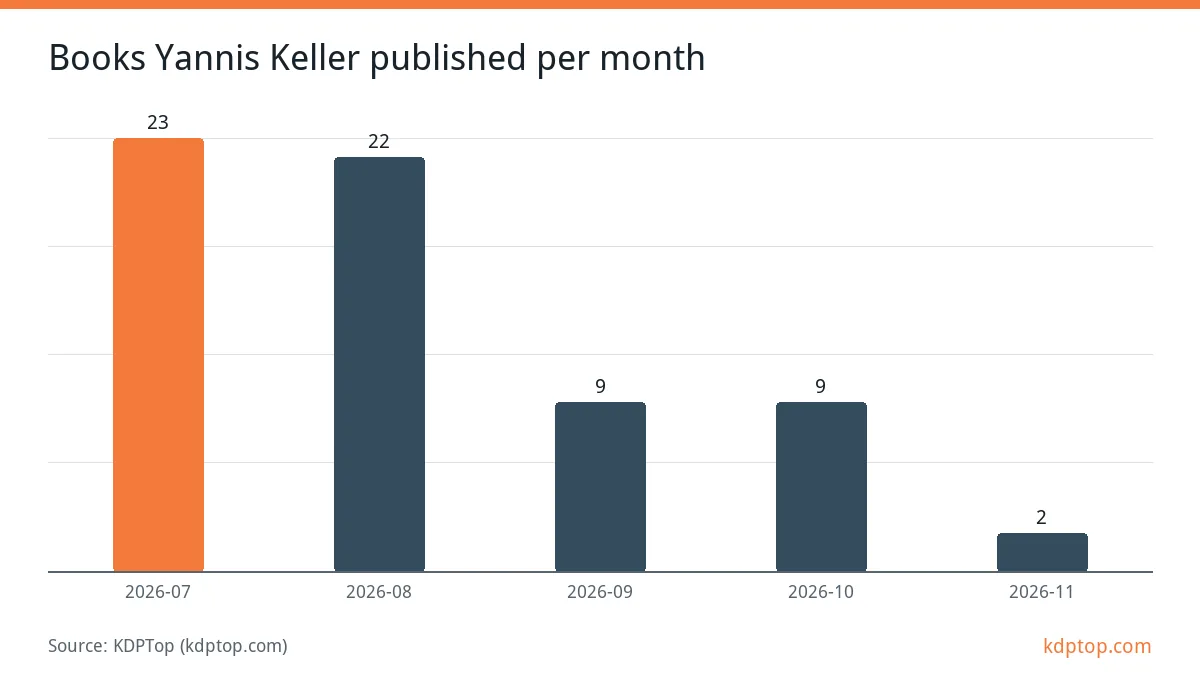
July and August account for most recorded releases
Show the data
| Month | Books |
|---|---|
| 2026-07 | 23 |
| 2026-08 | 22 |
| 2026-09 | 9 |
| 2026-10 | 9 |
| 2026-11 | 2 |
Keller's recorded publishing activity was concentrated in the earlier part of the tracked period. The monthly release figures show 23 books in July 2026 and 22 in August. September and October each recorded nine releases, followed by two in November.
The catalog's first recorded release was July 1, 2026, and its latest was November 1, 2026. Across the last 30 days, the supplied figures show 53 new books and 44 breakouts. A breakout means a new book on a New Releases list within the last 60 days that reached a Best Sellers list.
The release figures deserve careful interpretation. The monthly chart records 65 releases across the five displayed months, while the 53-book figure describes new books during the last 30 days. These are different reporting windows and should not be treated as interchangeable. The data also does not identify the production time, writing process or number of people involved in creating the books.
For a publisher considering a similar catalog strategy, the important operational issue is subject organization. Keller's titles repeatedly address distinct elements of trading analysis. A publisher could research a subject with several genuine reader questions and develop separate books where each has enough material to justify its own treatment. Repeating a title formula without enough original instruction would create a weaker catalog, regardless of release speed.
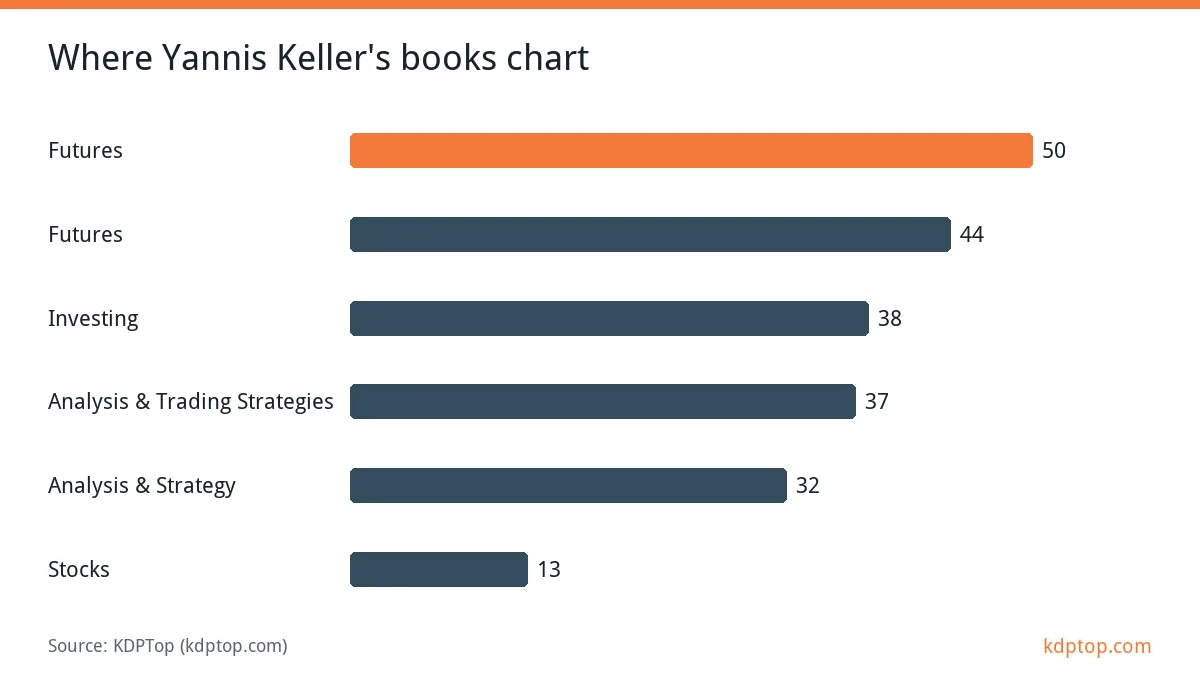
Futures and investing dominate category placement
Show the data
| Category | Books on its lists |
|---|---|
| Futures | 50 |
| Futures | 44 |
| Investing | 38 |
| Analysis & Trading Strategies | 37 |
| Analysis & Strategy | 32 |
| Stocks | 13 |
Futures appears 44 times in Keller's category placements, followed by Investing at 38. Analysis & Trading Strategies appears 37 times, Analysis & Strategy 32 times, and Stocks 13 times. These are category appearances, not counts of unique books, so one title can contribute to more than one category.
The category pattern matches the actual subjects of the leading books. Candle Types & Candle Traps covers candlestick interpretation. Multiple EMA Trading Strategies addresses moving averages. Liquidity Sweeps & False Breakouts and Fair Value Gaps & Order Blocks cover specific price-action concepts. Fibonacci Extensions and Price Targets focuses on measured moves and price targets.
This gives the catalog a consistent subject identity. Someone browsing for futures education may encounter several related titles, while someone interested in technical analysis can find books addressing individual methods. The overlap creates opportunities for readers to move between related subjects, although the available figures do not show cross-purchases or series completion rates.
A publisher researching categories should pay attention to the distinction between a broad market and a specific reader problem. Investing is a broad subject. A guide to interpreting fair value gaps is much narrower. Keller's catalog provides an example of using specific technical subjects to build a presence within larger nonfiction categories. Publishers entering another niche can apply the same research method without reproducing his titles or subject combinations.

Liquidity Sweeps & False Breakouts: Stop Hunts, Sweep-and-Reverse and Sweep-and-Continue Structures, and How to Tell a Fake Breakout from a Real One ... & Liquidity Trading: Price Action Setups)
- Price$19.19
- Reviews-
- BSR#310,440
- Est. revenue/mo$173

Fair Value Gaps & Order Blocks: Mitigation Blocks, Breaker Blocks, Fill Rate and How to Grade Strong, Moderate, Weak and Fake Zones (Candlestick & Liquidity Trading: Price Action Setups)
- Price$18.69
- Reviews-
- BSR#310,340
- Est. revenue/mo$168
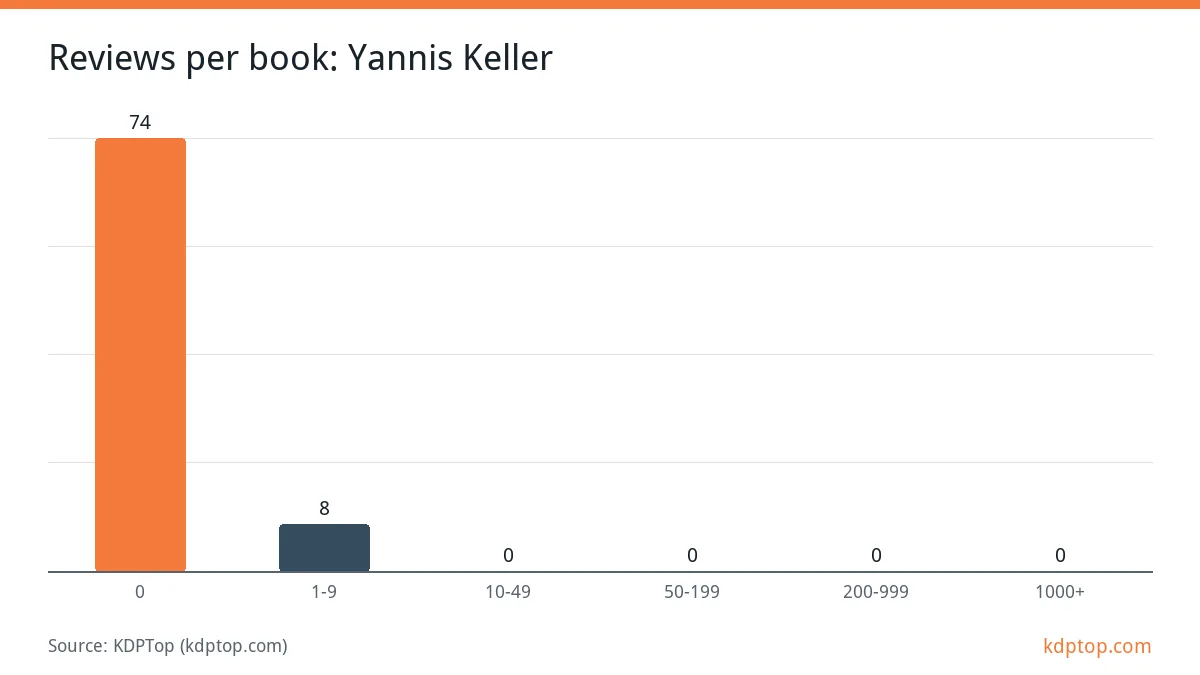
Nine reviews across 82 books tell a different story
Show the data
| Reviews | Books |
|---|---|
| 0 | 74 |
| 1-9 | 8 |
| 10-49 | 0 |
| 50-199 | 0 |
| 200-999 | 0 |
| 1000+ | 0 |
Keller's 82-book catalog has nine reviews in total. Seventy-four books have no recorded reviews, while eight have between one and nine. No books appear in the supplied data's higher review brackets. The median review count is one, and the average rating is 3.4.
That is a thin review profile for a catalog with 73 books appearing on Best Sellers lists in the last 30 days. Category visibility and customer feedback measure different things. A book can reach a category list without accumulating a large number of reviews, particularly when its sales volume is modest or its listing has not been established for long.
The review figures also make it difficult to judge reader satisfaction across individual titles. The data provides an overall rating and review distribution, but does not give enough review text or title-level feedback to identify recurring complaints. A 3.4 average rating is worth examining, but it cannot explain why customers rated the books as they did.
Publishers should take this as a reminder to separate discoverability from product quality. A listing can attract attention through its subject, title and category placement. Reviews provide another source of evidence about whether the book meets reader expectations. Clear descriptions, accurate contents, useful examples and careful editing remain important, particularly for technical nonfiction where readers expect instructions they can follow.
What another KDP publisher can learn from Keller's catalog
The strongest transferable idea is the use of focused subjects. Keller's catalog covers multiple aspects of technical trading, with individual books addressing recognizable concepts such as EMA strategies, liquidity sweeps, order blocks and Fibonacci extensions. This makes the catalog easier to understand as a collection of specialist resources.
A publisher working in coloring books, cookbooks, children's books or fiction should begin with the same kind of subject research, adapted to the category. Find a reader need that can support a complete book. Check competing titles and their prices. Look at the categories where comparable books appear. Then decide whether the proposed book offers enough distinct value to justify publication.
Pricing deserves its own research. Keller's median is $6.99, but several of his leading revenue titles cost considerably more. The difference suggests that price decisions should account for the type of product and the material inside it. A short activity book and a substantial technical reference guide do not have the same production requirements or perceived value.
Release speed is another part of the profile, but it is difficult to evaluate without production costs, manuscript details and advertising information. Fifty-three new books in 30 days is a high recorded output. Another publisher should first establish a repeatable quality-control process and a realistic production schedule. Publishing more titles only helps when the books answer real reader questions and meet the expectations set by their listings.
Finally, Keller's nine total reviews show why sales-rank estimates should not be treated as a complete measure of a publishing business. KDPTop estimates $3,197 in monthly revenue, but that is not profit. Printing costs, Amazon's share, advertising, production expenses and refunds are not represented in that figure. The catalog is a useful case study in specialist positioning and release activity, not a complete account of the author's financial results.

Fibonacci Extensions and Price Targets: Where Runs Actually Stop: Measured-Move Depths from One to Five, Tested Against Chance (The Measured Market: Fibonacci and Deviation Levels Book 2)
- Price$8.99
- Reviews-
- BSR#318,601
- Est. revenue/mo$108
- Published2026-09
Key takeaways
- Study how Keller turns individual trading concepts into focused book subjects rather than copying his titles or series names.
- Compare prices within the same product type before setting a price; Keller's catalog ranges from below $5 to above $20.
- Research category overlap because Keller's books appear across Futures, Investing and Analysis & Trading Strategies.
- Treat release volume as a production benchmark only after establishing a reliable editing and quality-control process.
- Use reviews alongside estimated sales and rank data; Keller's nine total reviews provide limited evidence about customer satisfaction.
Books in this analysis

Internal & External Range Liquidity: Equal Highs, Equal Lows and How to Predict the Next Draw on Liquidity from IRL to ERL and ERL to IRL (Candlestick & Liquidity Trading: Price Action Setups)
- Price$17.99
- Reviews-
- BSR#310,347
- Est. revenue/mo$162

Reversal Candles & Strong Candles: Candlestick Reversal Patterns, Momentum Candles and the Lower Timeframe Structure Inside Every Higher Timeframe ... & Liquidity Trading: Price Action Setups)
- Price$18.99
- Reviews-
- BSR#583,736
- Est. revenue/mo$152
- Published2026-10
Common questions
How many books has Yannis Keller published on KDP?
KDPTop tracks 82 books by Yannis Keller, all independently published through KDP. The recorded release period runs from July 1, 2026, to November 1, 2026.
How much does Yannis Keller earn from Amazon KDP?
KDPTop estimates his catalog generates $3,197 in monthly revenue from approximately 340 monthly units. These are modelled estimates based on Amazon Best Sellers Rank, not reported Amazon earnings or verified profit.
What types of books does Yannis Keller publish?
His catalog focuses on trading education, including futures, candlestick patterns, exponential moving averages, liquidity sweeps, order blocks and Fibonacci strategies. The tracked book types include how-to guides, nonfiction, study guides and reference books, and workbooks.
What is Yannis Keller's most successful book?
Candle Types & Candle Traps: The Candlestick Atlas of Strength, Position, the Levels Drawn on Each Candle and the Lower Timeframe Path That Built It ... & Liquidity Trading: Price Action Setups leads the tracked books by estimated monthly revenue at $202. Its listed price is $22.44, with nine estimated monthly units and a Best Sellers Rank of 310,579.
How we got these numbers
Data comes from KDPTop's continuous crawl of Amazon Best Sellers, New Releases, Movers & Shakers and book pages, plus each book's sales-rank history. Monthly units and revenue are estimated from sales rank (BSR); a single book can be off by ±30%, so use them to compare books, not as exact income. About our data
Explore KDPTop
- Studio: make the bookTurn the niche into a coloring or puzzle book ready for KDP, cover included
- Free category finderDescribe your book and get the KDP categories to pick
- Chrome extensionSee estimated sales and BSR right on Amazon
- User guideHow to read decision cards, scores and sales estimates
- PricingWhat the free plan covers and what paid plans add
Related analysis
-
Anshul Saraf: Inside a 206-Book KDP Publishing Catalog
Anshul Saraf has 206 KDP books, 123 bestseller-list appearances and estimated monthly revenue of $1,683. See his pricing, releases and top earners.
-
Hayden Van Der Post: 889 Books, Pricing and KDP Earnings
Hayden Van Der Post has 889 tracked KDP books, 187 recent bestseller appearances and an estimated $4,240 in monthly catalog revenue. Here is what his publishing data shows.
-
Mari Silva on KDP: 577 Books, 13 Breakouts in 30 Days
Mari Silva has 577 tracked KDP books, 317 recent bestseller appearances and 13 breakouts in 30 days. See her pricing, top earners and publishing strategy.